 Quality Assurance and Quality Management Systems
 Quality Assurance and Quality Management Systems
Quality can be thought of as “consistently meeting requirements” and offering products or services that are “fit for purpose”.
A system may be defined as an interacting set of component parts – usually with one or more objectives. In our everyday lives, we see examples of systems all around us; e.g. system of government, railway system, computer system, etc.
So a quality system could be defined as…
DEFINITION: A QUALITY SYSTEM
A system to establish and achieve objectives for quality.
The component parts would include processes and physical resources such as: people, documents, computer software, methods of performing tasks, training, etc.
Quality systems are normal based on the ISO 9000:2000 standards. ISO is short for the International Standards Organisation. The standards are generic in their nature, and there may often be different methods of meeting their requirements. A quality system should work for the business and not the other way around.
If a quality system is not real life, everyday use it will not be relevant to the business. This can – and will – lead to a failure to achieve the benefits that a quality system can bring.
It is vitally important that personnel are made aware of the development of the quality system, and the reasons for it. Where they are encouraged to participate, “ownership” may be fostered, which can greatly help the development and successful implementation of a quality system.
In developing a quality system, you are taking a very important step. The first step on what may become a continuous journey of improvement. The greatest benefits may flow from simply taking a fresh look at how you carry out your business. A quality system can help you to reduce or eliminate many problems. It is not something magical or mysterious – simply good business practice.
From Quality Control to Quality Assurance to Quality Management
We often see or hear these terms mentioned – but what do they mean? Are they just alternative ways of describing the same thing? Or are they different concepts?
Probably the oldest of the three terms is that of “quality control”. We would have all seen products with a little “QC Passed” sticker or something similar. The very words suggest a person with a white coat and clipboard checking items as they leave a production line. In this sense, quality control could be said to focus entirely on the product – or to be “product related”.
Quality control can be valuable – but it does have its blind spots. Let’s consider purchasing a vehicle. At the point it leaves the production line, the vehicle may meet all design requirements, pass all tests and apparently be a perfect specimen in all respects. However, despite our inspections and tests, there could still be problems that might leave the customer unsatisfied. The vehicle may be damaged during storage or delivery, it may be blue when they ordered a red one, delivery may be late, etc. In essence, quality control does not ensure that all aspects of the transaction between you, the supplier, and your customer meet with their satisfaction. Also, when an item is rejected at a final inspection or test some or all of the resources that went into it will be wasted. Far better to get it right in the first place.
Clearly, a broader consideration is needed - aimed at establishing the requirements for a product or service and then controlling all the processes that take place in bringing it to the customer.
This is often referred to as “quality
assurance” – which could be said to focus on the customer’s needs and
expectations – or to be “customer
related”.
So far we have looked at two very important “quality” issues – ensuring the product or service is correct, and that the customer’s needs and expectations are satisfied.
Others with an interest in the business (such as owners, employee’s, etc.) will also have objectives for efficiency, profitability, continuity of employment, etc. These and various other issues need to be addressed if the business is to successfully meet the requirements of those interested parties. Once again, our consideration becomes broader – dealing with wider issues while still keeping sight of the objectives of quality control and assurance.
This broader concept is often
referred to as “quality management”
– which could be said to focus on the overall business objectives – or to be
“organisation related”.
It is interesting to note in the 2000 edition of the ISO 9000 standards, reference is now made to quality management rather than just quality assurance.
By introducing a quality system,
an organisation sets out to both consistently meet requirements and to
continuously improve. Documenting
the system should not be an end in itself…but the completion of one step on a journey
of continuous improvement. The
journey can lead to many benefits for all interested parties.
Remember quality is a never ending
journey of continuous improvement not a destination.
Like all things there is a price to pay for quality. This total cost can be split into two fundamental areas:
(a) Non Conformance. This area covers the price paid by not having quality systems or a quality product. Examples of this are:
1. Rework: Doing the job over again because it wasn't right the first time.
2. Scrap: Throwing away the results of your work because it is not up to the required standard.
3. Waiting: Time wasted whilst waiting for other people.
4. Down Time: Not being able to do your job because a machine is broken.
(b) Conformance. Conformance is an aim of quality assurance. This aim is achieved at a price. Examples of this are:
1. Documentation: Writing work instructions, technical instructions and producing paperwork.
2. Training: On the job training, quality training, etc.
3. Auditing: Internal, external and extrinsic.
4. Planning: Prevention, do the right thing first time and poka yoke.
5. Inspection: Vehicles, equipment, buildings and people.
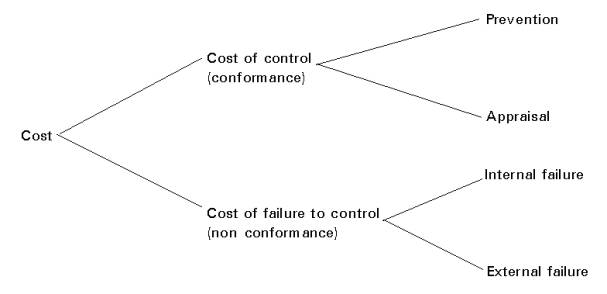
These two main areas can be split further as shown in Figure 1.1
Figure
1.1 The
Four Segments of Quality Costs
This shows the four segments of quality costs, which are:
(a) Prevention: This area covers avoiding defects (poka yoke), planning, preparation, training, audits, preventative maintenance and evaluation.
(b) Appraisal: This area covers finding defects by inspection (poka yoke), audit, calibration, test and measurement.
(c) Internal Failure: This area covers the costs that are borne by the organisation itself such as scrap, rework, redesign, modifications, corrective action, down time, concessions and overtime.
(d)
External Failure: This
area covers the costs that are borne by the customer such as equipment failure,
down time, warranty, administrative cost in dealing with failure and the loss of
goodwill.
A Quality Management Program based on the use of cost of quality data:
q Must use the cost of quality (Both good and bad quality) as the driving force for decision-making.
q Must include the use of statistical methods for controlling the process and task-oriented teams to solve problems.
However, the problems to be
solved and the priority of solving problems are based on quality costs. Use
of Quality Cost Data Will Help You:
q Identify "quality" losses
q Begin corrective action
q Achieve cost reductions
q Increase productivity
q Improve customer relations
Types of Quality Costs:
Prevention
1. Quality planning
2. Data analysis and corrective action
3. Development of measurement and other control equipment
4. Training
5. Quality systems audits
6. SPC team meetings
7. Development of standardized production systems
8. Improved communications of quality standards and information
9. Other prevention expenses
Appraisal
1. Inspection and test-purchased material
2. Laboratory acceptance testing
3. Maintenance and calibration of equipment
4. Inspection
5. Testing
6. Set-up of inspection and test equipment
7. Process and product audits
8. Checking labour
9. Data collection costs
10. Inspection and test material
11. Field testing and inspection
12. Outside endorsement
Internal Failure
1. Scrap - company caused
2. Rework - company caused
3. Production reruns
4. Equipment downtime due to non-standard materials
5. Vendor caused losses
6. Troubleshooting
7. Retest and reinspection
8. Extra production operations
External Failure
1. Rejected jobs
2. Field service
3. Lost customer goodwill
4. Damaged reputation
Oppportunity Costs
These are costs associated with missing chances to do things that would benefit the company.
“Hidden” Quality Costs
Many quality costs studies have shown that in addition to the “normal”, known costs of poor quality (i.e. scrap and rework) many hidden costs are caused by poor quality.
These costs are hidden because the typical cost accounting system classifies them by the type of cost, not by their cause.
Some studies show that in the typical manufacturing company for each known $1 of scrap and rework there is an additional $6 to $7 in “hidden” costs.
Examples of
"Hidden" Quality Costs Include:
q Extra set ups
q Emergency material purchases in small lots
q High labour costs due to emergency production runs (especially short runs)
q Lost machine capacity
q Disrupted production schedules
q Re-inspection and re-re-work
q Extra wear and tear on machines, dies, tools, gauges, etc.
q Lost management time
q Un-expected overtime
q Extra shipment costs of small jobs on an emergency basis
q Extra inventory
Reductions in Quality Costs
Are Improvements in Productivity and Capacity
Assume a company has a 10% scrap rate. For every 100 parts it ships it must produce, at least in part, 111. If through the use of SPC the scrap rate can be lowered to 3%, then 8 fewer parts must be produced to ship every 100 parts in the order.
This improvement in quality has a net effect that is the same as a productivity and capacity increase of 7%. This is in addition to the associated reduction in quality costs.
How Reductions in Quality
Costs Affect Profitability
Assumptions:
q To raise profits by $100 after taxes.
q You are in a 33% tax bracket.
q Your profit rate is the same as the national average (about 5%)
Two ways to raise your profits: Increase sales and reduce costs.
Much additional sales and costs savings are necessary to generate the additional $100 profit?
Using Additional Sales
$2000.00 X .05 = $100
Conclusion: You must generate $2000.00 in sales to make an additional $100 after taxes.
Using Cost Reduction
$149.25 X (1 - .33) = $100
Conclusion: You must only save $149.25 to make an additional $100 after taxes.
The solution is obvious isn’t it? Cost reduction is the way to go, as it is easier to save $149.25 than sell an additional $2000.00 of product.
Whilst aiming to reduce failure through appraisal and prevention it must be clear that these also cost as shown in Figure 1.2.
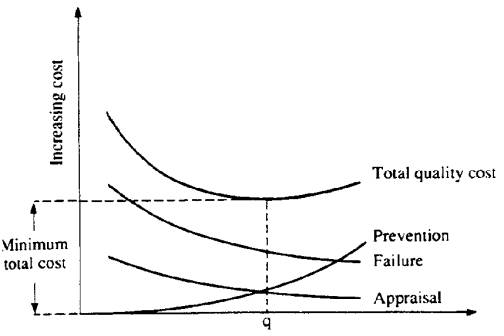
Figure 1.2
Total Quality Cost
The graph (Figure 1.2) shows that there is a minimum Total Quality cost, which is a combination of prevention, appraisal and failure. Reducing any of these reduces the total. The key to minimum cost, is striking the correct balance between the three.
Clearly prevention reduces both appraisal and failure costs, however eventually the cost of prevention itself starts to increase the total cost and so this must be controlled and set at an effective level.
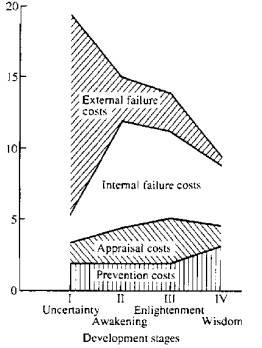
The graph in Figure 1.3 shows the four stages of Total Quality acceptance and implementation and what happens theoretically to the four segments of the cost of quality.
Figure
1.3 The
Four Stages of Total Quality Acceptance
The minimum total cost, is shown below (Figure 1.4) as being achieved at 98% perfection. This percentage is also known as best practice. That is, the cost of achieving an improvement outweighs the benefits of that improvement.
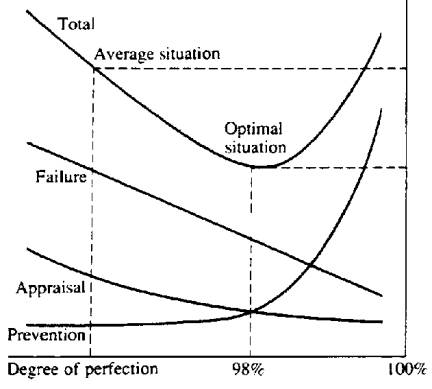
Figure 1.4
Minimum Total Quality Cost
The aim of ISO 9000:2000 is to enable organisations to consistently produce products (including services) that meet the requirements of customers and live up to the organisation’s stated intentions. The scope of ISO 9000:2000 is to specify the requirements of a quality management system where an organisation needs to be consistently provide products or services that meet customer expectations and/or regulatory requirements and where the organisation aims to enhance customer satisfaction through continual improvement. The rationale for implementing ISO 9000:2000 should include one of the following:
q Improve product or service quality and consistency.
q Improve organisational performance.
q Establish a Quality Management System that will be recognised by customers everywhere in Australia and the world.
ISO 9000:2000 introduces some new requirements over the old ISO 9000:1994. These new requirements fall into nine distinct categories.
q Continual improvement
q Increased emphasis on the role of top management
q Consideration of legal and regulatory requirements
q Establishment of measurable objectives for all relevant functions and levels
q Monitoring of customer satisfaction/dissatisfaction as a measure of system performance
q Increased attention to resource availability
q Determination of training effectiveness
q Measurements extended to system, process, and product
q Analysis of collected data on the performance of the quality management system
ISO 9000:2000 “Quality Management Systems – Fundamentals and Vocabulary.” This document is the result of merging the old ISO 8402:1994 and some of the content of ISO 9000-1:1994. This standard is intended to provide the fundamental background information and to establish the meaning of words and phrases used in the ISO 9000 family of standards. It is not a requirements document, but it is provided as an adjunct ISO 9001:2000 (“Quality Management Systems - Requirements”) to add clarity in understanding the underlying principles behind ISO 9001 and to define the vocabulary used in the standard.
ISO 9001:2000 “Quality Management Systems – Requirements.” This is the requirements standard to which ISO 9000 users must conform. The old 1994 standards, ISO 9001, 9002, and 9003 have been merged into this single document. Whereas under the 1994 version, ISO 9000 users had to decide on the basis of their activities which of the three standards to use for certification, under the 2000 version, there is no longer a choice. All certifications will be ISO 9001:2000. This raises the issue of applicability. For example, organisations that engage only in the manufacturing of product (that is, they have no design or development role) could formerly have been certified under ISO 9002. Now that ISO 9002 no longer exists, is ISO 9000:2000 still applicable to such firms? The answer is yes. ISO 9001:2000 is applicable to any kind of organisation, regardless of its activities. Provisions have been made to exclude requirements that are not relevant to the organisation. In this case, the manufacturer that does no design work will be certified to ISO 9001:2000 but with design related requirements excluded.
ISO 9004:2000 “Quality Management Systems – Guidelines for Performance Improvements.” This document represents a major revision of the old ISO 9004-1:1994, and is intended to assist organisations in establishing and improving their quality management systems. Although called a “standard,” as all such ISO documents are, this one does not contain requirements for the user organisations. Rather, used with ISO 9001:2000 it provides information and insights to help the organisation conform to the standard, and to continually improve performance – in other words, to go beyond the minimum requirements.
ISO has also updated its guidance document for auditors with ISO 19011 “Guidelines for Quality and Environmental Auditing.” This new document is the result of merging the old ISO 10011, Parts 1, 2, and 3 with ISO 14010, 14011, and 14012. ISO 10011 was the former guideline for quality management system auditing. The ISO 14010, 14011, and 14012 documents served the same purpose for auditing environmental management systems of ISO 14000 registered organisations. ISO has a long-range goal of blending the quality and environmental management systems, and ISO 19011 is one step in that direction. Many organisations registered under ISO 9000 will also be certified to ISO 14000, and the use of common audits makes sense for both the registrars and the auditees.
ISO 9001:2000 and ISO 9004:2000 have been developed to be what ISO calls a “consistent pair.” Their structure and sequence have been made nearly identical to make them easy to use together. Their table of contents parallel each other closely. One typically finds a difference only where necessary for the concepts of requirements and guidelines.
ISO 9000 users will find ISO 9001 and ISO 9004 to be their core working documents. ISO 9000 and ISO 19011 will be used for reference and conformance verification to the company’s quality management system.
ISO states the purposes of the ISO 9001 and ISO 9004 documents as follows:
“ISO 9001 specifies
requirements for a quality management system that can be used for internal
application by organisations, or for certification, or for contractual purposes.
It focuses on the effectiveness of the quality management system in
meeting customer requirements.”
“ISO 9004 gives guidance on
a wider range of objectives of a quality management system than does ISO 9001,
particularly for the continual improvement of an organisation’s overall
performance and efficiency, as well as its effectiveness.
ISO 9004 is recommended as a guide for organisations whose top management
wishes to move beyond the requirements of ISO 9001, in the pursuit of continual
improvement of performance. However,
it is not intended for certification or for contractual purposes.
From this it is clear that while the structure and sequence of the two documents are the same, their scopes are not. ISO 9001 takes the user to compliance with the standard, but ISO 9004 can take the organisation far beyond just compliance. So why would an organisation want to do more work and go beyond compliance with ISO 9001? The answer comes from the philosophy of total quality management. In a word, it is “competitiveness.” The more an organisation’s processes and products are improved, the more efficient and competitive the organisation becomes. In today’s world marketplace, being competitive is necessary for survival. Staying competitive requires continual improvement.
The
quality management system standards of ISO 9000: 2000 incorporates eight quality
management principles that come directly from TQM.
Senior management as a framework to guide their organisations towards
improved performance can use these principles.
They are:
1.
Customer
focus –
understanding their needs, striving to exceed their expectations.
2.
Leadership
– establishing
direction, unity of purpose, and a supporting work environment.
3.
Involvement
of people –
ensuring that all employees at all levels are able to fully use their abilities
for the organisation’s benefit.
4.
Process
approach –
recognising that all work is done through processes and managed accordingly.
5.
Systems
approach to management – expands on the previous principle in that achieving any objective
requires a system of interrelated processes.
6.
Continual
improvement – as
a permanent organisational objective, recognising and acting on the fact that no
process is so good that further improvement is impossible.
7.
Factual
approach to decision making – acknowledging that sound decisions must be based on analysis of
factual data and information.
8.
Mutually
beneficial supplier relationships – an organisation and its suppliers are interdependent and a mutually
beneficial relationship enhances the ability of both to create value.
The
standard is now designed around a “process approach.”
In fact the standard promotes the adoption of a process approach when
developing, implementing and improving the effectiveness of a quality management
system, to enhance customer satisfaction by meeting customer requirements.
ISO
9001:2000 includes a requirement for measurable objectives to be established at
“relevant functions and levels” within the organisation.
Essentially, this means that nearly everybody in the organisation will
have measurable objectives. ISO
9001:2000 uses the terms “quality objectives,” but in reality these will be
commonsense business objectives that give all employees at all levels an
opportunity to contribute to the success of the organisation.
This
is where the standard makes an especially strong link to strategy.
Since top management is responsible for ensuring that objectives are
established, they would be wise to make sure everyone bases their objectives on
the strategic direction of the organisation.
Customer
satisfaction is a theme that permeates nearly every paragraph of ISO 9001:2000.
In fact, customer satisfaction is so important that it is shown as one of
the three primary outputs of the quality management system (along with continual
improvement and the organisation’s products).
This is quite a big change since previous versions of the standard did
not even use the term “customer satisfaction.”
In essence, ISO 9001:2000 requires that the organisation do two things:
determine methods for obtaining data on customer perceptions and determining
methods for using this data. ISO
9001:2000 prescribes no specific data collection methods, but it is implied that
the methods will include those that are proactive.
The term “perceptions” implies a full range of reactions to the
organisation’s products and services: positive, negative, and whatever falls
in between. In other words,
analysing complaints alone would not satisfy this requirement.
Remember
customers are both “internal” and “external.”
The scope of ISO 9000:2000 includes any organisation wishing to be certified to the standard. Within the organisation the scope extends to any department or activity that can have an impact on the quality of the product or service. In a practical sense, this includes all departments and activities. The standard requires the certified organisation to structure its quality management system so that it addresses and conforms to all of the ISO 9001:2000 clauses from clause 4 through to clause 8 (there are eight clauses in all).
The clauses are laid out in a more logical sequence than previous versions of ISO 9000. The first three are:
Clause 1 - Scope
Clause 2 - Normative Reference
Clause 3 - Terms and Definitions
These clauses simply set the stage for the requirements of ISO 9001:2000 that are contained in the next eight clauses:
Clause 4 - Quality Management System
Clause 5 - Management Responsibility
Clause 6 - Resource Management
Clause 7 - Product Realisation
Clause 8 - Measurement, Analysis and Improvement
These clauses are explained in detail in other Quality Modules such as EA041 Quality Control Systems, EB030 Advanced Quality Concepts, EB036 Quality Management Systems and EB041 Quality Manual Development Writing.
The essence of conforming to ISO 9000:2000 is:
q Say what you do (Document it)
q Do what you say (Follow your plans and procedures)
q Record what you did (Document the facts)
q Check on the results (Analyse and record, i.e., document)
q Act on the difference (Take corrective action, document it)
Any quality system must include controls to ensure that:
(a) Important documents are checked and approved before they are used;
(b) Only the up to date versions are in use;
(c) Those affected are notified of any changes to documents.
Of course, documents include those that are in the form of computer data.
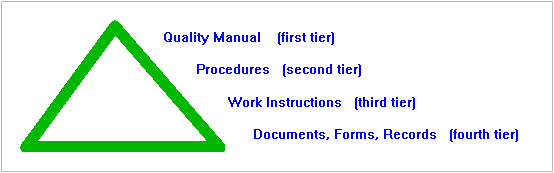
Most Quality Management Systems have a typical document structure that drives the system documents into three (or four) tiers or levels.
Figure
1.5 Four-Tier
Document Structure
It will not be possible to simply complete the quality manual and then work your way through the other documents. In particular, the procedures that you include in your own system will need to reflect back into the “system outline” section of the quality manual. A suggestion may be to commence with the quality manual – drafting an introduction, policy statement, objectives, organisation chart and a “Macro” flow chart of your overall business. You may then move on to develop procedures, before returning to complete the system outline and other sections of the quality manual.
The following is a brief description of some of the documents referred to in a four tiered document structure:
Quality Manual
The quality or policy manual may be considered to be a general overview of the system. Typically it will contain a quality policy statement and other statements regarding the objectives, allocation of resources, responsibilities, etc.
The quality manual should describe the organisation’s system. This may include a matrix or outline that considers all the clauses of the standard and their application to the company’s business. If it is considered that a clause (or part of a clause) is not applicable to the operation of the business, then a statement should be made that justifies its exclusion. For example:
Clause 7.6 Control of monitoring and measuring devices. “Our operations do not require the use of any measuring and monitoring devices as a means to verify quality. Therefore, this clause is not considered to be applicable to our quality system and will not be addressed further”.
Anyone reading the manual will now be aware that the issue hasn’t been overlooked and has been excluded for a justifiable reason.
Procedures
In the 1994 standards you were required to address clauses 4.3 to 4.20 (as applicable) in documented procedures. However, in the 2000 standard, only 6 clauses require documented procedures – although documented procedures may be chosen for other clauses too. At minimum six documented procedures must be established to address:
q
Control of documents
q
Control of records
q
Control of non conforming products
q
Internal Audits
q
Corrective action
q
Preventive action
In addition to these documented procedures, documentation must include a quality policy, documented statements of measurable objectives, and a quality manual. ISO 9001:2000 also requires that the organisation establish and maintain procedures needed for it own effective control and operation. In other words, it’s up to the organisation to decide what it needs in terms of documentation. Very simple organisations or organisations with only a handful of people may not require any more than the minimum documentation. In reality, most organisations will require somewhat more than the minimum amount of documentation specified by ISO 9001:2000, but at least it will be their decision based on business needs.
The standards do not precisely specify the format of documented procedures but the following is a fairly conventional layout:
Purpose
This section outlines why the procedure has been developed. It describes the primary objective(s).
Scope
This section explains where the procedure is applicable e.g. the range and the extent of it’s use. It may highlight any exclusions.
Responsibility
This section indicates who has the responsibility for carrying out the procedure. It may elaborate on those responsibilities.
Action/Method
This section describes how the procedure is to be carried out. The action/method should follow a logical sequence. It would not normally go into great technical detail. If necessary, such information is provided in work instructions.
Reference
This section lists what other documents may be relevant to the procedure. These may include the relevant clause(s) of the standard, other procedures, forms, or external documents.
Definitions
This section lists what definitions may be relevant to the procedure. Where the meaning of a word in the procedure may not be clear to the reader, you may also include a section on definitions. To avoid duplication, I prefer to use a central register of definitions in the quality or policy manual.
In the “reference” section, I normally list any forms, other documents or software programs to be used in the performance of the procedure. As an alternative, you may prefer to have a separate section for these – perhaps titled “Forms” or Documentation”.
Work Instructions
There are no hard and fast rules that divide work instructions from procedures. After all, they both form the same basic function of describing a process. A typical standard convention is illustrated below:
Document
Purpose
Example
Procedurre To provide general Example 1: Customer’s contract details will information be entered into the contact database.
Example 2: The Engineer will ensure that test instruments are calibrated in accordance with the manufacturer’s instructions.
Work Instrucction To provide step by Example 1: Instructions on how to use the
Step, or detailed contact management database.
technical guidance
Example 2: Manufacturer’s instruction for the calibration of a particular device.
The need for work instructions will depend to some degree on the level of expertise held by those performing the activity. Work instructions may also minimise the impact of any loss of key personnel by providing guidance for their replacement or substitute and reducing the learning curve.
Work instructions do not have to be textual. They may be in the form of photographs, videos, computer presentations, and representative samples, or any other suitable media.
Forms
Forms of some kind are necessary to generate records of firm’s activities. In preparing the forms, there are a number of factors that should be considered. These include:
(a) What is their purpose?
For
example, a customer enquiry form may be designed to record details of a
customer’s requirements and their contact details. The same form could be useful to record how the customer
learnt about the company or product and help the organisation evaluate where
advertising is being successful or otherwise.
(b)
How are they going to be used?
There
may be differences in layout between a form that is intended to be completed on
a computer screen and one which is intended to be completed by hand.
Larger spaces will generally be required for any hand written entries.
Combo boxes, or form fields may be useful for forms that will be
completed on screen.
It is suggested that a trial run be given to any forms developed before large-scale printing is undertaken.
Quality
Plans
A quality plan is a document that sets out specific practices, resources, activities and responsibilities for a particular product, contract or project. It may be developed where required by the customer, or where otherwise considered useful. Consideration should be given to those critical factors that may prevent the product or service from achieving the desired quality, and the quality plan should explain how those factors are controlled. A quality plan may typically include:
q A product specification;
q A description of work processes;
q Details of documents and other resources to be used;
q A description of inspection/testing activities, and their records.
The standards do not have any strict requirements for the layout of a quality plan. In some cases, a format that broadly follows that for a procedure may be useful. A flow chart may also be included. In other cases, the quality plan may be more like a form – which concentrates on specifying inspection/testing, and recording the results.
To put it simply a Quality Plan is a document specifying how a company plans to adhere to its written procedures, by whom, and when. For most companies this is documented in the operational procedures.
Letters and
Memos
Those in charge of a quality system need to communicate with others about it. One means of communication is via letters and memos:
q Employees need to be introduced to the system, told about the organisation’s policy and objectives, instructed on their roles and reminded about actions.
q Customers may be interested to learn of the introduction of the system and any milestones e.g. achievement of certification.
q You may wish to ask suppliers about their own quality systems, or coordinate certain activities with them to improve reliability and efficiency of supply.
You may wish to develop a series of standard pro-forma letters on these and other quality related issues.
Letters can be saved as templates to save writing time and help standardise your responses, etc.
Audit and
Management Review Documents
These include all documentation including check sheets that represent the objective evidence (proof) that the quality management system is, or is not, functioning as it should. In accordance with ISO 9001:2000, these would include as a minimum records such as the following:
q Records from management reviews
q Records of employee education, training, skills, and experience
q Records providing evidence that the processes and product meet requirements
q Records of review of customer requirements and related actions
q Records of design and development reviews and related actions
q Records of the results of design verification and related actions
q Records of the results of design validation and related actions
q Records of results of the review of design and development changes and actions
q Records of the results of supplier evaluations and related actions
q Where applicable, records of unique product identification for traceability
q Records of measuring results validity
q Records of monitoring and measuring device calibration and verification
q Records of internal quality audits
q Records providing evidence of product conformity
q Records of the nature of product non conformities and related actions
q Records of the results of corrective actions taken
q Records of the results of preventive actions taken
A written audit report should be submitted to management for all audits and reviews undertaken in the organisation.
Quality management reviews must include the following information categories:
q Results of audits
q Customer feedback
q Process performance and product conformity
q Status of preventive and corrective actions
q Follow up actions from previous management reviews
q Planned changes that could affect the quality management system
q Recommendations for improvement
Quality management reviews should also include the following:
q Status and results of quality objectives and improvement activities
q Status of management review action items
q Feedback on the satisfaction of interested parties other than customers
q Market related factors such as technology, research and development, and competitor performance
q Results from benchmarking activities
q Performance of suppliers
q New opportunities for improvement (not necessarily recommendations)
q Control of process and product non conformities
q Marketplace evaluation and strategies
q Status of strategic partnership activities
q Financial effects of quality related activities
q Other factors which may impact the organisation
The intent of the management reviews is that the quality management system, and all of its components, will be continually improved to ensure that performance is also continually improved. Therefore, the management review process and procedures together with internal audits conducted should ensure that the continual improvement process is always a major element of the reviews.
A
quality management system is comprised of all the organisation’s policies,
procedures, plans, resources, and processes, and its delineation of
responsibility and authority, all deliberately aimed at achieving product or
service quality levels consistent with customer satisfaction and the
organisation’s objectives. They
define how the organisation works, and how quality is managed.
The
number of documents in the “ISO 9000 family” has been reduced from eleven in
the 1994 version to just three in ISO 9000:2000.
These three are as follows: ISO 9000:2000, Fundamentals and Vocabulary;
ISO 9001:20000, Requirements; and ISO 9004:2000, Guidelines for Performance and
Improvement.
Compliance
is increasingly used in the standard to indicate adherence to legal and
regulatory requirements. The term conformance is usually used when
speaking of adherence to ISO 9000 standards.
The term supplier, when used in an ISO 9000:2000 context means
subcontractor (an entity that provides materials, goods, or products to the
organisation).
The
five components of good documentation are: Quality Policy; Organisational
Structure; Process Inputs, Flows, and Outputs; Operational Procedures for the
Processes; Quality Objectives.
ISO
9000:2000 documentation includes written and pictorial information used for
defining, specifying, describing, or recording the activities and processes that
lead to the design, development and production of products and provision of
services. Some of the elements that might be included in ISO 9000:2000
documentation are: written polices; written procedures; written instructions;
written quality objectives; written records; written plans; formal drawings;
forms; and sketches.
Reviews
of the quality management system must include the following:
results of audits, customer feedback, process performance and product
conformity, status of preventive and corrective actions, follow up actions from
previous management reviews, planned changes that could affect the quality
management system, and recommendations for improvement.
There are other factors that should be included, but those
just listed are mandatory.
Baker,
Richard, A Guide to Quality Management Systems: ISO 9001:2000, Granville
College of TAFE NSW, 2001
Besterfield,
Dale, Besterfield-Michna, Carol, Besterfield, Glen, Besterfield-Sacre, Mary, Total
Quality Management, 2nd Edition, Prentice Hall, 1999
Dale,
Barrie, G., Managing Quality, 3rd Edition, Blackwell
Publishers, 1999
Goetsch,
David & Davis, Stanley, Total Quality
Handbook, Prentice Hall, 2001
Goetsch,
David & Davis, Stanley, Understanding
and Implementing ISO 9000:2000, 2nd Edition, Prentice Hall, 2002
Summers,
Donna, Quality (with CD ROM), 2nd Edition, Prentice Hall, 2000
Taormina,
Tom & Brewer, Keith, Implementing ISO 9000:2000, The Journey from
Conformance to Performance, Prentice Hall PTR, 2002
ISO
9000:2000 Quality Management Systems – Fundamentals and Vocabulary
ISO
9001:2000 Quality Management Systems – Requirements
ISO
9004:2000 Quality Management Systems – Guidelines for Performance
Improvements
 TO MANUFACTURING ENGINEERING COURSEWORK
