>>~John Ashbery Biography~<<
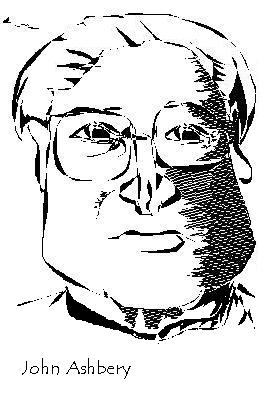
Poet and critic, who has deeply influenced American poetry from the 1970s. Ashbery is the best-known poet of the "New York School." The label was coined by John Bernard Mayers in 1961 in an article he wrote for the magazine Nomad. Ashbery's first volume, Turandot and Other Poems, appeared in 1953. His work is characterized by originality, impressionistic elegance, and dark themes of death and terror. In 'Self-Portrait' he wrote:
The locking into place is "death itself,"
As Berg said of a phrase in Mahler's Ninth;
Or, to quote Imogen in Cymbaline, "There cannot
Be a pinch in death more sharp than this," for,
Though only exercise or tactic, it carries
The momentum of a conviction that had been building.
John Ashbery was born in Rochester, New York, and raised on a farm near Lake Ontaro. His father was farmer and mother a biology teacher. Ashbery's younger brother died at the age of nine. At high school Ashbery read such poets as W.H. Auden, Dylan Thomas, and Wallace Stevens. However, his first ambition was to be a painter. From the age of about eleven until fifteen he took weekly classes at the art museum in Rochester. The first time Ashbery saw his his work in print was in Deerfield Academy. The poems appeared in Poetry, the most illustrious magazine at that time. Ashbery studied at Harvard, Columbia, and New York universities. In 1949 he graduated from Harvard, where he wrote a study of Wallace Stevens for the critic F.O. Mathiessen. Two years later he received a master's degree from Columbia University. After working in publishing, he moved to France in the mid-1950, just before the publication of his second collection of poems.
In Paris Ashbery spent ten years, nine of which he lived with the French writer Pierre Martory. Ashbery also translated some of his poems into English. He studied on a Fulbright fellowship and was the art editor for the European edition of the New York Herald Tribune. Ashbery's second collection of poems, Some Trees (1956) was chosen by the poet W.H. Auden to be included in a Yale University series of modern poets. In 1965 he returned to the US. He worked as an art critic for New York and Newsweek magazine. From 1965 to 1972 he served on the editorial board of ARTnews and then worked as a creative writing teacher in Brooklyn College and as the Charles P. Stevenson, Jr., Professor of Languages and Literature at Bard College. From 1976 to 1980 he was an editor of Partisan Review. In 1989 Ashbery's writings on art were collected in Reported Sightings.
Ashbery has received several literary awards. In 1975 he won the Pulitzer Prize, the National Book Award, and the National Book Critics Circle Award. In 1984 he received the Bollingen Prize and in 1985 a MacArthur Prize fellowship.
In the 1950s Ashbery adopted to his poetry techniques used by such abstract painters as Willem de Kooning and Jackson Pollock. In 'The Painter' (1956) he wrote:
"Sitting between the sea and the buildings
He enjoyed painting the sea's portrait.
But just as children imagine a prayer
Is merely silence, he expected his subject
To rush up the sand, and, seizing a brush,
Plaster its own portrait on the canvas."
He also was interested in the music of John Cage and Anton Webern and the writings of the French surrealist Raymond Roussel. Ashbery formed with his friends Frank O'Hara and Kenneth Koch the nucleus of a group of artists known as the "New York school" of poets. It lasted into the early 1970s - Ashbery himself has doubted that there ever was a shool. His uncompromising avant-gardism was first greeted with puzzlement - critics and readers considered his poetry obscure and difficult. Some critics have said that his poems are like abstract paintings in words. Ashbery himself has said, that he aims "to record a kind of generalized transcript of what's really going on in our minds all day long." He has also denied that there are allegorical -
"In think my poems mean what they say, and whatever might be implicit within a particular passage, but there is no message, nothing I want to tell the world particularly except what I am thinking when I am writing." (from Writers at Work, ed. by Geroge Plimpton, 1986)
From the beginning of his career, Ashebery has tried to find new ways and rules of expressions. His poems are formally innovative. He often lets his text flow in paragraph-length-associative structures, which penetrate layer after layer deeper into anxieties, doubts, and false beliefs.
"Later one protest: How did we get here
This way, unable to stop communicating?
And is it all right for the children to listen,
For the weeds slanting inward, for the cold mice
Until dawn? Now every yard has its tree,
Every heart its valentine, and only we
Don't know how to occupy the tent of night
So that what must come to pass shall pass." (from 'Brute Image', 1992)
In The Tennis Court Oath (1962) Ashbery reached the peak of his experimental phase. The work was considered by some critics impenetrable. Ashbery do not hide his vast and deeply cultured learning - the title of the book referred to the sketch by the French artist Jacques-Louis David (1748-1825), which portrays a key moment before the French revolution. David planned to paint a mammoth canvas based on The Oath, but he never completed the work - this must have attracted Ashebery, who seems to rely more on first impressions and freshness of perception than academic perfection. In Rivers and Mountains (1966) Ashebery abandoned his fragmented expression and turned to his reader with the pleading words: "And I sing amid despair and isolation / Of the chance to know you, to sing of me / Which are you." Chinese Whispers: Poems (2002) returned to the theme of interpretation and misunderstanding, trials and errors of a writer. The title of the book refers to a children's game, in which a message is whispered from ear to ear around a circle of people, inevitably changing along the way.
The success of Self-Portrait in a Convex Mirror (1975) made Ashbery one of America's foremost poets. It won The National Book Critics Circle Prize, the National Book Award for Poetry, and the Pulitzer Prize. The critic John Russel has called its title poem "one of the finest long poems of our period." Ashbery's only novel, A Nest of Ninnies (1969), written in collaboration with James Schuyler, was a satire on literary life. The author has also written plays and Girls on the Run (1999), a surrealistic poem based on the illustrations of Henry Darger. "His poetry appeals not because it offers wisdom in a packaged form, but because the elusiveness and mysterious promise of his lines remind us that we always have a future and a condition of meaningfulness to start out toward." (Nicholas Jenkins in The New York Times, January 4, 1998)
