Bonnie and Clyde
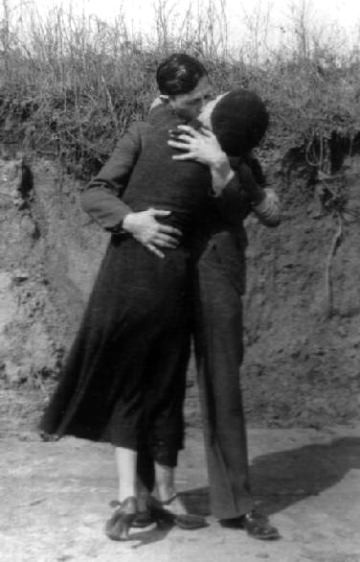
Bonnie Parker didn't even reach 5 foot. 4�11" in her stocking feet, she weighed under 100 pounds- 90 pounds to be exact. She had Shirley Temple-colored hair that illuminated in her strawberry-blond curls, and that made her beautiful. She also had a freckled-face, according to those who knew her well. Born October 1, 1910, in Rowena, Texas, her parents were hard working people, but life was hard, especially for them. They didn't have much at all. They were very, very poor. As a good student in high school, she excelled in creative writing and displayed a dramatic flair for the arts. She used everything she had to the utmost. To go to school was a privilege for her, not a chore.
Among her favorites was the color red. When she could afford it, she wore fashionable clothes with, ofcourse, a BUNCH of red. She also adored hats of any and every kind. As a child, her father died young and her mother was forced to bring her and her two siblings to Cement City, near Dallas, where they lived with Mrs. Parker�s parents. Married way too young at age 16, her immature rattle-brained husband, Roy, wound up in the penitentiary a year later. He was never really there for her when she needed him. It seemed like most of her family and friends were in jail. Poor Bonnie didnt realize what was heading her way. For money, she was forced to become a waitress. Bored and poor, she knew life had something more to offer if one would take it. And so she decided to "borrow" all of life's goodness.
Clyde Chestnut Barrow had many names and many aliases. But that didnt matter. He was still 5�7," weighed 130 pounds, and had slicked back, thick brown hair. Have you ever watched O' Brother Where Art Thou? His hair was similar to the style in that day, waxed back and parted it on the left. His eye color matched his hair. Women found him attractive. Bonnie was one of those women. He came into this world as one of many children born to dirt-poor tenant farmer parents barely making a living on the cotton fields of Teleco, Texas. Moving with his parents, brothers and sisters to the Dallas outskirts, where his father ran a gas station (in which the family members crowded as one into a tiny back room), Clyde quickly learned to abhor poverty. Bored and poor, he too knew life had something more to offer. He was tired of being poor. He didn't deserve it. He always wondered why he was born into a poor family. Why did he have to carry on this tradition of poverty? He decided to end it.
Bonnie and Clyde were meant for each other, even if Roy, Bonnie's husband, was in the way. They clung to each other while they fought back against the harsh conditions set out for them. These were destitution, deprivitation, depression. They were children of a nationwide economic depression that not unlike France in the late 1700s had its commotion -- and those who tried to keep small the size and impact of the commotion.
An anger dwelt within Clyde, having been born with almost nothing into a world that gave him nothing in return. This made him more ragged by the Depression. He sometimes killed in cold blood, and always tried to justify the murders as if he had a right to pull that trigger, thus releasing somehow the greed that built up like a volcano deep inside him. Perhaps he actually believed in his own special privilege. As the fame and mystery of Bonnie and Clyde grew, they shot their way out of police loops, each time growing tighter and tighter, and claimed that the "laws" they killed just happened to get in the way between their fiery outcry and the rest of the country. Their killings were not personal, they contended. But, the government took them personal. And Bonnie and her man were marked for death. What a surprise.
Depression had lowered a hideous shroud over the nation. The American Dream collapsed along with Wall Street in 1929. Pride of freedom became a joke. "The country�s money simply declined by 38 percent," explains E.R. Milner, author of The Lives and Times of Bonnie and Clyde. "Gaunt dazed men roamed the city streets seeking jobs...Breadlines and soup kitchens became jammed. (In rural areas) foreclosures forced more than 38 percent of farmers from their lands (while simultaneously) a catastrophic drought struck the Great Plains...By the time Bonnie and Clyde became well known, many had felt the capitalistic system had been abused by big business and government officials...Now here were Bonnie and Clyde striking back."
While they terrorized banks and store owners in five states -- Texas, Oklahoma, Missouri, Louisiana, and New Mexico -- Americans thrilled to their "Robin Hood" adventures. The presence of a female, Bonnie, escalated the sincerity of their intentions to make them something unique and individual -- even at times heroic -- and above similar activities of all-male motor bandits like John Dillinger, "Baby Face" Nelson and "Pretty Boy" Floyd.
Historian Jonathan Davis, in an excellent A&E Cable Network-produced Biography on the two bandits, says of Bonnie and Clyde�s crimes, "Anybody who robbed banks or fought the law were really living out some secret fantasies on a large part of the public."
Even more than their insurgence against their status in life was Bonnie and Clyde�s devotion to their own. With police and government detectives constantly on their trails, sometimes literally by inches, they time and time again risked their own lives to protect the other. Says Marie Barrow, Clyde�s sister, in Biography, "They never worried about anything else but each other."
When on the lam, they found time to visit their Dallas-area families, risking capture more than once. Marie asserts that her brother and father had concocted their own signal to let the families know when the outlaws were in town: Clyde would pause the latest of his stolen automobiles in front of the Barrow service station and from the car toss a soda pop bottle containing directions to a place of rendezvous. "My mother would fix them something to eat," she adds.
In their getaway cars, Clyde and Bonnie habitually carried a Kodak box camera; they loved to pose in dramatic tableaux wielding shotguns and revolvers, self-parodying the gangster image they realized they had earned. More than that, they loved to pose together, embraced or kissing, having other gang members do the snapping. When they died, the police found an undeveloped roll of film under their car seat -- photos of them together, looking adventurous and deeply in love.
They knew they were going to die, maybe next week, maybe next month. Maybe in the morning. They never pretended they might be the only exception to the standard, "Crime doesn�t pay". But, because they knew their time was limited -- their crime spree lasted less than two years -- they decided to let it all break loose in the meantime to steal and kill till' death do them part. Bonnie�s last request to her mother was, "Don�t bring me to a funeral parlor. Bring me home."
The last two years of their lives, once they met, were a whirly-gig. Never-ending highways burning in the Southwest sun; dusty backroads; the scorch of over-heated radiators; the burn of rubber; the stifled crampedness of one car after another; their only air the hot breeze they channeled through rolled-down car windows. Fast life. A die-young life. And they wouldn�t have traded it for the world. They ended up being ambushed and died in a gun firing spree.
B and C all the way BABY! :)
Bonnie and Clyde Resources, With Clyde's Death Scene
