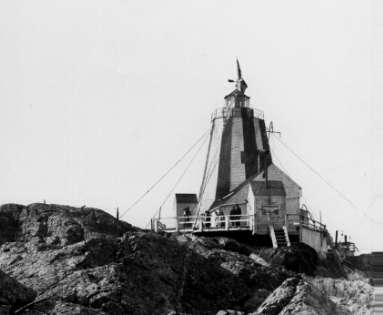
When the lighthouse was built on Gannet Rock in 1831, it was the end result of many petitions to the New Brunswick government to establish and maintain a revolving light on one of the islands or rocks near the southeast coast of Grand Manan. The Saint John Board of Trade, in particular, wanted a guide for shipping to and from the port of Saint John. In 1827 the provincial Legislature approved approximately $137 for the commissioners of lighthouses to determine the best location for the station. Rafts of logs were placed on Gannet Rock and other ledges and left for the winter. In the spring the only logs left were on Gannet Rock.
In 1830 the Legislature approved money to be applied towards building a lighthouse there. According to J.G. Lorimer in his History of the Isles and Islets of the Bay of Fundy, John Purvis built the lighthouse and Joseph Hogg put up the lantern. The tower was forty one feet from the base to the vane. The original lamp burned what was called fluid oil - a mixture of whale oil, turpentines and other inflammables. In 1931 Gannet Rock was reputed to be the second most powerful light in the world (85,000 candle power), second only to England's Eddystone Light. Today there is a 1,000 watt light which beams twenty four hours a day. The original house remained until a new one was built in1884, rebuilt in 1887. A brick house was built in 1906 and the present house was built of cement in 1931.
Storms have caused much destruction over the years; for example, during the winter of 1857 -1858 gales desroyed the platform around the light tower. This platform had to be repaired often until a concrete wall and deck were built in 1913. The old wooden platform can be seen in the photo at the top of this page.
Capt. Lamb lit the light for the first time Christmas Eve, 1831 and remained there for four years, at which time E.G. Miller took his place. Mr. Miller met an untimely end shortly thereafter, when he and his assistant drowned in 1837, on the return trip from rowing to nearby Kent Island for a fresh supply of water.
Kent Island was owned by John Kent and he and his wife, Susannah and their children, were the only occupants. Their son, Jonathon, became the third keeper at Gannet Rock. Six years later, he was replaced by Henry Mclaughlin, who had recently married his daughter, Abigail.
Information about Gannet Rock in the early days is sketchy, but in 1845 the Inspector of Lights for the government ordered work to be started on a stone wall and foundation for a new tower. The contractors were John Purvis, master carpenter, and Robert Barbour, master stone cutter and builder, who had come to Saint John from Scotland in 1828. Their contract amounted to about 1500 pounds. In 1904 Walter McLaughlin wrote a letter to John Kelley, Inspector of Lights, concerning this work.
I am now the only person living who assisted in building the stone wall, or foundation for the new tower....the stone was brought in the schooner Olive Branch, of St. John....they had to erect derricks and bolt down the tramways....it was September 1st before they had landed the first stone. They did much blasting to get a good level cut in the rock for the foundation stones....they built an honest foundation and the first story of a stone tower which you will find is about forty feet in diameter....the stones were of about four tons weight....my brother (Daniel McLaughlin) landed every stone without an accident during a very foggy summer....
There were about 17 to 25 men in all. We lived like a band of brothers....On work days the men were served with a wine glass of the best of Jamaica spirits three times a day....I seem to see now the bright faces of those irish and Scotsmen when they came in and waited their turn, for they all drank from the same glass....
We finished the work on the evening of the 7th of November "by the lantern dimly burning". I held the hand lantern while Robt. Purvis drove the last spike in the walk near the lighthouse door....I felt badly when they all left me in a "southwest" snowstorm on that night of November 7, 1845. They just escaped the Old proprietor ledge where they would have all perished had the vessel struck.
In 1853 Walter Mclaughlin became keeper of Gannet Rock and it is his journals which, fortunately, gives us some insight into life there from that time until 1880. At that time the Keeper had to pay his assistant out of his salary. One assistant, Finlay MacDonald, was paid 167 pounds for nine months' work in 1867. Mr. Mclaughlin spent much of his time away from Gannet attending to other duties and returned one day to find that his assistant had abandoned the Rock and left the Death flag flying.
Following are some interesting entries from Walter Mclaughlin's Journal:
August 14, 1855 Asa Foster came to the Rock to build breakwater.
August 27, 1855 Henry Mclaughlin landed timber for building a breakwater.
July 9, 1856 Mr. Pettingell and 3 other carpenters landed with 12 1/2 thousand shingles last night.
July 18, 1864 Can see the middle of Grand Manan all on fire and raging with tremendous force.
July 19, 1864 Very smoky- fires still raging on Grand Manan.
NB The smoke continued for thirteen days.
March 18, 1865 The little birds made their appearance for the first time this season.
July 9, 1867 We discontinue the light today and began to take down the old lantern.
August 1, 1867 We lit the new light and were well satisfied with it.
April 3, 1871 At 4 p.m. felt a slight shock of Earthquake.
Sept. 2, 1871 Strong gale with a most terrible ground swell - the sea broke all over the rock and buildings and did us much damage.
July 15, 1871 Last night about 12 I saw a wonderful display of Northern lights so low down that when I was in the lantern I was right in their midst.
Oct. 11, 1871 We have detected a strong smell of burning buildings, and I am of the opinion that some large city such as New York or Boston is burnt.
Oct. 18, 1871 The boat came today and brought news of the burning of Chicago.
March 16, 1875 One lone sparrow came.
March 19, 1875 Our sparrow died today.
March 30, 1875 The sparrows sang dutifully this fine march morning which is very cheery after so long and terrible a winter.
Walter Mclaughlin left Gannet Rock in 1880 to tend the new lighthouse at Southwest Head on Grand Manan and was succeeded at Gannet Rock by Oliver Kent, son of Jonathon. He remained there for 18 years, until 1898, when Lincoln Harvey took over the job.
I was very fortunate to be able to spend many delightful hours with Elsie Clark, Lincoln Harvey's daughter, when she was in her late 90s. She had so much information to give about Gannet at the turn of the century that I have given her her own page, where she will tell you about being a child on Gannet Rock.
©1999 Deborah Daggett
All rights reserved