Gradiva
as defined by the art world
This page will enlighten you on where Gradiva originated for me. I encountered it in my studies of surrealism and the following will inform you of its meaning to the surrealists of the late 30s and how they themselves discovered it.
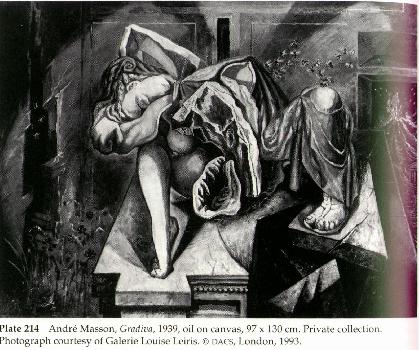
"In a fractured, Cubist space, Masson portrays a female figure as half-flesh, half-statue. The divided female is half the classically draped female figure reminiscent of Picasso's monumental nudes of the 20s, half entrails spilling onto the broken classical plinth on which she reclines. The 'inside' of the body-cum-cast is positioned at the centre of the painting, and the body is turned toward the viewer, revealing a gaping vagina - rather than reclining in the usual way as the upper dilineating line suggests it would. On one level, the image negated the calm, statuesque female figures of earlier representations. However, that such an overtly sexualized and violated image of the reclining figure should signify the 'violence' of an epoque also shows how the female body was treated as a suitable terrain for disfigurement and metaphorical decimation."
"To draw attention to Masson's war-torn imagery is to begin at the point where the 'Gradiva' imagery of the 30s ended - crumbling and ravaged. But, as Whitney Chadwick has argued, from 1930 onwards the mythical figure of Gradiva was represented as the ideal muse and inspiration to Surrealist poets and artists. Salvador Dali had said of Gala Eluard: 'she is Gradiva the woman who advances. She is according to Paul Eluard, "the woman whose glance pierces walls".' Andre Breton's essay of 1937, called again, 'Gradiva', centred on teh theme of metamorphosis, from life into death, unconscious to conscious - on the idea of transition from one thing to another, from one state to another, i.e. the condition of metaphor that preoccupied Surrealism."
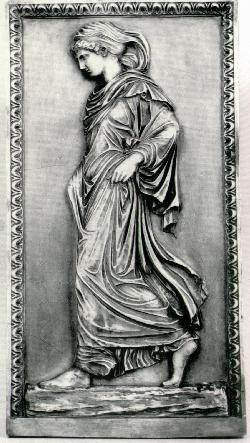
"The name 'Gradiva' comes from Gradiva: A Pompeian Phantasy, a story by the German writer Wilhelm Jensen, published in 1903. The Surrealists would probably have passed the story by had it not been drawn to their attention by Freud's study of it, 'Delusions and dreams in Jensen's "Gradiva"', published in 1907 but not translated into French until 1931, when it was read by Breton. Jensen's novel is the story of a young archeologist, Hanold, who fell in love with a classical relief that he first saw in a museum of antiquities in Rome. He obtained a plaster-casst of the relief, which he named Gradiva or "the girl who steps along', and hung it in his study. Captivated by the graceful gait of the figure as she walks along in her flowing robes, he convinced himself that she would be found in Pompeii. Labouring under this delusion, he beleived that he found Gradiva in Pompeii, stepping calmy along with her characteristic gait 'without his having suspected it, living as his contemporary; (quoted in Freud, 'Delusions and dreams in Jensen's "Gradiva"'. p. 38). The woman whom he meets turns out to be his childhood sweetheart, Zoe, who by appearing to accept his delusion fully, actually works to bring about his cure."
"When, in 1937, the Surrealists opened their own gallery, of which Breton was the director, they called it 'Gradiva'. Situated on the Rue de Seine, the silhouette of the male and female figures on the glass doors was designed by Marcel Duchamp. Breton seems to have opened the gallery largely because he was short of funds. The poster, which announced its opening read:
Gradiva. This title, borrowed from Jensen's marvellous work, means above all: 'She who advances'. What can she be 'She who advances; if not the beauty of tomorrow...? (quoted in Ades, Dada and Surrealism Reviewed, p.324)

"The 'stepping forward' of the Gradiva figure in the ancient relief was treated as a metaphor for 'advanced' art, the progressive movement forward of the Surrealist avant-garde. We find a calculated reversal of available models of the modernity: an ancient relief of a female figure stepping along is taken as a sign for cultural advancement, in opposition to comtemporary forms of modernity such as the modern male dress that, earlier in the 20s, Le Corbusier used; opposed also to the prevalence of the 'engineer' and 'constructor' metaphors; and opposed even to Andrei Zhdanov's 'engineer of human souls', the role for the Socialist Realist artist that Breton and others saw as pernicious. So Gradiva could personify various aspects of the Surrealist project - the concern with the release of the unconscious, ideas of metaphor and metamorphosis, notions of avant gardism, and the theme of the woman as the artist's muse."
All images and excerpts are not my own original material but rather they were taken from pages 232 - 237 of Realism, Rationalism, Surrealism which was written by Briony Fer, David Batchelor, and Paul Wood, published by Yale University Press of New Haven and London in 1993.
For more information please try the gradiva abstracts

