The Wheel of Life
Edited by Patrick Mok
Hong Kong
Samsara
The phenomena of existence, the Aggregates, Bases of Consciousness and Elements, are transitory, suffering and empty of a Self or anything belonging to a self, but they do not occur by chance; they originate in desire. Their appearance and disappearance are ruled by Dependent Origination, by virtue of which arising is due to action and action is due to passion.
Samsara, which has no begining and is like an infinite sequence of existence, is this world, filled as it is with so much pain and
sorrow. They are subject to the mechanism of the twelvefold Dependent Origination, each fold or link of which is cause, or more exactly, the condition of the next. This interdependence is traditionally indicated in the following way: "This being, that is; from the arising of this, that arises; and conversely, this not being, that is not; from the distruction of this, that is distroyed." All beings in this world are subject to the law of karma.
Karma
means volitional act, that is, something you do, say, or think that is
in fact in your control. Karma is intentional action, that is, a deed done deliberately through body, speech or mind.
Karma means good and bad volition (kusala Akusala Centana). Every volitional action (except that of a
Buddha or of an Arahant) is called Karma. The Buddhas and Arahants do not accumulate fresh Karma
as they have destroy all their passions.
In other words, Karma is the law of moral causation. It is action and reaction in the ethical realm. It is
natural law that every action produces a certain effect. So if one performs wholesome actions such as
donating money to charitable organizations, one will experience happiness. On the other hand, if one
perform unwholesome actions, such as killing a living being, one will experience suffering. This is the law
of cause and effect at work. In this way, the effect of one's past karma determine the nature of one's
present situation in life.
Any such act has moral consequences, called
vipaka,
which means fruit. In traditional Buddhism, this consequences can
occur in this life, or in a future life.
Most Buddhists believe in rebirth. For many, rebirth is
no different from what the Hindus believed, i.e. reincarnation or transmigration
-- moving from one's old body at death to a new body at birth or conception.
A little more precisely, rebirth is nothing more than the transmission
of one's karma. Buddha likened it to the flame that passes from one
candle to another. So the idea of an immortal soul, a continuing
personality, is definitely not part of the rebirth idea.
Buddhism teaches that birth, death and rebirth are part of the continuing process of change. This is
similar to the continuous process of growth, decay and replacement of cells in one's body. According to
medical expert, after every seven years, all the cells in one's body are replaced by new ones.
At the moment of death, when this life is over, and the body can no longer survive, the mind is separated
from the body. At that time, the craving for lives causes one to seek a new existence, and the karma
done previously determine the place of one's rebirth.
There are six realms in which one may be reborn after death. They are the realms of gods, the demigods,
human beings, animals, hungry ghosts and the hells. These are just general categories and within each,
there exist many sub-categories. The six realms of existence include three relatively happy states, and
three relatively miserable states. The realms of the gods, the demigods and human beings are considered
more happiness and less suffering. The realms of animals, hungry ghosts and the hells are considered
relatively miserable because living beings there suffer more from fear, hunger, thirst, heat ,cold and pain.
In general, wholesome actions like good conduct, charity and mental development, are the cause of
rebirth in the happy realms of gods, demigods and human beings. On the other hand, unwholesome
actions like immoral conduct, miserliness and cruelty cause rebirth in the unhappy realms of animals,
hungry ghosts and the hells.
One need not wait until one is reborn to imagine what existence in other realms is like. For instance,
when one is intensely happy or totally at peace with oneself, one experience a sate similar to that of the
gods. When one follows one baser instincts and is totally preoccupied with eating, sleeping and sex, one's
existence is like that of the animals. Then again, when one is overwhelmed by fear and pain, or is tortured
and killed in this life, one experience suffering like that of the hells.
Of all the six realms, the realm of human beings is considered the most desirable. In the realm
of human beings, the conditions for attaining Nirvana are better. In general, in the unhappy realms,
the suffering of living beings is so intense and their ignorance so great that they are unable to recognise
the Truth and follow the path to attain freedom. Alternatively, living beings in the realms of the gods and
demigods experience so much happiness and have so many distractions that they do no think of rebirth
until is too late. Then they may be reborn in one of the lower realms of suffering. In the realm of human
beings, however, people experience both happiness and suffering, and are intelligent enough to recognise
the Truth and follow the path to attain freedom from the cycle of birth and death.
Rebirth and similar concepts are not a part of most westerners' cultures,
so many western Buddhists, as well as some eastern Buddhists, take rebirth
as a metaphor, rather than literally. Buddhism has never been a particularly
literalist religion, so this is not at all taboo. In fact, Buddha
often avoids discussing the reality of one metaphysical idea or another
as irrelevant to the practice of the Dharma.
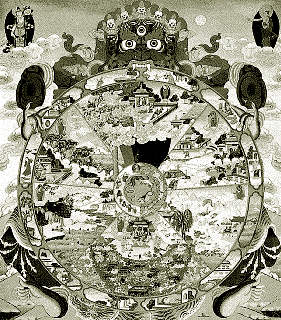
The image to the right is the Tibetan Wheel of Life, which represents
Samsara. In the very center, there is a rooster chasing a pig chasing
a snake chasing the rooster -- craving, hatred, and ignorance. Around
that are people ascending the white semicircle of life, and others descending
the black semicircle of death. The greatest portion of the Wheel
is devoted to representations of the six realms -- the realm of the gods,
the realm of the titans, the realm of humans, the realm of animals, the
realm of the hungry ghosts, and the realm of demons -- each realm looked
over by its own boddhisattva. The outermost circle is the 12 steps
of dependent origination. The entire Wheel is held by Yama, the Lord
of Death.
Pratitya-Samutpada
This is dependent origination, also known as conditioned arising, interdependent
arising, conditional nexus, causal nexus.... It refers to the idea
that, as long as we remain ignorant, clinging, and hateful, we will continue
to create karma, and so continue to be reborn into this world full of suffering
and pain. It is described using the metaphor of a wheel of life,
wherein one thing inevitably leads to another.
(Sanskrit: "origination by dependence"), Pali Paticca-samuppada, the chain, or law, of
dependent origination, or the chain of causation--a fundamental concept of Buddhism describing
the causes of pain and the course of events that lead a being through rebirth, old age, and
death.
Existence is seen as an interrelated flux of phenomenal events, material and psychical, without
any real, permanent, independent existence of their own. These events happen in a series, one
interrelating group of events producing another. The series is usually described as a chain of 12
links (Sanskrit nidanas, "causes"), though some texts abridge these to 10, 9, 5, or 3. The first
two stages are related to the past (or previous life) and explain the present, the next eight
belong to the present, and the last two represent the future as determined by the past and what
is happening in the present. The series consists of: (1) ignorance (Sanskrit: avidya; Pali:
avijja), specifically ignorance of the Four Noble Truths, of the nature of man, of transmigration,
and of nirvana; which leads to (2) faulty thought constructions about reality
(samskara/sankhara). These in turn provide the structure of (3) knowledge (vijana),
the object of which is (4) name and form--i.e., the principle of individual identity (nama-rupa)
and the sensory perception of an object--which are accomplished through (5) the six domains
(sadayatana)--i.e., the five senses and their objects--and the mind as the coordinating organ of
sense impressions. The presence of objects and senses leads to (6) contact (sparsa/phassa)
between the two, which provides (7) sensation (vedana). Because this sensation is agreeable, it
gives rise to (8) thirst (trsna/tanha) and in turn to (9) grasping (upadana), as of sexual
partners. This sets in motion (10) the process of becoming (bhava), which fructifies in (11) birth
(jati) of the individual and hence to (12) old age and death (jara-marana).
The formula is repeated frequently in early Buddhist texts, either in direct order (anuloma) as
above, in reverse order (pratiloma), or in negative order (e.g., "What is it that brings about the
cessation of death? The cessation of birth"). Gautama Buddha is said to have reflected on the
series just prior to his enlightenment, and a right understanding of the causes of pain and the
cycle of rebirth leads to emancipation from the chain's bondage.
The formula led to much discussion within the various schools of early Buddhism. Later, it came
to be pictured as the outer rim of the wheel of becoming (bhavacakra), frequently reproduced
in Tibetan painting.
“All psychological and physical phenomena constituting individual existence
are interdependent and mutually condition each other...?which is what
entangles us in samsara. (The Encyclopedia of Eastern Philosophy and Religion)
1. Ignorance (avidya). "A" is ignorant of the dharma.
The blind man cannot see the truth
2. Impulses (samskara). "A" therefore has intentions
(karma), good, bad, or neutral, and acts on them. A potter creates
a new pot from clay and water.
3. Consciousness (vijana). These create a
new conscious being, "B," who enters a womb. A monkey, with no self
control, jumps from one branch to another.
4. Name and form (namarupa). "B" takes form.
Three or four men in a boat: The body is the vehicle that carries
us through life.
5. The six bases (shadayatana). "B" comes into a
world of objects ready to be experienced. House with doors and windows:
The senses let in the world, like windows let light into a house.
6. Contact (sparsha). "B" has contact with that world
of objects. Lovers symbolize the intimate contact between world and
mind.
7. Sensation (vedana). "B" has perceptions of that
world of objects. A man with an arrow in his eye: Sensations
can be so strong that they blind us to the truth.
8. Craving (trishna). "B" perceptions give rise
to desires. A man drinking: The promise of satisfaction only
leads to intoxication.
9. Clinging (upadana). Desire leads "B" to cling
to life, even at death. Like a monkey clinging to a fruit tree, we
cling to things.
10. Becoming (bhava). And another conscious being,
"C," is begun. A pregnant woman: A new life has begun.
11. Birth (jati). Thus, "C" is born. A woman
gives birth.
12. Old age and death (jara-maranam). And "C" birth
leads inevitably to his or her old age and death. An old man carries a
corpse to its resting place.
And the cycle continues, one thing leading to another....
Samyojana
Samyojana are
one of ten 'fetters' that tie beings to the wheel of birth and death. They are: belief in a substantial self, skeptical doubt, clinging to rules and ritual, sensual craving, ill will, craving for fine-material existence, craving for immaterial existence, conceit (mana), restlessness and ignorance. The first five are the 'lower' fetters; the second five are the 'upper' fetters. In the Stream Enterer the first three fetters have been destroyed; in the Once-Returner the next two are weakened, and in the Non-Returner they are destroyed; in the Arahant all fetters have been destroyed.
The Ten Fetters (Samyojana) bind us to samsara.
1. Belief in a separate personality or individuality (drishti)
2. Doubt that has no desire for satisfaction (vichikitsa)
3. Uncritical attachment to rules and rituals (silabbata-paramasa)
4. Sensuous craving (kama-raga)
5. Ill will, wishing harm on others (vyapada)
6. Craving for a higher material existence (rupa-raga)
7. Craving for non-material existence (arupa-raga)
8. Conceit or egotism (mana)
9. Restlessness (udhacca)
10. Ignorance (avidya)
Dharmas
Dharmas are the ultimate elements or particles of the universe
. A little like atoms, they are very small, but they exist for only
a split second, in keeping with the doctrine of impermanence. And while
atoms are purely material, dharmas include all phenomena, mental and physical.
I like to think of them as little flashes of colored light, and I would
translate the word as scintilla. Don't get confused between these
and the Dharma, meaning the teachings of the Buddha!
Like the ancient Greeks, the ancient Buddhists thought there were four
basic elements: earth, water, air, and fire. The dharma theory
turns these elements into qualities, or even verbs: fire becomes
hot becomes burning; air becomes cool becomes blowing.... Ultimately,
then, all things?are nothing more than bundles of these qualities or
actions, and are empty?inside. This led to one of the most important
ideas of the Madhyamaka School of Mahayana Buddhism: Shunyata,
which means emptiness.
In Mahayana Buddhism, the dharmas were considered something more like
phenomena than atoms, and the Yogachara School took the change even further,
and considered them something more like ideas in the universal mind.
The Skandhas
Skandhas or aggregates are the parts of the self. Sometimes
they are called the aggregates of attachment, which bring about suffering.
Just like a car is nothing more than the sum of its parts, so we are nothing
more than the sum of our parts. There is no atman, meaning
soul, self, or ego, holding the pieces together. Nevertheless, just
like the car can run despite being nothing but a collection of pieces,
so we can live as a person.
Traditionally, there are five skandhas:
1. The body, matter or form (rupa). Includes the
body and the sense organs.
2. Feelings or sensations (vedana). Pleasant, unpleasant,
and neutral feelings, coming out of contact between sense organs and objects,
plus out of the contact between mind (manas) and mental objects (ideas,
images...).
3. Thoughts or perceptions (samj?a). Recognition
of objects -- form, sound, smell, taste, bodily impressions, mental objects.
4. Will, mental acts, or mental formations (samskara).
Volition, attention, discrimination, joy, happiness, equanimity, resolve,
exertion, compulsion, concentration, etc.
5. Consciousness (vij?ana). Awareness prior
to recognition -- seeing, hearing, smelling, tasting, kinesthesia, ideation.
The last four are called naman, name, meaning the psyche. Namarupa
(name-form) is therefore the buddhist term for the person, mental and physical,
which is nevertheless anatman, without soul or essence.
Ayatana is the six fields of naman: sight, hearing, smelling,
tasting, touching, and mind, as well as the objects of these six senses.
The Yogachara school adds alaya-vijana, a storehouse?consciousness, similar to Jung's idea of the collective unconscious.
What is stored there are called bijas or seeds, which are inborn
and result from our karmic history. They combine with manas
or ego-mind to form the illusion of ordinary existence. By stilling
mind, storehouse consciousness becomes identical with tathagata,
or the Buddha-mind. The word tathagata is
not used either in the Upanishads or (so far as I am
aware) in older Sanskrit writings, there exists no
available evidence earlier than the Pali Pitakas; and
there its use is so common as to merit special
investigation.
The term Tathagata is, in the Buddhistical
literature, exclusively applied to Sammasambuddhas,
and it is more especially used in the Pitakas when
the Buddha is represented as speaking of himself in
the third person as 'the Tathagata.' The meaning
'sentient being,' which is given to the word in the
Abhidhanappadipika and in Childers's Dictionary, is
not confirmed, as far as we know, by any passage of
the Pitakas. This translation of the word is very
possibly based merely on a misunderstanding of the
phrase often repeated in the Sutta Pitaka, Hoti
tathagato param marana, which means, of course,(2)
'does a Buddha exist after death?'
Chitta means mind or consciousness. In Yogachara, everything
is ultimately chitta. For this reason, Yogachara is also called the
chitta-matra,
Nothing but consciousness,?or idealistic school.
Snelling, John (1991). The Buddhist Handbook. Rochester,
VT: Inner Traditions.
Rahula, Walpola (1959). What the Buddha Taught. NY:
Grove Press.
Gard, Richard (1962). Buddhism. NY: George
Braziller.
The Encyclopedia of Eastern Philosophy and Religion (1994).
Boston: Shambhala.
The Encyclopaedia Britannica CD (1998). Chicago:
Encyclopaedia Britannica.
Return to Top
Return to
Table of Contents
Return to Homepage