Topology is a branch of geometric mathematics concerned with order, contiguity, and relative position, rather than actual linear dimensions. Topological mathematics (such as knot theory) also tend to be perspective independent. If you have a tangled fishing line and kept wiggling and pulling the string to see haw many knots it had. the number of number of knots would be independent of what angle you were viewing it, or whether you had access to a metric or yard ruler.
Benji's TOE will be using various perspective independent mathematical concepts such as multidimensional topology (of M-Theory, and Loop Gravity) and Super-symmetry. The measurement systems used will be generally digital or otherwise metric independent. Axis when used will represent an observers perspective.
When we talk about shapes or directions we generally refer to things in 3 dimensions or less. We are familiar with directions such as North, South, East, West, Up down Left, Right, Clockwise and Anti-clockwise. Likewise we are familiar with shapes such as 0D points, 1D line segments, 2D triangles, and 3D tetrahedral pyramids, all belong to a "triangular series" of shapes "with the smallest number of sides for its number of dimensions". Calling a seven dimensional shape of this series a 7D triangle is a convenient shorthand term, but keep in mind that a line segment is both a 1D triangle and a 1D cube. Likewise a point is a 0D anything.
The term "hyper" as in "hyper cube" sometimes refers to 4D objects and/or objects with an extra dimension than there name suggests. Visit An Introduction to the Vocabulary of Dimension for more details on usual conventions but I will generally be using the terms something D triangle, cube or sphere when referring to shapes.
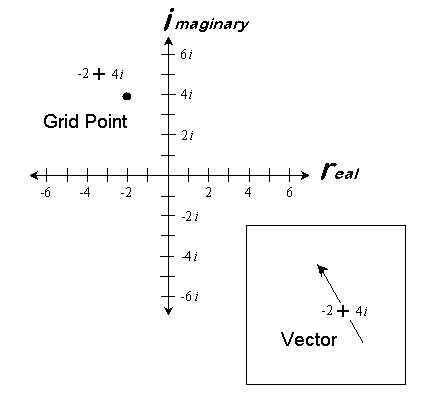
Complex numbers consist of a pair of numbers the first being a "real" number such as negative 7 and an imaginary number which is a "real" number multiplied by i ("the square root of negative one"). Thus (7-5i) would be a complex number; (-6+0i) = -6 is a real number; (0+4i) = 4i is an imaginary number.
Complex numbers can be represented can be represented as a point on a grid or as a vector (which is an arrow that need not have a grid).
