Pokemon Trading Card Game Section
This Is my Pokemon TCG
Section. I've Been wanting to get one for a while but never got around to doing
it. But When I moved my site it finally got up. I've set up the page into three
sections: Beginner Rules, Normal Decks, and Jungle Decks.
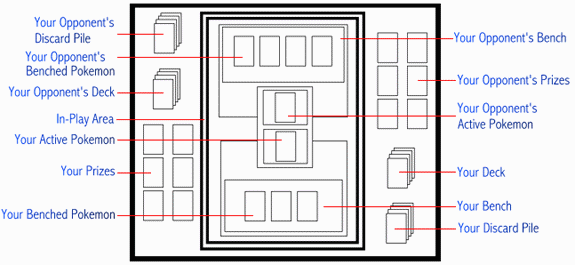
Beginner Rules
What's the pokemon game like?
You might have several Pokemon on the table at one time, but only one of them
(called your "Active Pokemon") will be fighting for you at a time. The rest
will be sitting on your Bench, waiting for their turn to fight. Every turn,
you'll have a chance to attack with your Active Pokemon, which will either do
damage to your opponent's Active Pokemon (called the "Defending Pokemon" during
your attack) or do something to it, like making it asleep, confused, Paralyzed,
or Poisoned. If your attack does enough damage to knock out the Defending Pokemon,
you get to take one of your 6 Prizes. When you take your sixth Prize (when you've
Knocked Out six of your opponent's Pokemon), you win!
What do you need to play?
Well, you and your opponent will each need your own deck of 60 cards, a coin
to flip, and some counters to mark damage to your Pokémon.
How to win
In Pokémon, you can win three different ways. First, at the start of the game
you set aside 6 of your cards as prizes. Every time one of your opponent's Pokemon
is Knocked Out, you take one of your Prizes and put it into your hand. When
you've taken all 6 of your prizes, you win the game! Second, you also win if
your opponent has no Pokemon left to fight against your Pokemon. And finally,
you win if your opponent's deck is out of cards at the start of his or her turn.
What are the different kinds of cards?
Basic Pokemon are your most important cards. They fight for you turn after turn
against your opponent's Pokemon.
Evolution cards are played on top of your Basic Pokemon (or sometimes on top
of other Evolution cards). They make your Pokemon bigger and more powerful.
Energy cards are attached to your Pokemon to give them the energy they need
to do their attacks.
Trainer cards are one-shot cards that do something once and are then discarded.
Starting The Game
1) Shuffle your deck and draw a starting hand of 7 cards. Put the rest of your
deck face down in front of you.
2) If you don't have any basic Pokemon cards in your hand (it'll say "Basic
Pokemon" in the upper left-hand corner), show your hand to your opponent, shuffle
it into your deck, and draw 7 new cards. Your opponent may then draw up to 2
extra cards. If you still don't have any Basic Pokemon in your new hand, you
can repeat this process, but your opponent gets to draw up to 2 extra cards
each time!
3) You and your opponent each choose a Basic Pokemon card from your hands and
put them face down. These will be your Active Pokemon.
4) Each may, if he or she wishes, choose up to 5 Basic Pokemon from his or her
hand and put them face-down on his or her Bench (this is where Pokemon wait
when they are not Active).
5) Put the top 6 cards of your deck face-down in front of you. These are your
Prizes, which you take as your opponent's Pokemon are Knocked Out. You can't
look at a Prize card until you take it.
6) Flip a coin to see who goes first.
7) Flip over all the Active and Benched Pokemon that have been put on the table.
Let's Play!!
As you play, you and your opponent take turns. During your opponent's turn,
you don't do anything except replace your Active Pokemon if it gets Knocked
Out (see below). During your turn, go through the steps below.
What can you do during your turn?
1) Draw a Card
2) Do any of the following in any order and as often as you like.
a.) Put a Basic Pokemon on the Bench
b.) Evolve a Pokemon in Play
c.) Attach an Energy card to a Pokemon (only once per turn)
d.) Play a Trainer Card
e.) Retreat your active Pokemon
f.) Use a Pokemon Power
3) Attack with your active Pokemon
4) Your turn is over now
|
|
|
1) Draw a card
You always begin your turn by drawing a card. (If your deck is empty at the
beginning of your turn, the game is over, and your opponent wins).
2) Do any of the following in any order and as often as you like:
Put a Basic Pokemon on the Bench
Choose a Basic Pokemon from you hand and put it on your bench. You can have
no more than 5 Pokemon on your Bench at any time, so you can put a new Basic
Pokemon there only if your bench has 4 or fewer Pokemon on it.
Evolve a Pokemon in play
If you have a card in your hand that says "Evolves from so-and-so" and so-and-so
is the name of a Pokemon you already have in play, you may play that card in
your hand on top of the Pokemon so-and-so. This is called "evolving" a Pokemon.
Example: Juliane has a card called Ninetails that says "Evolves from Vulpix,"
and she has a Vulpix card in play. She may play the Ninetails card on top of
the Vulpix card.
When a Pokemon evolves, it keeps any Energy cards, and Evolution cards, and
any damage counters it might already have. All other things about the Pokemon
go away - Sleep, Confusion, Paralysis, Poison, or anything else that might be
the result of an attack some Pokemon made earlier. All of these things go away.
Attach an Energy card to a Pokemon
Take an Energy card from your hand and attach it to one of your Pokemon in play
(put it under the Pokemon card)
Play a Trainer Card
To play a Trainer card, do what it says, then put it in the discard pole.
Retreat your Active Pokemon
You may switch your Active Pokemon with one of the Pokemon on your Bench. To
do this, you must discard Energy cards equal to the Active Pokemon's retreat
cost that's written in the lower right-hand corner. (You'll read more about
costs in the "Attack with Your Active Pokemon" section). If you can't do that,
then you can't retreat. Pokemon with no retreat cost don't need to discard any
Energy when they retreat - they can retreat 'for free'.
A Pokemon that is Asleep or Paralyzed can't retreat. A Confused Pokemon can
TRY to retreat, but it might not succeed. (Why this might happen will be explained
later on in the rules).
When your Active Pokemon goes to your Bench (whether it retreated or got there
some other way), it keeps any Energy cards, any Evolution cards, and any damage
counters it may already have. All other things about the Pokemon go away - Sleep,
Confusion, Paralysis, Poison or anything else that might be the result of an
earlier attack. All of these things go away. Retreating does not cost your attack.
Use a Pokemon Power
Some Pokemon have a special "Pokemon Power" written on the card. Many of these
Powers can be used before you attack. Each Pokemon Power is different though,
so you should read carefully how each Pokemon Power works.
3) Attack with your Active Pokemon
If you wish, you may have your Active Pokemon attack your opponent's Active
Pokemon (also called the 'Defending Pokemon'). This is the last thing you can
do during your turn - you can't do anything else afterward. You can only attack
one time during your turn, and your Pokemon can only use one of its attacks
each turn. To attack, just tell your opponent which one of your Pokemon's attacks
you're using. You can only use an attack if you have at least the required amount
of Energy attached to your Active Pokemon.
Any type of Energy - forest, fire, water, lightning, psychic, fighting, or colorless
- can count toward colorless Energy requirements (the little star). But only
Energy of the appropriate type counts toward Energy requirements of that type.
So if an attack has an Energy requirement of Fire, you must have a fire energy
to make the attack work. But if an attack has a colorless Energy requirement,
you just need any one energy - it doesn't matter which kind!
When you attack read the attack you're using and do what it says. For each 10
damage a Pokemon takes, put one damage counter on it. If a Pokemon ever has
total damage at least equal to its Hit Points (for example, 4 or more damage
counters on a Pokemon with 40 HP), it's immediately Knocked Out.
Some Pokemon have a Weakness or Resistance to Pokemon of other types. (For example,
Charmander has a Weakness to Water Pokemon.)
A Defending Pokemon takes double damage from a Pokemon that it has a Weakness
to, and it subtracts damage from a Pokemon that it has a resistance to.
What happens when your Pokemon is Knocked Out
Whenever a Pokemon is Knocked Out, put its Basic Pokemon card and all cards
attached to it (Evolution cards, Energy cards, etc.) in the discard pile of
whoever played them. The opposing player takes one of his or her Prizes and
puts it into his or her hand. A player who loses his or her Active Pokemon must
immediately replace it with a Pokemon from his or her Bench. (If a player can't
do this because his or her bench is empty, that player loses.) If both Active
Pokemon are Knocked Out at the same time, the player whose turn it is replaces
his or her Pokemon last.
4) Your Turn is Over Now
Sometimes there are things to do after your turn is over but before your opponents
turn begins. After you've done those things, your opponent's turn begins.
What happens after each players turn?
After each player's turn, if either player's Active Pokemon is Poisoned, it'll
take damage, and if it's Asleep or Paralyzed it might recover. Then the next
players turn begins.
How do sleep, poison, confusion and paralysis work?
Some attacks cause the Defending Pokemon to be Asleep, Confused, Paralyzed,
or Poisoned. These things don't happen to a Benched Pokemon, only to an Active
Pokemon - in fact, if a Pokemon goes to the Bench, these things are removed
from it. And evolving a Pokemon also means it's no longer Asleep, Confused,
Paralyzed, or Poisoned.
Asleep
If a Pokemon is Asleep, it can't attack or retreat. Turn the Pokemon Sideways
to show it is Asleep. After each player's turn, flip a coin. On a heads, the
Pokemon wakes up (turn the card back right side up), but on a tails it's still
Asleep, and you'll have to wait until after the next turn to try and wake it
up again.
Confused
If a Pokemon is Confused, you have to flip a coin whenever you try to attack
with it or whenever you try to make it retreat. Turn a Confused Pokemon with
its head pointed toward you to show it's confused.
When you try to make a confused Pokemon retreat, you must first pay the retreat
cost by discarding Energy cards. Then flip a coin. On heads, you can retreat
the Pokemon as normal. On tails, the retreat fails, and that Pokemon can't try
to retreat again that turn.
When you attack with a Confused Pokemon, you flip a coin. On heads, the attack
works normally, but on tails your Pokemon attacks itself with an attack that
does 20 damage. (If your Pokemon has a weakness or a resistance to its own type,
or if there is some other effect that would alter the attack, apply these things
as usual.)
Paralyzed
If a Pokemon is Paralyzed, it can't attack or retreat. Turn the Pokemon sideways
to show it is Paralyzed. If an Active Pokemon is Paralyzed it recovers after
its player's next turn. Turn the card right-side up again.
Poisoned
If a Pokemon is Poisoned, place a "poison marker" on it to show that is poisoned.
As long as it's still Poisoned, the Pokemon takes 10 damage after each player's
turn, ignoring Weakness and Resistance. If an attack would poison a Pokemon
that is already Poisoned, it doesn't get doubly poisoned; instead the new Poison
condition replaces the old one.
Can your pokemon be asleep and confused at the same time?
If a Pokemon is Asleep, Confused, or Paralyzed, and a new attack is made against
it that causes it to become Asleep, Confused, or Paralyzed, the old condition
is erased and only the new one counts. But these three conditions are the only
attack effects that erase each other. For example, a Pokemon can be Confused
and Poisoned at the same time.
Blackout
Leave your rivals in the dark as you destroy their energy with the fighting
and water Pokémon in the "Blackout" deck!
12  Energy Energy
3 Staryu
4 Squirtle
2 Wartortle
|
|
16  Energy Energy
4 Machop
2 Machoke
3 Sandshrew
3 Onix
1 Hitmonchan
2 Farfetch'd
|
|
Trainers
4 Energy Removal
1 Super Energy Removal
1 Gust of Wind
1 PlusPower
1 Professor Oak
|
|
 |
The goal of "Blackout" deck is to eliminate your opponent's Energy cards so
that his or her Pokémon are helpless, and then defeat them with your own Pokemon.
The deck's Pokemon mix is made more powerful by the addition of some more evolved
Pokemon (Starmie and Blastoise). The energy-card destruction theme is supported
by the addition of Dragonair and another Super Energy Removal.
Remove:
2 Energy
1 Sandshrew
3 Onix
2 Farfetch'd
1 Gust of Wind
1 Pluspower
|
|
Replace:
2 Energy
2 Starmie
1 Blastoise
3 Dratini
1 Dragonair
1 Super Energy Removal
|
Bushfire
Suprise your opponents by attacking swiftly and fiercely with the fire and
Grass Pokémon in the "Brushfire" deck!
18  Energy Energy
4 Charmander
2 Charmeleon
2 Growlithe
1 Arcaine
2 Vulpix
1 Ninetales
|
|
10  Energy Energy
4 Nidoran
4 Weedle
2 Tangela
|
|
Trainers:
1 Pluspower
3 Potion
1 Gust of Wind
1 Switch
1 Energy Removal
2 Energy Retrival
1 Lass
|
|
 |
The goal of the "Brushfire" is to attack your opponents quickly with Pokémon
that do a lot of damage. The changes help the deck by adding Magmar, a Basic
Pokémon that can do 50 damage, and Charizard, the king of Fire Pokémon. An extra
Pluspower helps you do damage even more quickly, and an extra Gust of Wind makes
it harder for your opponent to save his or her Pokémon by retreating them. The
Pokémon Trader gets you just the Pokémon you need when you need it.
Remove:
2 Vulpix
1 Ninetales
1 Energy Removal
1 Switch
1 Lass
|
|
Replace:
2 Magmar
1 Charizard
1 Gust of Wind
1 Pluspower
1 Pokémon Trader
|
Overgrowth
Take over the game by evolving your Grass and Water Pokémon to maximum toughness
with the "Overgrowth" deck!
16  Energy Energy
4 Weedle
2 Kakuna
1 Beedrill
4 Bulbasaur
2 Ivysaur
|
|
12  Energy Energy
4 Staryu
3 Starmie
2 Magikarp
1 Gyarados
|
|
Trainers:
2 Super Potion
2 Switch
2 Gust of Wind
2 Bill
1 Potion
|
|
 |
The goal of the "Overgrowth" deck is to beat your opponent with hightly evolved
Pokémon. To support that theme, this version of the deck adds Venusaur (a Stage
2 Pokémon) and another Ivysaur and Gyarados (both Stage 1 Pokémon). It also
adds a Pokémon Breeder to help you play your larger Pokémom more quickly. Since
we've taken out more Water Pokémon than Grass Pokémon, we've changed the Energy
card mix a bit as well.
Remove:
2 Energy
3 Staryu
3 Starmie
|
|
Replace:
2 Energy
1 Ivysaur
1 Venusaur
2 Magikarp
1 Gyarados
1 Pokémon Breeder
|
Zap!
Knock your opponent's Pokémon out of the fight with the Psychic and Lightning
Pokémon in the "Zap!" Deck!
16 Energy Energy
3 Abra
1 Kadabra
3 Gastly
2 Haunter
2 Jynx
2 Drowzee
1 Mewtwo
|
|
12  Energy Energy
3 Magnemite
4 Pikachu
|
|
Trainers:
2 Bill
2 Gust of Wind
2 Switch
1 Super Potion
1 Potion
1 Defender
1 Professor Oak
1 Computer Search
|
|
 |
The goal of "Zap!" is to paralyze, confuse, put to sleep, or otherwise disable
your opponent's Pokemon, preventing them from them from hurting you. This version
of the deck adds another Gastly and another Jynx, and also adds a Raichu and
2 Electabuzzes, since these Pokemon fit the theme well. Because Pokemon have
gotten bigger, the deck swaps out a Potion for a Super Potion. The deck uses
a little less Energy than before, but has an Energy Retrieval to make up for
it.
Remove:
1 Energy
1 Energy
2 Drowzee
1 Mewtwo
1 Switch
1 Potion
|
|
Replace:
1 Gastly
1 Jynx
1 Raichu
2 Electabuzz
1 Super Potion
1 Energy Retrieval
|
Jungle Decks
Power Reserve
Load your bench quickly with the "Power Reserve" Deck. Then evolve your Pokémon
to bring on the power for victory. Pokémon unite! With the "Power Reserve" deck,
your Grass and Psychic Pokémon will come swarming to each other's aid!
17 Energy
4 Bellsprout
1 Gloom
4 Nidoran
2 Nidorina
2 Oddish
2 Weepingbell
|
|
11 Energy
4 Abra
1 Jynx
2 Kadadra
|
|
Trainers:
2 Bill
2 Gust of Wind
1 Pokédex
3 Potion
1 Switch
|
|
|
|
The goal of the "Power Reserve" deck is for your Pokémon to bring out more and
more friends and family Pokémon, with Nidoran, Bellsprout, and Oddish leading
the charge. Then, once you have filled your Bench, you can upgrade to Nidorina,
Weepingbell, and Gloom to turn the tide in your favor! Use Jinx, Abra, and Kadabra
to back up your Grass Pokémon, and you'll be victoriuos. To improve your deck,
you'll need to collect some more Pokémon cards! Here is one way to give this
"Power Reserve" deck even more awesome Pokémon Power. Wigglytuff's Do the Wave
attack works very well with the Power Reserve theme--you can ensure that Wigglytuff
will have 5 Benched Pokémon to work with at all times!
Remove:
1 Gloom
2 Oddish
1Jynx
1Kangaskhan
1 Gust of Wind
|
|
Add:
4 Jigglypuff
2 Wigglytuff
|
Water Blast
The "Water Blast" Deck is loaded with water Pokémon to hose your opponents
until they're all washed up! Hold your opponent's Pokémon at bay until it's
time to bring out the big guns with the Fighting and Water Pokémon in the "Water
Blast" deck!
14 Energy
4 Poliwag
2 Poliwhirl
1 Seel
1 Vaporeon
|
|
14 Energy
2 Machop
1 Rhydon
3 Ryhorn
4 Evee
4 Meowth
2 Persian
|
|
Trainers:
2 Gust of Wind
2 Potion
1 Professor Oak
2 Super Potion
1 Switch
|
|
|
 |
The goal of the "Water Blast" deck is to use Fighting and other Pokémon to stall
for time while you build up a Water Pokémon that uses a Water Gun. You can also
build up a better evolved Pokémon to help you win, like Rhydon or Persian. To
improve your deck, you'll need to collect some more Pokémon cards! This version
of the deck focuses more on the Water Guns by adding Poliwrath and another Vaporeon.
Adding Dewgong and another Seel gives the deck some needed Water power (as does
swapping out Energy for
Energy).
Remove:
1 Energy
2 Meowth
1 Persian
1 Rhyhorn
|
|
Add:
4 Energy
1 Dewgong
1 Poliwrath
1 Seel
|
