| Sabbats |
| Sabbats - Pagan holidays marked by the solar calendar. Often depicted as describing the life cycle of the God through his birth, death and rebirth, the sabbats are all power days, and days of celebration. |
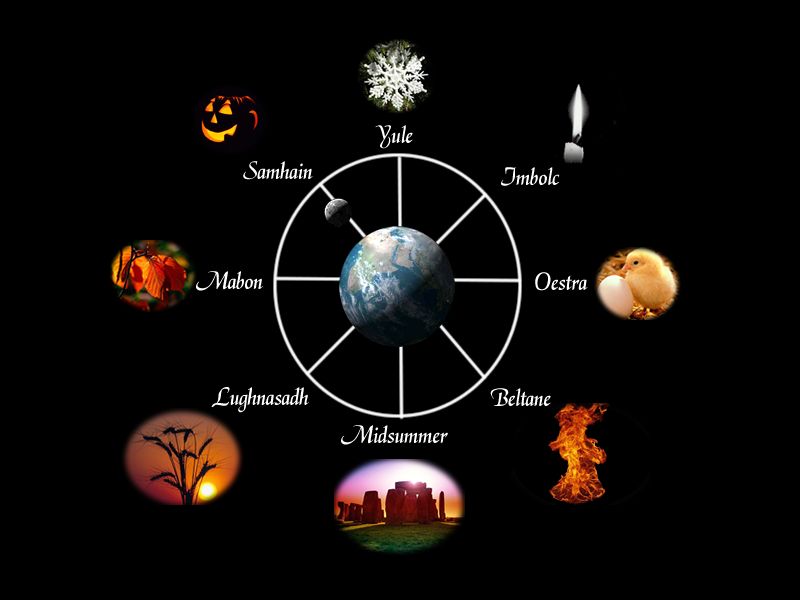 |
| Yule, Winter Solstice - around 22nd December Imbolc, Candlemas - 1st February Oestra, Ostara, Vernal Equinox - around 21st March Beltane, May Day - 1st May Midsummer, Litha, Summer Solstice - around 21st June Lughnasadh, Lammas - 1st August Mabon, Autumnal Equinox - around 22nd September Samhain, Hallowe'en - 31st October |
| The Wheel Of The Year |
| Yule A lesser sabbat, the rebirth of the God, the longest night, the days begin to grow longer. Celebrated by burning the Yule log, exchanging gifts and putting up a Yule tree which can be hung with dried fruits, herbs and coloured ribbons Imbolc A greater sabbat, the God growing up, the Goddess in Her Maiden aspect, pregnant with spring. This day is sacred to Brigid, a Celtic goddess of healing, poetry and fire. Imbolc means 'in milk' - when sheep and goats lactate. Celebrated by lighting white candles Oestra A lesser sabbat, the earth hatches and is reborn after winter, day of balanced night and day, the Norse goddess of fertility is honoured. Can be celebrated by the decoration of eggs for the altar Beltane A greater sabbat, celebration of the union between the God and Goddess, the Goddess becomes pregant. A fertility festival in which the god Bel is honoured. A symbol of Beltane is the Maypole Litha A lesser sabbat, when magick is at its peak, the longest day in the year, the God is at the height of His powers. Celebrated by feasting and thanking the Gods for the harvested food Lughnasadh A greater sabbat, the first harvest is gathered, the God begins his descent, honours Lugh, the Celtic fire god and Demeter, the Greek goddess of grain and harvest. Beginning of the 'Chase of Lugh'. It is traditional to get a few ears of corn to decorate the altar Mabon A lesser sabbat, a time of balance when there is as much day as night, the Goddess is in her Mother aspect, the chase of Lugh ends. Tradtions include collecting dried leaves to decorate altar, walking through forests and blackberrying Samhain A greater sabbat, also called the Feast of the Dead or the Feast of Apples, Pagan new year, the God passes on for winter, a time of reflection on the past. The veil between worlds is thinnest, so a good time to practise divination and honour those who have passed away. |
| 2003 March 21 June 21 September 23 December 22 |
| 2004 March 20 June 21 September 21 December 21 |
| Oestra Litha Mabon Yule |
| Lesser Sabbat Dates |
 |
| 2005 March 20 June 21 September 22 December 21 |