 |
 |
 |
| Page 5A |
 |
| Eight Verses of Thought Transformation *With the thought of attaining Enlightenment for the welfare of sentient beings, who are more precious than a wish fulfilling jewel, I will constantly practice holding them dear. *Whenever I am with others, I will practice seeing myself as the lowest of all and from the very depth of my heart, I will respectfully hold others as supreme. *In all actions, I will examine my mind and the moment a disturbing attitude arises, |
| endangering myself and others, I will firmly confront and avert it. *Whenever I meet a bad person who is overwhelmed by negative energy and intense suffering, I will hold such a rare one dear, as if I had found a precious treasure. *When others, out of jealousy, mistreat me with abuse, slander, and so on, I will practice accepting defeat and offering the victory to them. *When someone I have benefitted and in whom I have placed great trust hurts me badly, I will practice seeing that person as my supreme teacher. *In short, I will offer directly and indirectly every benefit and happiness to all beings, my mothers. I will practice in secret taking upon myself all their harmful actions and sufferings. |
| *Without these practices being defiled by the eight worldly concerns, by perceiving all phenomena as illusory, I will practice without grasping to release all beings from the bondage of the disturbing, unsubdued mind and karma. |
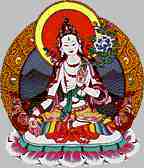
| The Practice of Tara Who is Tara and Why do we Pray to Her? The origin of Tara / Why do we need to practise Tara? / The Benefits of Tara Practice / Green Tara and the Twenty-One Taras / The Symbolism of Green Tara / The Twenty-One Taras / The Mantra of Tara: Who is Tara and Why do we Pray to Her? The origin of Tara... In the past, many eons ago, during the time of Buddha Dundubhisvara (Drum-sound), in the Universe called Manifold Light, there lived a princess by the name of Moon of Wisdom-knowledge. She was a very devoted disciple and would daily set out many offerings to the Buddha and His Sangha. Eventually she generated Bodhicitta, the aspiration to attain Enlightenment and become a Buddha herself, in order to help all living beings. Some Bhikshus came to know of this, and urged her to dedicate the merits she had created to be reborn as a male. However, the princess rejected this advice, saying: "Here there is no man, there is no woman, no self, no person, and no consciousness. Labelling 'male' or 'female' has no essence, but deceives the evil-minded world." She went on to make the following vow: "There are many who desire Enlightenment in a man's body, but none who work for the benefit of sentient beings in the body of a woman. Therefore, until samsara is empty, I shall work for the benefit of sentient beings in a woman's body." From that time onwards the princess dedicated herself to winning full and complete Enlightenment. Once she accomplished that goal, she came to be known as Tara, the Liberator. There is another story regarding Tara which tells that Chenrezig (Kuan Yin) had been working for a long time to help sentient beings. He had been able to help hundreds of thousands of beings become free from samsara, but then he checked and realized there were still so many more beings suffering in samsara. He began to cry, and from the pool formed by his tears a lotus arose and Tara appeared from the lotus, saying "Don't worry - I will help you." Thus Tara is associated with Chenrezig, as well as with Amitabha Buddha (she has a tiny image of Amitabha Buddha on her crown.) Why do we need to practise Tara?... There are many inner obstacles to our mental development, and these inner obstacles can create external obstacles. To obtain success in our Dharma practice, to actualize the path to Enlightenment, we need to rely on a special deity or Buddha, for example, Tara. All actions of the Buddha manifest in the female form, Tara, to help sentient beings successfully accomplish both temporal and ultimate happiness. The Benefits of Tara Practice... Lama Zopa Rinpoche explains that through practising Tara we can obtain the following benefits: - we can create a great deal of merit - we can avoid a suffering rebirth in the next life - we can quickly attain Enlightenment - we receive initia-tion from millions of Buddhas - all our wishes can be fulfilled, e.g. it can help us with our health, business, getting a job, having a child, etc. - it protects us from fear and dangers. It is said that Tara protects from the 8 fears, of which there are an internal and an external aspect: The 8 external fears The 8 internal fears 1. floods 1. attachment 2. fire 2. anger 3. elephants 3. ignorance 4. snakes 4. jealousy 5. lions 5. pride 6. imprisonment/chains 6. miserliness 7. thieves 7. wrong views 8. ghosts 8. doubt. Green Tara and the Twenty-One Taras / The Symbolism of Green Tara... Green Tara is seated upon a lotus arising from the waters of a lake, just as Tara is said to have arisen from the compassionate tears of Avalokiteshvara. Her right hand is in the mudra of supreme generosity indicating her ability to provide beings with whatever they desire. Her left hand at her heart is in the mudra of bestowing refuge: her thumb and ring finger are pressed together to symbolise the united practice of method and wisdom, and the three remaining fingers are raised to symbolise the Three Jewels of Refuge - Buddha, Dharma and Sangha. In each hand she holds the stem of a blue utpala flower. Each flower consists of three blossoms indicating that Tara, the embodiment of Enlightened activities, is the Mother of the Buddhas of the past, present and future. Tara is dressed in the silken robes of royalty. She wears rainbow colored stockings, a white half-blouse and various jeweled ornaments. These symbolise her mastery of the perfections of generosity, morality and so forth. The tiara fastened in her black hair is adorned with jewels, the cen-tral one is a red ruby symbolic of Amitabha, her spiritual father and the head of her Buddha family. She is seated in a distinctive posture, her left leg withdrawn to symbolise her renunciation of worldly passion and her right leg extended to show that she is always ready to arise and come to the aid of those who need her help. With a warm compassionate gaze she looks down upon each sentient being as a mother regards her only child. Her emerald-green color - related to the wind element and hence to movement - signifies her ability to act swiftly and without delay to bring benefits to sentient beings. From the teachings of Ven Lama Thubten Yeshe: Tara is known as the "Mother of all Buddhas." This is because she is the wisdom of reality, and all Buddhas and Bodhisattvas are born from this wisdom. This wisdom is also the fundamental cause of happiness, and our own spiritual growth comes from this wisdom. That is why Tara is called the Mother. And Mother Tara has much wisdom to manifest many aspects, sometimes peaceful, sometimes wrathful, in different colors - all to help sentient beings. |
 |
| The Twenty-One Taras... Tara has 21 primary emanations which perform different activities such as pacification, increase and so forth. The different colors of these 21 Taras correspond to the 4 different types of Enlightened activity, as explained by Ven. Kirti Tsenshab Rinpoche: Tara is the female Buddha of Enlightened Activity (Tib: trinley), of which there are 4 types: pacifying, increasing, overpowering and wrathful. Each of these is represented by a different color: White represents the Enlightened activity of pacifying, for example overcoming sickness, causes of untimely death and obstacles to success in one's life or one's practice. Yellow represents the Enlightened activity of increasing the positive qualities conducive to a long life, peace, happiness and success in one's Dharma practice. Yellow represents the Enlightened activity of increasing the positive qualities conducive to a long life, peace, happiness and success in one's Dharma practice. Red represents the Enlightened activity of power, or overpowering external forces that cannot be tamed through the first two activities, for example, removing obstacles to sickness, untimely death, etc., and forcefully accumulating conducive conditions for one's Dharma practice. Black represents the Enlightened activity of wrath, which |
 |
| involves using forceful methods for accomplishing activities for Enlightened purposes that cannot be accomplished through other means. Here is a list of the 21 Taras, their names in English and Tibetan, and their colors: 1. The Swift Heroine (Nyur.ma.pa.mo) - red. 2. Saraswati (Yang.chen.ma) - white. This Tara is also known as "The Great Pacifier" because she pacifies negative obscurations. 3. The Giver of Su-preme Virtue (S�.nam.chog.ter.ma) - yellow (with a slightly bluish hue). Also known as "Tara who Increases." 4. The All Victorious (Nam.gyal.ma) - white. Also known as "Tara of Life Force." 5. The Giver of Intelligence (Rig.je.ma) - red/ yellow. Also known as "Tara who Resonates with HUM." 6. The Terrifier (Jig.je.ma) - black with tinge of red. A.k.a. "Tara who is Victorious over the Three Worlds." 7. The Invincible (Shen.gyi.mi.tub.ma) - black. A.k.a. "Tara who Crushes Others' Forces." 8. The Conqueror of Others (Shen.le.nam.par.gyal.ma) - red/black. A.k.a. "Tara the Pulveri-zer of the Maras." 9. The Savior of the Scented Forest (Jig.ten.sum.la.gyal.ma) - white. A.k.a. "Tara who embodies the Three Jewels." 10. The Conqueror of the Three Worldly Realms (Jig.ten.sum.la.gyal.ma) - red. A.k.a. "The Great Subduer." 11. The Giver of Wealth (Nor.ter.ma) - red/yellow. A.k.a. "Tara who Eliminates Poverty." 12. The Auspicious (Ta. shi.d�n.je.ma) - red/yellow. A.k.a. "Tara Who Bestows Auspicious Conditions." 13. The Destroyer of Opposing Forces (Da.pung.som.ze.ma) - red. A.k.a. "Tara Who Blazes in Flames." 14. The Wrathful (To.nyer.chen) - red/ black. A.k.a. "Tara of Wrathful Gaze." 15. The Very Peaceful (Rab.shi.ma) - white. A.k.a. "The Great Pacifier." 16. The Blazing Light (Bar.w�.od.chen.ma) - red. A.k.a. "Tara Who Saves by Means of HUM." 17. The Subduer of Countless Harmful Forces (Pag.me.n�n.ma) - red/yellow. A.k.a. "Tara Who Causes the Three Worlds to Tremble." 18. The Peahen (Ma.ja. ma) - white. A.k.a. "Tara Who Eliminates Poisons." 19. The Invincible Queen (Mi.pam.gyal.ma) - white. A.k.a. "Tara Who Eliminates Conflicts and bad Dreams." 20. The Mountain-dwelling Mendicant (Ri.t�.ma) - red/yellow. A.k.a. "Tara Who Eliminates Diseases." 21. Rays of Light (�d.zer.chen.ma) - white. A.k.a. "Tara Who Accomplishes All Enlightened Activities." |
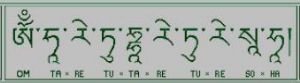
| The Mantra of Tara (Tara's mantra is OM TARE TUTTARE TURE SOHA)... OM represents Tara's holy body, speech and mind. TARE means liber-ating from true suffering, the sufferings of samsara, our aggregates being under the control of delusion and karma. TUTTARE means liberating from the 8 fears, the external dangers, but mainly from the internal dangers, the delusions, and also karma. TURE means liberating from the ignorance of the absolute nature of the "I;" it shows the true cessation of suffering. SOHA means "may the meaning of the mantra take root in my mind." Also, |
 |
| "I;" it shows the true cessation of suffering. SOHA means "may the meaning of the mantra take root in my mind." Also, in the context of the Lam Rim, TARE refers to the graduated path of the lower capable being; TUTTARE refers to the path of the middle capable being; TURE refers to the path of the higher capable being. So the meaning is that by taking refuge in Tara and doing Tara practice, we can achieve the fully Enlightened state with the four Kayas, which is the state of cessation of, or liberation from, the two obscurations. To practise reciting Tara's mantra, you can visualize Tara in front of you, with a white syllable OM at her crown, a red syllable AH at her throat and a blue syllable HUM at her heart. As you recite the mantra, visualize rays of light flowing from these three places, and striking your three places. These purify all negative karma and obscurations of your body, speech and mind created from beginningless time. Alternatively, you can visualize Tara on the crown of your head, and do the visualization as above. Recite as many mantras as you wish.At the end, pray to Tara to help you develop Bodhicitta - your practice of ethics, and your development of Bodhicitta are what please Tara the most. This is the best offering you can make to Tara, and will bring you closer to her. Then, Tara dissolves into light, which dissolves through your forehead (or crown) and into your heart. Feel "My body, speech and mind are now blessed to become Tara's body, speech and mind." Then dedicate the merit that you will become Enlightened - like Tara - in order to be able to help all sentient beings. (by Ven Lama Zopa Rinpoche) |
| Beijing plans to cobble together its very own Dalai Lama... China has set out its plans to appoint a puppet Dalai Lama when Tibet's spiritual leader dies. The communist regime will ignore the Tibetan Buddhist method of identifying his reincarnation and instead use a "historical ritual" cobbled together, at the behest of its own officials, from Tibetan and Chinese traditions. The move, reported in Chinese state media, threatens to lead to the creation of rival Dalai Lamas. The Tibetan government-in-exile denounced the plans as "a new imposition which will never be accepted by the Tibetan people." The state news agency Xinhua quoted Raidi, the most senior ethnic Tibetan in the administration, saying that when the exiled Dalai Lama died, China proposed to find several candidate boys for his reincarnation. One will be chosen by drawing lots from a golden urn, then his status will be confirmed by "ratification by the Chinese central government." According to traditional Buddhist tenets, high lamas have foreknowledge of when and where they will be reborn, and frequently leave detailed, if cryptic, instructions as to where they will be found. Search parties carry possessions of the deceased lama, which the reincarnation should be able to recognise. The Chinese alternative, blending religious ritual and political power, was first used in November 1995, when China imposed on Tibet its chosen reincarnation of the Panchen Lama, the second most senior cleric in Tibetan Buddhism. The boy failed to attract popular support in Tibet, despite intensive "patriotic education" campaigns, backed by arrests and intimidation in monasteries. A rival small boy chosen by the exiled Dalai Lama as the new Panchen Lama was taken into custody by Chinese officials, along with his family. He has never been seen again, although China insists he is alive and well. China's propaganda machine sets great store by the golden urn at the heart of its "ritual," but Kesang Takla, the secretary for international relations of the Tibetan government-in-exile, said the urn had no legal force. "The Chinese communists have no religious faith, and no right to interfere in rituals that are based on Buddhism, and are very spiritual.'' She repeated predictions that the next Dalai Lama would be born in exile. "We believe that high lamas have some freedom over where they are born." China says it will reject any "foreign" Dalai Lama. (2002) |
|
| TIBET - Called Bhot by Tibetans, the Mongols called it To-Bhot (high Bhot) which in European languages became Tibet. In Nepal, the people of Tibetan heritage are called Bhotia. Until very recently, Tibet existed as a culture that relied on subsistence agriculture and herding. Except for caravans of traders, people lived in the numerous valleys in small communities that existed in relative isolation. Armies detoured around it as far as was possible; when they did not, large segments of the population picked up and moved out of their way. In that way, Tibetans settled in Turkestan, Mongolia, and Nepal and other areas. Before the seventh century CE, there were no written records. Notched sticks and knotted cords were in use as aids to memory. There may have been a form of picture writing, and certainly pictures and symbols were used for religious and ritual purposes. In 622, King Srong-tsan (pron. Songtsen) Gam-po who conquered territories in China and India, sent his minister Thomi Sambhota (now regarded an incarnation of Manjushri) to collect sacred |
|
| books from India. As a consequence, a written Tibetan language was developed that is derived from the Devanagri script used for Sanskrit. The originally brush-formed letters with horizontal heads have changed little though they are now carved into blocks of wood for use in printing books. A half-cursive form with "cornered letters" developed into the more current headless form. Though the first Buddhist objects reached Tibet from Nepal in 461, it was Srong-tsan Gampo who firmly helped establish Buddhism. In this he had the help of his two wives, the princess Bribsun (Tri-sun, Bhirkuti) daughter of King Jyotivarma of Nepal, and the princess Wen Ching from imperial China. Some scholars believe that these two women are the actual inspiration for the cults of the Green and the White Taras, respectively. In 639, the same ruler founded Lha-ldan (God's ground,) the city that is known as Lhasa. Succeeding kings favored Bud-dhism, and during the eighth century invited Indian scholars to Tibet. When Kamalashila came, the monastery of Sam-ye was built for him. The fifth of the Tibetan kings, Khri-srong De-tsan (Trisong Deutsen) set an influential example when he abandoned Bon, the traditional beliefs, for Buddhism. Under his rule, in 747 Padmasambhava (Guru Rinpoche) arrived from the south-western regions. During his short stay his impact was widely felt, for besides translating many volumes of the Kanjur (the Buddhist canon), his personal influence firmly established the tantric Buddhist tradition. In 899, under King Lang-dharma there was widespread persecution of Buddhists which historians see as due to his concern for loss of political control. Despite that time of oppression which naturally was followed by decline and confusion, Bud-dhism was firmly re-established with the arrival of Atisha who came from Bengal in 1050 to settle at the great monastery of Thoding. Various monasteries then exerted predominant influences, but the original stream is known as Nying-ma. Sakya lamas were the next to establish their monastery and tradition, followed by the Kagyu who were the first to publicly announce incarnated lamas. Change came with reforms instituted by Tsongkhapa, who in 1407 organized a conservative form of Buddhism usually referred to as Gelugpa. In return for helping Buddhism reach the Mongols, the Gelug lama, Sonam Gyatso, received the abbotship of Ganden near Lhasa and the title in 1576, of Dalai Lama (Ocean, that is Wide-wisdom Teacher). During the reign of the fifth Dalai Lama, the Mongols exerted such influence in Tibet that certain local rulers called for Chinese intervention. Gushri Khan, in response, invaded Tibet and established the Dalai Lama as monarch in 1645. The Dalai Lama also called Gyalpo Rinpoche (Precious King) is one of those considered to be an incarnation on earth of Bodhisattva Avalokiteshvara. The Tashi or Panchen Lama, though, is considered the incarnation of Buddha Amitabha. The former, being closer to sentient beings in experience, perhaps held greater secular power, and he was situated in the capital Lhasa, in his palace and monastery called the Potala. The Tashi Lama at Tashilunpo, though he is considered an emanation of Buddha Amitabha, was "only" spiritual advisor to the former. The various 7 or 8 regions of Tibet were administered by both lamas and laymen. Their were local rulers, aristocracies and landholders as well as territories administered by monastic institutions or labrangs. Besides various ministers of state there was a na-tional assembly, the Tsongdu, and a lesser assembly that was always in session. Administrative subdivisions were divided into prefectures, each under two men - one a layman, the other a lama. They collected taxes in kind - sheep, meal, wool - and were responsible for judicial duties and communications. Under these local sub-prefects were the village headmen and elders who were appointed. |
| We have accounts by travelers such as the Italian, Marco Polo, some Arabs, Turkish traders, and there may also be evidence of earlier contact by the Romans. However, the first documented European contact came in 1661 with the Jesuit Antonio Andrada. Six years later an Austrian traveled to Lhasa followed by the Belgian, D'orville. In 1774, British East India Company agents reached the Tashi Lama at Shigatse. In the 19th-century, Europeans were prevented from entering Tibet, and expelled if caught. They managed to visit the Forbidden City anyway. The Bengali Indian scholar Sarat Chandra Das whose dictionary is well-known, obtained Tibetan texts, and the American W. W. Rockhill collected geographical information. When Indian officials tried to open trade with Tibet, they were refused and fighting broke out in Sikkim. The Tibetans were repulsed by the British; the Chinese intervened, and a treaty was signed which the Tibetans refused to recognize. When a Mongolian Russian, Dorjieff, interested the Russians in Tibet and the Dalai Lama tried to play Russia off against the British, the "Great Game" was afoot. Russian arms began arriving in Lhasa and British interests were threatened when conflict again broke out on the Sikkim-Tibetan border. After fruitless negotiations, Col. F. E. Younghusband managed to enter Tibet in December 1903 with armed British troops that reached Lhasa in August. Finally, a treaty resulted which included trade concessions. Though the Russians and British agreed to stay out of Tibet, the Chinese were not included in the picture. Though a large |
 |
| segment of Tibetan territory had been under Chinese influence as for example, western Szechuan, for the most part Tibet had been able to exert its independence as the Chinese situation deteriorated severely in the 20th century. "In 1950, the forested areas of eastern Tibet were annexed to China and renamed as parts of Sichuan and Yunnan [for example, Kartse]. Tibet's forests became the PRC's second largest timber source, and an intense programme of clearance began. It is estimated that in 1950 forests covered 9% of Tibet, but that by 1985 the total area had been reduced to 5%. In Kham, between 1950 and 1985 forest cover was reduced from 30% to 18% - an estimated reduction of 40%. In U'Tsang and Amdo there was a 50% reduction. Roads continue to be built to make the forests accessible for logging. By 1985, 15% of U'Tsang's forests and 50-70% of those in Kham had been opened up by road." Under the Communists, a treaty was signed which defenseless Tibet could not avoid. Then the Chinese broke the conditions and moved great numbers of troops and Chinese settlers into Tibet. Interference was followed by fighting most notably in the eastern part of Tibet. Then the Dalai Lama fled to India as did many other people, and in Jan. 2000 came the remarkable escape of the present (17th) Karmapa, Urgyen Trinlay Dorje. [All in all, it is estimated 1.5 million died.] Chinese roads, dams and railroads are being built with slave labor. The environment is being ruined and the natural resources robbed. Every day news emerges with the testimony of fleeing refugees of the atrocities being committed on the country and its people. Nepal, once a generous haven for fleeing Tibetans has recently instituted, as a consequence of its closer ties with China, a severe policy including fines and imprisonment for those without proper visas. Disclaimer: All images and articles retain the original copyrights of their original owners. 1/28/05 |
| Updated January 28, 2005 |
 |
 |
 |