
 |
 |
 |
 |
 |
 |
 |
 |
 |
 |
 |
 |
 |
 |
 |
 |
 |
 |
 |
 |
 |
 |
 |
 |
 |
 |
 |
 |
 |
 |
 |
 |
 |
 |
 |
 |
 |
 |
 |
 |
 |
 |
 |
 |
 |
 |
 |
 |
|
|
 |
|
Page 4 |
|
|
|
 |
|
|
|
|
|
|
|
|
|
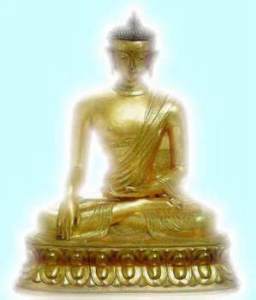
Look upon the world as a bubble, look upon it as a mirage: the king of death does not see him who thus looks down upon the world. Come, look at the glittering world, like unto a royal chariot; the foolish are immersed in it, but the wise do not cling to it. The grasping man is an enemy because he is grasping, because he expects a lot in return whenever he gives a little, because he performs duty only out of fear, and because he only serves his own interests. Better than sovereignty over the earth, better than going to heaven, better than Lordship over all words, is the reward of the first step in holiness. There are four types who should be looked upon as true friends: a man who wants to help you; a man who is a friend in good and bad weather; a man who gives good advice; and a man who is sympathetic. The thoughtless man, even if he can recite a large portion of the Law, but is not a doer of it, has no share in the priesthood, but is like a cowherder counting the cows of others. The man who says only what you like to hear is an enemy because he consents to an evil deed and doesn't consent to a |
|
|
 |
|
|
|
|
|
good one, because he praises you to your face, but runs you down behind your back. If you see an intelligent man who tells you where true treasures are to be found, who shows what is to be avoided, and who administers reproofs, follow that wise man; it will be better, not worse, for those who follow him. |

|
|
|
 |
|
|
|
No matter who you are, no matter how you spend your time, each day you have dozens of opportunities to make a difference in the lives of people around you whom you know, as well as the people you don't know. How? By allowing your natural passion for life to express itself through the silent language of the heart. Your passion acts like an invitation to others, beckoning their own passion to come forth. When you are in love with life, you see the world through the eyes of a lover. You perceive the world through they eyes of passion. Seeing with passionate eyes means noticing the beauty in everything, marveling at the magic in every moment, and looking for the love in everyone. Passion that transcends the body occurs when your whole being is passionate about someone else. Your mind is passionate about his/her mind. Your heart is passionate about his/her heart. Your spirit is pas-sionate about his/her spirit. Every cell in your body vibrates with passion for your beloved. This is the passion of devotion. In the very instant your passion expresses itself, whether through an embrace, a sweet glance, or an act of kindness, you enter into the timeless world of the heart. It does not matter what has happened before. It does not matter what will happen next. All that matters is this moment. All that matters is love. Look passionately for the good in each person. If you look, you will find it. Then, it will not matter if you end up spending only twenty minutes with him/her, or twenty years. The time you share will be a time of love, because you looked for the love, because you found the love. |
|
|
|
 |
|
|
|
"It is possible to indicate one's particular spiritual way of life through external means, such as wearing certain clothes, having a shrine or altar in one's house, doing recitations and chanting. However, these practices are secondary to one's religious or spiritual way of life because all of these activities can be performed by a person who harbors a very negative state of mind. On the other hand, all the virtues of mind, the mental qualities, are genuine spiritual qualities because all of these internal mental qualities cannot exist in a single moment simultaneously with ill feelings or negative states of mind. "Regarding inter-gender relationships, I see two principal types of relationships based on sexual attraction. One form is pure sexual desire in which the motive or impetus is temporary satisfaction, a sort of immediate gratification. But it is not very reliable or stable because the individuals are relating to each other not as people, but rather as objects. In the second type, attraction is not predominantly physical. Rather, there is an underlying respect and appreciation of the value of the other person, based on one's feeling that the other person is kind, nice and gentle. One can therefore accord respect and dignity to that other individual." The Dalai Lama |
|
|
|
 |
|
|
|
There are countless ways of attaining greatness, but any road to reaching one's maximum potential must be built on a bedrock of respect for the individual, a commitment to excellence, and a rejection of mediocrity. Everyone is responsible and no one is to blame. People don't care how much you know until they know how much you care. We make a living by what we get, but we make a life by what we give. How I feel about and behave toward myself is the basic determinant of most of my behavior. If I improve my self-regard, I will find dozens of behaviors change automatically. If, for example, I increase my feelings of self-competence, I will probably be less defensive, less angered by criticism, less devastated if I do not get a raise, less anxious when I go to work, better able to make decisions, less afraid of making decisions, and more able to appreciate and praise other people. Any path is only a path, and there is no affront to oneself or others, in dropping it if that is what your heart tells you. Look at every path closely and deliberately. Try it as many times as you think necessary. Then ask yourself, and yourself alone, one question. "Does this path have a heart?" If it does, the path is good; if it doesn't, it is of no use. Better than a thousand useless words, is one word that brings peace. Better than a thousand useless verses, is one line that brings joy. Better than a thousand useless poems, is one poem that brings love. One day of contemplation, is better than a hundred years of thoughtlessness. One day of wisdom, is better that a hundred years of ignorance. One day of effort, is better than a hundred years of laziness. One moment of reverence for a Master, is better than a hundred years of worship and a thousand sacred rituals. One moment of reverence for a Master, is better than living in the forest a hundred years and tending a thousand sacrificial fires. One moment of reverence for a Master, is better than one hundred years of beauty, happiness, and strength. Christmas trees are cut down without prayers. We need to respect Mother Earth and care for the planet. |

|
|
|
 |
|
|
|
This mind of mine went formerly wandering about as it liked, as it listed, as it pleased; but I shall now hold it thoroughly, as the rider who holds the hook holds in the furious elephant. If one man conquer in battle a thousand times thousand men, and if another conquer him- self, he is the greatest of conquerors. One's own self conquered is better than all other peo- ple; not even a god, a Gandharva, nor Mara with Brahma could change into defeat the vic- tory of a man who has vanquished himself, and always lives under restraint. Well-makers lead the water; fletchers bend the arrow; carpenters bend a log of wood; wise people fashion themselves. As a fletcher makes straight arrows, a wise man makes straight his trembling and unsteady thought, which is difficult to keep, difficult to turn. As a fish taken from its watery home and thrown on the dry ground, our thought trembles all over in order to es-cape the domination of Mara, the tempter. It is good to tame the mind, which is difficult to hold in and flighty, rushing wherever it listeth; a tamed mind brings happiness. Let the wise man guard his thoughts, for they are difficult to perceive, very artful, and they rush wherever they list; thoughts well guarded bring happiness. Whatever a hater may do |
|
|
 |
|
|
|
|
|
to a hater, or an enemy to an enemy, a wrongly directed mind will do us greater mischief. Not a mother, not a father will do so much, nor any other relative; a well-directed mind will do us greater service. Buddha |
|
|
|
 |
|
|
|
The greatest gift is a portion of yourself. Being a role model may not only be the best way to teach; it may be the only way. Albert Schweitzer To be nobody but yourself in a world which is doing its best to make you somebody else, means to fight the hardest battle which any human being can fight and never stop fighting. Self-esteem is the reputation we acquire with ourselves. The greatest motivational act one person can do for another is to listen. |
|
|
|
 |
|
|
|
Never in the history of the world had a scheme of salvation been put forth so simple in its nature, so free from any superhuman agency, so independent of, so even antagonistic to the belief in a soul, the belief in God, and the hope for a future life, it was a turning-point in the religious history of man when a reformer, full of the most earnest moral purpose, and trained in all the intellectual culture of his time, put forth deliberately, and with a knowledge of the opposing views, the doctrine of a salvation to be found here, in this life, in an inward change of heart, to be brought about by perseverance in a mere system of self-culture and of self-control. "Suppose a man, who can see, were to behold the many bubbles on the Ganges (river) as they are drivng along. And he should watch them and carefully examine them. After carefully examining them, they will appear to him as empty, un-real, and insubstantial. In exactly the same way does the monk behold all the bodily forms, feelings, perceptions, mental formations, and states of consciousness whether they be of the past, or the present, or the future, far or near. And he watches them and examines them carefully, and after carefully examining them, they appear to him as empty, void and without Ego" Buddha And, at the end, the Buddha said...."Rebirth (for me) is destroyed, I have completed the holy life, done is what had to be done, there is no more of being for me." Whereupon the Buddha cried out in joy: "My emancipation is assured, this is my last birth, there will be no more re-becoming." |
|
|
|
 |
|
|
|
"When one meditates on mindfulness of the body, reflecting upon the manner in which the body comes into being, and examining the casual conditions, then one will also see the impurities of the body. Then from that perspective, one will find that even those who seem successful in worldly terms are not really objects worthy of envy; they are still within the bondage of suffering and dissatisfaction. The greater the success one enjoys in worldly terms, the more complex the psychological make-up seems to be, because there is a much more complex nexus of hopes and fears, apprehensions and inhibitions. "There is no possibility of happiness and peace while someone is under the leadership of a very negative person. Therefore, reflect upon the fact that you are under the rule of ignorance; ignorance is like a despotic king, and anger and attachment are like his ministers. We live under the tyranny and influence of ignorance, the self-grasping attitude, and also the self-cherishing attitude - factors that all the Buddhas and Bodhisattvas treat as real enemies. "The practice of morality, which means guarding your three doors of body, speech, and mind from indulging in unwholesome activities, equips you with mindfulness and conscientiousness. Therefore, morality is the foundation of the Buddhist path. "There is no way to escape death, it is just like trying to escape when you are surrounded by four great mountains touching the sky. There is no escape from these four mountains of birth, old age, sickness, and death. Aging destroys youth, sickness destroys health, degeneration of life destroys all excellent qualities, and death destroys life. Even if you are a great runner, you cannot run away from death. You cannot stop death with your wealth, through your magic performances or recitation of mantras, or even your medicines. Therefore, it is wise to prepare for your death. "Sexual desire, by definition, wants something: the satisfaction of desire by the possession of the other. To a large extent this is a mental projection, provoked by a certain emotion: we imagine the other in our possession. At the moment of desire, everything seems agreeable and desirable. One sees no obstacle to it, no reason for restraint. The object desired seems to have no defects, to be worthy of all praise. But then everything changes with possession. Once the desire disappears whether it considers itself satisfied, or time passes and weakens it we no longer look at the other in the same way. Some people admit they are stunned by this. Each one discovers the true nature of the other. That is why there are so many broken marriages, quarrels, lawsuits, and so much hatred. "To remain discouraged is not the way of a human being, we are not birds and animals, so it is not enough for us to simply lament and complain but we should use our intelligence and work hard. "If you rely on someone who has lower qualities than yourself, that will lead to your degeneration; if you rely on someone who has qualities similar to yourself, you will stay where you are; and if you rely on someone who has better qualities than yourself, that will help you to achieve sublime status. |
|
|
"We must each lead a way of life with self-awareness and compassion, to do as much as we can. Then, whatever happens, we will have no regrets. "Guilt, according to some scholars, is something that can be overcome. It does not exist in Buddhist terminology. With the Buddha nature, all negative things can be purified. Guilt is incompatible with our thinking, as you are a part of an action but not fully responsible for it. You are just part of the contributing factor. However, in some cases, one must repent, deliberately hold responsibility, have regret, and never commit the mistake again. "When others insult, rebuke, and speak unpleasant words to us, although an intolerable pain arises like a thorn at the heart, if we comprehend the Teachings, then we can recognize the essence-less nature of these words which resemble an echo. So just as when an inanimate object is scolded, we will experience not the slightest mental turmoil." The Dalai Lama |
|
|
|
 |
|
|
|
|
|
 |
|
|
|
Tibet has always attracted the interest of Western man, if only because of its mystery and inaccessibility. Hidden in the remotest parts of the Himalayan range, due north of India and west of China, it is reachable only via tortuous moun-tain passes and was virtually unknown until a half century or so ago, when Westerners first began to penetrate it. For a long time, Tibet remained the Forbidden Land, which permitted no foreigners to enter. What were the Tibetans pro-tecting so jealously? Perhaps many things, but certainly they were protecting their way of life, protecting themselves from "modernization" and "Westernization," those tendencies which, while they brought benefits to many peoples, have also destroyed much of great traditional value. The Tibetans revered their way of life and wanted to be left alone to follow it. A cruel fate has since placed them under the barbaric rule of Communist China. Tibet had traditionally been ruled by monks and priests and the life of the Tibetan people had been oriented towards the Buddhist Dharma. Indeed, vast numbers of the male population were monks and the supreme ruler of the nation, His Holiness The Dalai Lama, is even in exile a force to be reckoned with in the entire Buddhist world. Tibetan Buddhism is extremely complex and intermixed with a host of other beliefs, especially an earlier Tibetan teaching called Bon and a form of Indian Bud-dhism called Tantric Buddhism. This latter teaching has strong "esoteric" elements, meaning it is passed on orally to trained disciples and select initiates. The Buddha himself rejected esotericism and stated he kept nothing back to teach only to a group of developed people. We refer to Tibetan Buddhism generally as "Lamaism," but the word signifies a teaching followed by the majority of the Tibetan priesthood. It countenances many things which may seem strange to us after we have studied the Buddha's life: worship, rites, prayers, the idea of intercession, and other forms of the de-votional life. How could this be, when the Buddha himself deplored dependence on gods? The answer lies in the Maha-yanan deification of what is called "the Buddha-principle." Gautama was a man, they said, but in achieving Buddha- hood, he became a god. And since Gautama Buddha himself admitted that he was the fifth of a line of incarnated Bud-dhas, then it follows that there are five gods to worship. Not only were there five, however, but a veritable host, for the Mahayanists believe that Buddhahood lies latent in each man and that many have reached the stage of Enlightenment, thus also becoming divine in the Buddha-essence. It is their Buddhahood, not they themselves, which is worshipped. Still, inevitably, prayers and temples and rites were established. The Mahayanists took one further step and held out the possibility of intercession. A man who believes firmly enough in the Dharma and who prays fervently enough to the Buddhas can achieve merit, they stated. Of course, this is disputed by the old believers, the Theravadists. Such theolog-ical disputes are not terribly meaningful to the average Buddhist, nor perhaps even to many Buddhist monks. In 1891, an American, Colonel H. S. Olcott, founding president of the Theosophical Society, formulated fourteen Fundamental Buddhist Beliefs, and in the 1940's, Christmas Humphreys of the Buddhist Society in London put together his Princi-ples of Buddhism. Adherents of all schools signified agreement with these points, put down by an American and an Englishman. Yet, this is not strange to the Buddhist, for he would regard the teaching of the Lord Buddha as universal and as having meaning to many in many lands. In recent times, there has grown in the West, a great new interest in Buddhism and the Japanese form of Zen has particularly attracted Westerners. Since the collapse of communism, in-terest in Buddhism has also grown in Eastern Europe, including Russia. While the Occidental world's knowledge of the Dharma is hardly more that a hundred and fifty years old and therefore relatively new, it is probable that more and more Occidentals will be prompted to study the words of Gautama Buddha. They may not thereby become Buddhists, but in broadening their own appreciation of the wisdom of the East, they will benefit from tasting the Buddha's sublime and compassionate Way of self-development. Other "Ways" exist, and it is up to each searching man or woman to find and follow that path which best speaks to them. Whichever they follow, however, it is likely they will encounter in it these universal Buddhist truths: "Cease to do evil, learn to do good, cleanse your own heart; this is the Teaching" (Walter Henry Nelson) Disclaimer: All images and/or articles retain the original copyrights of their original owners. |
|
|
|
Visit our main Buddhism site. More information, images, and, NO pop-ups! |
|
|
 |
|
 |
|
|
 |
|
|
|
|
|
 |
|
|
|
|
|
|
|
|
|
|
|
|
|
Lastl Update: 9/23/05 |
|
|
|
|
|
|
|
|
|
|
|
|
|
|
|