 |
| Page 24A |
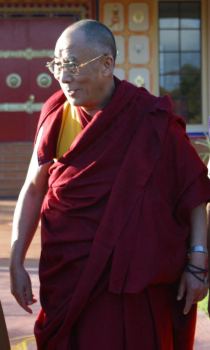 |
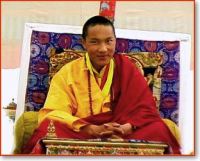
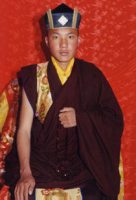
| Why is one of the great spiritual leaders of Tibet still imprisoned in India? He is a virtual prisoner in India. But the Karmapa, one of Tibet's spiritual leaders, is working to free his people. You don't get to see a deity every day. And when you do, you expect a certain solemnity, a white beard. But this god, tall and slim, with finely chiselled features, is still a teenager. He sleeps in a bedroom, not a cloud, and, at 17, hasn't lived long enough to accrue much gravitas. There's a ru- mour that he is about to appear on his balcony, and a crowd of devotees is gathering outside his home, perched high in the foothills of the Himalayas. There are, among others, Tibetan schoolgirls carrying devotional white scarves waiting to catch a glimpse of him, several policemen and a couple of government intelligence officials. A few feet away, one man is armed with an AK-47. The authorities are there not only to protect him and make sure his followers don't get too close, but also to keep him under lock and key. Ugyen Trinley Dorje is the 17th incarnation of the Karma-pa, leader of one of Tibet's four main schools of Buddhism, the influential Karma Kagyu. He occupies a unique position: since his recognition as the 17th Karmapa in 1992, his legitimacy has been acknowledged not only by the Dalai Lama, but also by China. He is the first incarnate lama to be officially recognised by Beijing since 1959, perhaps in deference to historical tradition - previous Karmapas had been gurus to the emperors of China.The Dalai Lama, the focus of all Tibetan groups, is now 67, and when he dies Ugyen will most likely become one of the most influential |
| spiritual and political figures in the world, with a following of millions. Which makeshim, if you like, a kind of deity-in-waiting. UNLIKE other spiritual leaders, Ugyen has no proper home. Imagine the Pope without the Vatican, and you begin to understand his plight. He is exiled from his homeland, Tibet, which he fled three years ago, India finds him an embarrassment, and China, which has occupied Tibet for the past 52 years, crushing Buddhism, feels humiliated by his flight. Far from being a haven of freedom, India has become his prison. His presence there has strained the country's already tense relations with neighbouring China. Unlike monotheistic religions, Buddhism believes that its leading lamas all reveal aspects of divinity. Ugyen is not a god in the sense the West would understand, but nevertheless he attracts worshippers who speak reverently of 'His Holiness' and hang upon his every utterance. 'The status of the Kar-mapa is that of a very high spiritual leader,' he says. 'But I am here, staying in a small guesthouse. I am not even al-lowed to go into the main shrine room without first asking permission. Sometimes I feel so ashamed when people ask me these questions about my circumstances.' The young lama is composed, the only signs of vulnerability are a down-ward gaze and a thoughtful stroking of his head, as if he is struggling to contain his thoughts. Sitting in a simple wood-en chair in his audience chamber, he talks through an interpreter. There are thangkas, or religious hangings, on the walls, as well as a cuckoo clock and an ornamental cockatoo - presents from followers. Getting to him has not been easy. It has taken several months of faxes and telephone calls to his aides simply to set a date. But the real problems start on arrival at Gyuto. Every entrance is guarded, passports are checked, there are body searches, tape recorders are confiscated, photography banned on a whim. Even getting a notebook in has been difficult. The Tibetan monks at Gyuto are almost outnumbered by plain-clothes policemen and armed guards. Once, security staff and lamas shared their meals in the monastery's canteen. Now, thanks to rising tensions, this habit has been dropped. It is far from the life Ugyen expected to lead when he fled Tibet three years ago. 'I escaped to India because I thought it was a free and de-mocratic country,' he says. 'I thought I would be able to see my teachers. In Tibet, I was prevented from seeing them by the Chinese government.' The constant surveillance, however, is only half of his problems. In truth, he doesn't want to be here. He wants to go to the Rumtek monastery in Sikkim, far to the southeast. This is his religious seat in exile. The 16th Karmapa fled there in 1959, bringing with him the main religious relics of the Karma Kagyu school. The 17th incarnation's return is crucial to the survival of the Karmapa lineage and to a tradition of wisdom unbroken for 800 years. It is here that Ugyen will put on the traditional black hat, or Bodhisattva crown, said to be made from the hair of 10,000 celestial beings, and become a true spiritual leader. But Sikkim is a politically sensitive area: India annexed it in the 1970s, and China does not recognise the claim. So far, Ugyen has been unable to go there. 'I've been here for three years, but it has still not been possible for me to go to Rumtek. The situation has not moved on in any way.' Despite his |
 |
| recognition for political reasons. Party officials wooed the boy with expensive toys and visits to China, trying to mould him into a patriotic figure loyal to the Communist party who could one day rival the Dalai Lama. But despite having been in exile for 43 years, the Dalai Lama retains the loyalty of Tibetans as their temporal and spiritual leader. And the young Karmapa showed an increasing defiance to the regime. Once, he horrified his Chinese minders by refusing to prostrate himself before the boy chosen by China as the 11th reincarnation of the Panchen Lama. When China denied him access to his two trusted teachers, Tai Situ Rinpoche and Gyaltsab Rinpoche, resident in India, because of their closeness to the Dalai Lama, Ugyen decided to flee. Banning contact with teachers threatened the continuation of the Karmapa lineage. According to Tibetan Buddhist belief, there is is only so much the lama can learn from the writings and teachings left by his previous incarnations, so high-ranking teachers are crucial links in an orally transmitted tra-dition, teaching the new Karmapa the ancient philosophies and scriptures. 'The decision to leave my homeland, monas-tery, monks, parents, family and the Tibetan people was entirely my own - nobody told me to go and nobody asked me to come,' he says. His flight began from his religious seat at Tsurphu, about 40 miles west of Lhasa, Tibet's capital, at the end of 1999. He announced that he was going on a retreat, and two monks, Lama Tsultrim and Lama Tsewang, who ac-companied him on his journey, told everyone they were going on a trip - strategies that ensured a delay in their being discovered. During the evening, two of the monastic security guards in charge of his quarters were diverted by monks in a prearranged plan. Around 10.30pm, Ugyen, having swapped his robes for a baseball cap, jacket, shirt and trousers, climbed out of his bedroom window and leapt to the ground, where a Jeep was waiting. At one point, Ugyen and his com-panions had to get out of their car and continue on foot while it passed through an army checkpoint. It was pitch black and they had to feel their way along the mountainside. Blind and stumbling, they almost gave up hope of finding the vehicle again until the moon emerged from behind clouds for a second to illuminate the Jeep. Another anxious moment came when they sought shelter in a devout Tibetan home. There were many photographs of the 17th Karmapa on the shrine, and the monks were worried that he might be identified, but the family did not recognise the young man in a baseball cap as their religious leader. Further on, their route took them past a Chinese military camp where, miracu-lously, the guards failed to spot them. Then they trekked for more than 30 hours over Nepalese territory, travelling part of the way by helicopter. They crossed the border into India at Bihar and arrived in Dharamsala in the early morning of January 5, 2000, where Ugyen met the Dalai Lama for the first time. 'My joy knew no bounds,' he says. Still, the priva-tions continue. He has access now to his teachers, but to little else. He cannot walk freely in the grounds. He must ask permission to pray in the shrine. He cannot ever be alone with visitors. And though his teacher, Tai Situ Rinpoche, is at a monastery just two hours away, he may not visit him. He is allowed the occasional pilgrimage to sacred sites and he sees the Dalai Lama at least five times a year. His aides believe the government finds him a diplomatic embarrassment, a figure who could scupper India's relations with China. 'On the one hand, India wants to prevent his assassination, which they feel is a risk, but they also want to prevent him escaping from Gyuto,' says a security official for the Tibetan government in exile. 'It seems China is urging the Indian authorities to 'protect' the Karmapa, which means to keep him under their control.' Whatever their motives, it's too late to silence him. The Dalai Lama is spreading the word. 'Even at such a young age, the Karmapa is so intelligent, so deeply devoted to the Dharma (Tibetan Buddhist philosophy) and very gifted, particularly in writing poetry,' he has said. 'The first time we met he explained he has two main priori-ties: to serve the Dharma and to serve the Tibetan people. I was very impressed by this statement.' And if that weren't enough, Hollywood has joined in. Ugyen has just met the actor Richard Gere, a practising Buddhist who has long es-poused the Tibetan cause. 'He's quite dedicated to his religious practice,' says Ugyen. 'I'm not sure whether I've seen any of his films because we don't have a television in Gyuto. But when I'm allowed to go on a pilgrimage, we generally stay in five-star hotels, and I really enjoy watching all the different TV channels in the room.' He is, after all, a religious |
| frustration, Ugyen remains calm, displaying a maturity beyond his years. He was only 14 when he risked his life to flee Tibet. Evading Chinese security, he made an eight-day journey - trekking on foot across some of the world's highest mountain passes, riding a horse, travelling in a Jeep, and then a helicopter and a train, to Dharamsala, the base of the Dalai Lama and the Tibetan government in exile. Ugyen Trinley Dorje was born to a nomad family in eastern Tibet. A number of magical portents were said to have ac-companied his birth, including rainbows over the family's tent the night before he was born. As a child, he was given the name Apo Gaga ('Happy, happy brother') by his sis-ter. He was said to be able to tell people where to find lost sheep or cattle, and would often build toy monasteries from mud and stone. China, a secular state, approved his |
 |
| leader for the 21st century. He may be a 10th-level Bodhisattva - one at the threshold of En-lightenment who works for the benefit of all beings - but he's also pretty proficient on a PlayStation. The senior monks say he beats them every time, skilfully downing virtual planes and crashing cars with gusto. 'I really enjoy rap music, though I don't understand the words yet,' Ugyen says. Then he pauses. 'I also enjoy some Chinese instrumental music. Music is meant to make you happy, but I sometimes find I can't listen to it, because it makes me sad.' He finds in poetry and painting a freedom that is missing from his real life. And in a distinct tone of wistfulness, he says: 'The westerners I've met have lots of freedom; I find them to be very open-minded and easy-going.' He has a laptop computer, but communications at Gyuto are basic and there is no access to the internet. Like the Dalai Lama, a well-known ambassa-dor for world peace, Ugyen is keen to keep up with world news and eagerly questions his west-ern visitors on the latest developments. THERE IS another layer to Ugyen's story, one that all |
| the diplomacy in the world won't solve. A pawn in the power play between India and China, he is also the victim of in-fighting within his own Buddhist school. Depending on who you speak to, he isn't the 17th Karmapa. A rival group led by a senior religious leader, Shamar Rinpoche, claims that another 17-year-old Tibetan, Thaye Dorje, is the true rein-carnation; the continuing row has spilt over into violence at Rumtek at least twice. Shamar Rinpoche was voted out of power by most Karma Kagyu organisations in 1992, but he still wields some influence with the Indian authorities, and there are fears of instability in Sikkim between the two factions, should Ugyen be allowed to go there. It doesn't stop there. As well as the two disputed 17th Karmapas, there are two Panchen Lamas. The one recognised by the Dalai Lama is languishing in Chinese custody, his whereabouts unknown; the one the Chinese have nominated is naturally not rec-ognised by Tibetans. No wonder both the Dalai Lama and Ugyen - from quite different schools - have called for unity among the differing Buddhist groups. Ugyen's predecessors all steered clear of politics, and he too is reluctant to be in-volved. Can he envisage talks with Beijing one day to help resolve the Tibet issue? 'I'm not claiming I have the ability to do this right now,' he says. 'But I accept that this idea is being expressed by people. Yes, sometimes I feel that this might happen.' The threat to Tibetan religion and culture has never been more extreme. Monks, nuns and spiritual leaders risk torture and imprisonment. Nearly 3,000 Tibetans, many from various religious orders, flee into exile every year. The Buddhist religion is bound up with Tibetan national identity. Following the Chinese invasion in 1949-1950, thousands of Tibetan monasteries and nunneries were destroyed. T he Dalai Lama fled to India in 1959, and in the 1990s, China stepped up efforts to undermine his influence. Ugyen's concern for the refugees was evident at a recent audience for those who had just arrived. 'The main principles of our religion and culture are communicated through the Tibetan language and culture, and so we should try to sincerely preserve [it],' he told them. 'At the present time, it is difficult - we are at a crucial point in our history. But we should not despair, we should try to feel hope and to think of our future.' Among his audience were two nuns, Choeyang Kunsang and Passang Lhamo, who escaped from Tibet five months after Ugyen. Choeyang Kunsang, 21, endured torture and solitary confinement during her four-year prison sentence in Lhasa's notorious Drapchi jail. She recalls hearing the news of his escape. 'We were all very happy, know-ing His Holiness would have the freedom to practise his religion. For the young generation, born after Tibet lost its in-dependence, the Karmapa was one of the few High Lamas left, and it was essential that he should preserve his lineage.' Choeyang trekked across the Himalayas with her friend Passang, 20, who had been sentenced to five years' jail after staging a peaceful demonstration. She underwent months of severe maltreatment at Drapchi prison. 'We would be forced to stand in the sun without moving and talking for the whole day,' she remembers. 'The guards would put books or cups of water on our heads, and when the book fell or when some water was spilt, then you would be beaten. If you helped someone next to you who had fallen then you would both be beaten. In the winter we'd have to stand all day barefoot on icy concrete. Sometimes they made us run around the prison courtyard all day long. By the end of the day most of us would have collapsed, unable to move any more.' During the audience, Passang sits in silence, her hands folded in prayer, appearing to be entirely at peace. 'In Tibet, the Karmapa was the only person we could put our trust in, our only source of hope. When I saw him first in exile, I felt a great sadness as well as happiness. It's like when you meet your mother for the first time after a long separation; you feel happy but also sad about being apart for so long. We are far away from home, but the Karmapa gives us inspiration to continue with our lives.' Ugyen's situation may be difficult, but it is not hopeless. While the Indian government declines to comment on the situation, there are signs that his presence on Indian soil is helping to change politicians' attitudes little by little.The chief minister of Sikkim has urged the government to allow the Karmapa to travel there, while Ugyen himself is reaching a wider community, from Hollywood stars such as Richard Gere to ordinary Indian devotees. Even the Indian security police at Gyuto refer to him as 'guru-ji,' a term of respect for a teacher. Recently, the influential Buddhist organisation in India, the Maha Bodhi Society, invited him to be their guest of honour at a religious ceremony, while he has officiated at the wedding of a member of an Indian business clan that owns the Oberoi chain of resorts. Unless India changes its policy, it may be years before he can fulfil his destiny. Meanwhile, an increasingly impatient Ugyen is practising acceptance. And that in itself is a very Buddhist accomplishment. (By Katharine Saunders January 9, 2003) |
 |
 |
| April 18, 2004 |
| The Great Passing... "My years have now come to their close, there is nothing remaining of my life. Leaving you now, I shall go. I have taken ref-uge in the self. O earnest bhikshus, be assiduous; be truly mindful, hold fast to the discipline. By your thinking, make your hearts truly onepointed, keep your hearts steady. Those who are assiduous in this Dharma and discipline will throw off the cycle of birth and death, and bring about the end of suffer-ing." Mahaparinibbana Suttanta After his realization, the Buddha walked through the territory of the Ganges basin from town to town, village to village for more than forty years, giving his teachings to the people of northern In-dia. To establish a historical sequence, however, is extremely difficult, in-as- |
| much as all that any Buddhist scripture records is that the Buddha at a certain time, at a certain place, to certain people taught certain things. We can however learn through the Mahaparinibbana-suttanta scripture a fair amount of detail about events just before and just after the end of his life, at the age of just over eighty. The Pali word nibbana, or nirva-na in Sanskrit, originally had the meaning to blow out, as for instance a lamp, and by a shift of meaning it came to be used as a word to express the death of the Buddha. Besides the Pali version of this text, fragments of the Sanskrit ver-sion have been found in Central Asia, and there is a Tibetan translation and five translations into Chinese. The ac-counts they give have roughly the same content (although there are a fair number of additions in the various texts) and they may be taken to be close to the historical and geographical facts. We shall now try to retrace the last journey of the Buddha as depicted in this scripture. The Buddha Old and Weak "I am old and weak. I have reached old age, full eighty years. Just as, Ananda, an old cart goes along held together by thongs, so the body of the Tathagata goes, held together by thongs." This was said by the Buddha during his last journey, when he stopped at Bamboo Forest Village (Venugramaka) near Vaishali for his last rainy season retreat. He had barely recovered from a severe illness, and com-pared his laborious gait to a broken-down old cart, tied together with leather thongs and so just able to go forward. The Beginning of the Journey Facing his eightieth year, the Buddha left the Vulture Peak of Rajagriha behind him and took the road to the north. It seems he was making for Shravasti and its Jeta Park vihara, and then Kapilavastu his birthplace, with his attendant Ananda going the whole way with him. The scripture says in places that he went "with a great number of bhikshus," but there could have been only few companions. According to the Pali version, the Buddha after leaving Vulture Peak went to the house of the lord of Ambalatthika Park and then stayed in the Pavarika (mango forest) at Nalanda. It was only much later that Nalanda boasted its magnificent temple complexes. At that time it would have been no more than a hamlet five kilometres north of Rajagriha. Patali Village and the Ganges Then the Buddha with Ananda went to the village of Patali on the south bank of the Ganges. This was the place which would soon become Pataliputra, capital of Magadha. The lay followers at Patali village, hearing of the arrival of the Buddha, invited him and his disciples to a 'rest house.' Here the Buddha gave a discourse to the villagers until nightfall, inspired them and sent them back home rejoicing, as tradition says. Again, in this place he gave teaching to two ministers of the kingdom of Magadha who were preparing fortifications in the war against the Vriji peoples of the north bank of the river. Then the Buddha crossed the Ganges, which was in flood, with the water so high that the crows on the bank could drink from it. It is said that the gate by which the Buddha went out came to be called Gotama gate, and the place where he crossed the Gotama crossing-place. The present-day city of Patna, the capital of Bihar state, stretches far to the east and west along the south bank of the Ganges, covering any traces of old Pataliputra. In the eastern part of modern Patna, down river, have been excavated the remains of the great palace of the Maurya period, with its round pillars. The western part, facing up river, seems to have been in ancient times the bed of the Son river, so it can be surmised that in the time of the Buddha, Patali village was the down-river part. As to the Gotama gate and Gotama crossing-place, there is one theory that this is the present Gai Ghat (the bank of the bull - and Gotama means a fine bull), but it is difficult to identify the actual place. The flow of the Ganges here is of considerable volume even in the dry seasons, and the ferries to the other shore take about one hour and a half in their diagonal crossing. In the time of the Buddha, the crossing would have been no easy matter. Probably it would have been in a little boat, taking every advantage of wind and cur-rent, that went via the islands in the middle of the stream. The Buddhist scriptures record the Buddha's superhuman powers, describing how, while other people were seeking a boat or raft, "the Buddha, as (easily as) a wrestler might stretch out his bent arm, or bend his outstretched arm, disappeared from the hither side of the Ganges and appeared on the far bank." The Villages Koti and Nadika Where the Buddha landed on the north bank after crossing the Ganges is not specified at all in the scriptures. Only in The Buddhist Record of the Western World by Hiuen Tsang is it said that he walked a little to the north-west along the northern bank and there was the Shvetapura (White Castle) monastery. I Tsing in his Record of the High Priests Search for the Dharma in the Western Lands takes this as a temple of Vaishali Buddhists, and adds that there was a road here which led from India to Nepal, so that it can be supposed that the place became prosperous afterwards. Today there is a theory that a little village now called Checher was probably the former Shvetapura. The village is a little east (downstream) from Patna on the other bank, and there are ruins of a number of stupas ranged near the bank. Even today a ferryboat plies between this place and Patna. In the Hindu temple on the bank a Buddha image is enshrined, and gold coins have been found there. In the scriptures, the first village of the north bank that appears is Koti. Its location is not clear. There is a view that it was on the huge sand island in the mid-dle of the Ganges. But it is usually supposed that it was near the confluence of five rivers, the Ganges, the Gandak, the Son and two others. Next the Buddha went to the brick hall of Nadika village, where he stopped and gave a sermon, af-ter which he went towards Vaishali. About 25 km south of Vaishali at the village of Gotaro in the ricefields by the Gan-dak is a mound made of heaped-up broken bricks something like the ruins of a stupa, and there are those who main-tain that this perhaps is the ruins of the brick hall of Nadika village. Vaishali Vaishali was the largest and most impor- |
| this place is sacred, as the birthplace of their founder Mahavira, and they continue to hold a great festival here each year on his birthday. There are many incidents related about the Buddha's stop at Vaishali on this his last journey. One of the highest class of courtesans of the town, Amrapali, heard of the arrival of the Buddha at the mango grove some distance from the city which she herself had donated to the Sangha, and with 'carriages beautifully decorated' she set out to meet him. After listening to his discourse she invited the Buddha and his disciples to a meal. Then some young people of the Licchavis, also with beautifully ornamented carriages, set out to the place where the Buddha was. On the way they met with the returning carriage of Amrapali and learned that the Buddha had accepted her invitation. With 'a hundred thousand gold pieces' they urged her to surrender the right to them, but she replied that she would not do so even for the whole land of Vaishali. The Buddha acknowledged her claim and went in accordance with her invitation. The Self as the Lamp, the Dharma as the Lamp The Buddha passed the last rainy season retreat at a village in the bam-boo forest near Vaishali. It seems that here the Buddha said to his disciples, 'Stay for the retreat near Vaishali, depend-ing on friends, on acquaintances, or on close relatives' and took only Ananda with him to Bamboo Forest village. During this retreat he contracted a serious illness 'so grave that he was near to death'. The Buddha endured it patiently but Ananda was overwhelmed with anxiety and earnestly asked, "If the Buddha dies, on what shall we rely?" To this the Buddha replied, "I have taught the Dharma entire, without distinctions of an inner and an outer teaching; in my teach-ing there is no 'closed fist of the teacher,' nothing concealed from the disciples. There is no thought in me, 'The bhik-shus depend on me' or 'I am the guide of the bhikshus.'" The Buddha continued, "Even though I enter Nirvana, if those who are bhikshus know themselves, know their own hearts, know Dharma, sweep away craving and depression and sor-row, and continue their spiritual practice placing reliance on the self like an island (in mid-stream) and not placing re-liance on another, placing reliance on the Dharma like an island and not on anything else, they will be able to attain the supreme state. These instructions presage his Nirvana. Here the word dipa, island, can have the sense of lamp, and in the Chinese translations it is rendered 'make the self the lamp, make dharma the lamp." The Prediction of Nirvana At the end of the rainy season retreat, the Buddha went walking to beg in Vaishali, and during the day he rested at a num-ber of chaityas (holy trees or holy spots) of which there had been many in Vaishali even before the advent of Buddhism. Walking in India today one sees here and there some old tree or rock surrounded by a low stone or concrete enclosure where the particular god is worshipped, offerings are made or perhaps people are resting. The word chaitya later came to have the sense of a holy mausoleum or shrine, but originally it was a 'holy place in the open,' what one could call an open-air shrine. One day when the Buddha was under the Chapara holy tree, having sent Ananda away, there appeared to him that devil who, as we have seen, tempted him in various ways on the occasions of his leaving home, his spiritual practice and his realization. He urged the Buddha to enter Nirvana at once. The Buddha replied, "Till the renunciate bhikshus and lay disciples and believers have well controlled their selves, are clear-seeing, pay good heed to the teach-ings, perform spiritual practice rightly, keep to what their teacher says, put down any criticisms of what the teacher teaches, I will not enter Nirvana." The evil spirit urged him again and again to do so, on the ground that the teachings of the Buddha were being propagated by many people and that there was no cause for anxiety as to the future. Finally the Buddha predicted his own death in three months. The Departure from Vaishali The Buddha called together the dis-ciples who had been staying near Vaishali and told them that nothing more of his life remained. He left the city and went through Bhanda, Hatthi and other villages and then set his face towards Kushinagara by way of Pava. As he was leaving, the Buddha turned to Ananda and said, "This is the last time I shall see Vaishali," and then he turned as an elephant turns to look - he turned right round to gaze at it. The phrase in the scripture 'as an elephant turns to look' means that a comparison is being made with the way a great elephant, when it looks back to see something behind it, slowly turns its whole body; in the simile the movement of the aged and still convalescent body of the Buddha is skil-fully depicted. In the Chinese it is 'As a king of elephants turns its body right round, he looked over the castle city of Vaishali.' Hiuen Tsang remembered this as he stood by the side of the stupa built at the place and recalled the time of the Buddha's going. The Remains at Vaishali The remains at Vaishali are scattered in an area six to eight km in radius in Basarh and neighbouring villages situated east of the river Gandak and about 30 km north-north-west after crossing the Ganges from Patna. Of the threefold fortifications round the town of which the Buddhist scriptures speak, two have been discovered. The ruins of a palace in the centre of the 'circumference of 4-5 li' reported by Hiuen Tsang are now a mound enclosed by earth walls and a moat in a rectangle; it measures south to north about 515 metres and east to west about 240 metres. It is today called Raja Vishala ka Garh (Palace of the King of Vaishali). Diggings have brought up earthenware, terracottas, coins and so on. They are characteristic of all the different periods in the one thousand years or so from the time of the Buddha to the last stages of the Gupta dynasty in about 600 ce, so that it is clear that people lived here and flourished during that time. The remains of the vihara noted by Hiuen Tsang in his pilgrimage as con-nected with the Sammatiya sect have not yet been found, but Abhishekha Pushkarni lake, where the Licchavi aristocra-cy used to purify themselves, has been identified as Kharauna Pokhar, sited about one kilometre north-west of the pal-ace ruins. Nearby is a stupa presumably erected by the Licchavi people, and in recent years, as will be explained, some relics, apparently of the Buddha, have been found there. About three km north-north-west of the palace ruins there is an Ashokan stone pillar with a single lion on top but no inscription and also a stupa and a pond. This is pointed out as the place where monkeys assembled and made an offering of honey to the Buddha. This story appears in Chinese trans-lations of works such as Vinaya of the Mulasarvastivadin sect, and it also appears in the section on Mathura in the Bud-dhist Record of the Western World. The tradition that the Buddha's preaching extended beyond the human world seems to have existed from ancient times. Whenever he stopped in Vaishali the Buddha stayed at the Storeyed Hall, which, ac-cording to the Chinese version of the Samyutta Nikaya, was on the banks of the Markata-hrada, the pond excavated by monkeys for the Buddha. No remains of this famous hall have yet been identified. There is also the supposed location of the home of the courtesan Amrapali and the mango grove, but whether it is authentic or not remains an open question. An account of how the Buddha left Vaishali and the people came to see him off but then would not turn back is found in the Chinese scriptures and in Fa Hien. Hiuen Tsang puts the place of the final separation at 50-60 li north-west of the palace ruins, but just where it was is quite unknown. There is only the tradition that the Buddha, in order to make the Licchavis accept the parting, by supernatural power caused a great river to appear between them, and it may be an indi-cation that this was when the Buddha crossed the Gandak river, north of Vaishali. There are ruins of a stupa at Kesari-ya, about 48 km northwest of Vaishali, which could possibly be identified with the great stupa which Hiuen Tsang speaks of as marking the place of the final separation, but it is rather too distant for that. Outline of the Journey The route |
 |
| tant city of the Licchavi people, and in the time of the Buddha it was very prosperous. Its origin goes back to the Vishala Puri founded by Vishala, one of the descendants of the King Ikshvaku who appears in the Ramayana. In the fifth or sixth century bce, when the Buddha lived, the re-publican system was adopted and the city was prosperous as one of the most important commer-cial centres in northern India. Then it fell under the dominion of Ajatashatru the king of Ma-gadha. After the Western era, it passed through Kushan and later Saka rule, and it was one of the cities which still flourished up to the Gupta period. According to the Buddhist scriptures, Vaishali was surrounded by a triple rampart with watchtowers and city gates. The people's homes were separated into various residential quarters, and Jain scriptures record that there was a Kshatriya, a Brahmin and a Vanik quarter. Many viharas were built, and about a hundred years after the Buddha's Nirvana, the Second Council on the Buddhist scriptures was held at this place. The name of the city was therefore widely known in the later centuries. For the Jains too |
 |
| which the Buddha followed in his last journey from Rajagriha towards Kushinagara - crossing the Ganges at Patali village, passing Vaishali and reaching the ford across the Gandak river - is roughly along the present-day road running from Patna by Muzaffarpur out to Raxaul to link India with Nepal, but a little closer to the Gandak. We can infer this from the fact that the stone pillars of Ashoka on the north bank of the Ganges and the Vaishali, the Laurya Araraj, the Laurya Nandangarh, and the Rampurva rivers are aligned along the course of the Gandak almost due north. Versions of the Mahaparinirvana Sutra all give details of the names of vil-lages, towns and rivers by which the Buddha passed between Patali village and Kushinagara, but there is a good deal of variance among the accounts. For instance the Pali text the Mahaparinib-bana Suttanta says that beyond Vaishali the Buddha passed the villages Beluva and Bhanda and then went on to Hatthi, Amba and Jambu villages, but in the Sanskrit fragments there appear after Vaishali the names of Drona and three other villages, and moreover the order of arrival at |
| the villages is reversed. Chunda's Offering The Buddha soon came to the town of Pava which is near Kushinagara, and he stayed in the mango garden of Chunda, son of a smith. He accepted a dish of sukara-maddava, a kind of mushroom, and became seriously ill. In the scriptures it says that a stream of blood gushed out and that a terrible agony brought him near to death. Presumably the illness was accompanied by severe diarrhoea. The word sukara-maddava can also mean pork, and many Western scholars take it that the meal which was offered on this occasion was in fact pork meat. Peaceful Passing Away of the Buddha Beneath Sala Trees Overruling the pains of illness, the Buddha accompanied by Ananda came to Kushinagara and went into the wood of sala trees belonging to Upavattana of the Malla people. The Buddha said, "Ananda, spread for me a bed on the ground between two sala trees, with the head to the north. I am tired and I will lie down on my side." When the bed was prepared he lay down on his right side, laying one leg on the other, entered meditation and so passed away - thus the tradition. His final words for Ananda and the bhikshus were: "Imper-manent are all compounded things. Strive on Heedfully." This was in the middle of the night on the fifteenth day of the second month, and the end was perfectly peaceful. How great was the grief and lamentation of his followers can be seen from the descriptions in the Buddhist scriptures: 'There was a great shaking of the earth, the hair of the people stood on end with terror, and in the sky the thunder drum of heaven resounded.' Among the bhikshus, those who had com-pleted their spiritual training firmly registered grief with the words "All that lives will perish, and even the Buddha is no exception," but those who had not yet reached that state "stretched out their arms and wept, or fell rolling on to the earth like broken rocks." This brings vividly before the mind the two attitudes towards human feelings when a great teacher departs. On the one side there is praise for total suppression of the grief by holding to the principle of truth, but surely this does not mean that those who threw themselves wholly into weeping, accepting the grief for what it was, can be criticized as foolish. It was in this way that they showed their sincerity of feeling as human beings. The pair of sala trees on each side of the dying Buddha's bed are often mentioned in literature later; even in the medieval epic of Japan, Heike Monogatari, a verse at the beginning alludes to the story with the words 'The changing colour of the flowers of the two sala trees teaches the truth that what flourishes must also decline. In the scriptures it is said that at that time the two sala trees put forth flowers out of season, and all those flowers were in full bloom. In this way they changed their nature as their offering to the Buddha, and from the skies heavenly mandarava flowers and sandal perfumes were poured upon the body of the Buddha. The Nirvana of the Buddha was perfect peace. An old verse, said to have been com-posed by the god Brahma, describes it: 'All that lives in the world In the end must give up the body. As even the man to whom none in the world can compare, Such a teacher, so powerful in spiritual practice, The man of realization - even he has passed away.' The Funeral With the dawn, Ananda bore the news of the death of the Buddha to the people of Kushinagara. The Mallas, men and their sons and daughters and their wives, were frightened and sorrowful. Soon, bearing incense and flowers, with many musical instruments and 500 layers of cloth, they assembled at the sala trees. There they paid reverence for six days to the body of the Buddha with dances and songs and music and flowers and in-cense, stretching out a canopy overhead and bringing mandarava flowers in offering. It may seem strange to have dancing and music when mourning for the dead, but in a Hindu funeral to this day, and particularly when it is that of an elderly person, the procession goes to the crematorium by the river bank chanting the scriptures in a loud voice or playing musical instruments, which seems to be this same ancient custom. 'Wrapped in 500 layers of alternate new cloth and hemp cloth', the body of the Buddha was placed in an iron coffin filled with oil, and on the seventh day 'eight chiefs of the Malla people, their heads washed and in new clothes', carried it through the north gate into the town of Kushinagara and then out through the east gate to Makutabandhana Vihara (temple of the heavenly crown) to the east of the city, where it was enshrined. Here they waited for the arrival of the disciple Mahakashyapa, and then they cre-mated the body on a pyre of fragrant wood. Mahakashyapa with 500 of the disciples, on the way from Pava to Kushina-gara, had met an Ajivika ascetic carrying mandarava flowers, who told them of the death of the Buddha. Alhough the death was a natural one, it created a great commotion among the disciples. There were those such as the old bhikshu Subhadda who had come in the train of Mahakashyapa who blurted out, 'Our teacher the Buddha, the great shramana, is dead. Now there is no one to impose those tiresome restrictions. Cease your weeping: from today we can do as we like, and need not do what we do not like - we shall be free in what we do', and he began to urge this on the others. The Chinese scripture says that Mahakashyapa, on hearing this, was not pleased; there are other instances of his displeas-ure at monks of extreme tendencies. Division of the Ashes and Erection of Stupas The ashes (sharira) of the Buddha were divided up into eight parts, and eight stupas built for them - such is the old tradition from early days. The Pali, Sanskrit and Chinese scriptures vary somewhat in their accounts, but it is probably right to accept the fact of the divi-sion and the stupa-building as historical. Hearing the report of the death, Ajatashatru king of Magadha, the Licchavi people of Vaishali and others sent envoys to the Mallas of Kushinagara demanding a part of the Buddha's remains, but the Malla people refused them. A dispute arose over the question of the division of the Buddha's ashes, but in the end they were apportioned out among the following parties, each of whom built a stupa for them in their respective territor-ies: Ajatashatru king of Magadha the Licchavi people of Vaishali the Shakya people of Kapilavastu the Buli people of Allakappa the Koliya people of Ramagrama the Brahmins of Vethadvipa the Malla people of Pava the Malla people of Kushinagara. The division was made by a Brahmin named Drona, who took the urn in which the ashes had been put. The Mauliyas of Pippalivana, who came too late took some ashes still left. Thus there were eight stupas built for the ashes, one for the urn, and another for the remnant of the ashes taken by the Mauliyas. Of the original eight stupas which were built, only two are more or less clearly known to us today. One is the ruin of a great stupa at Piprahwa, which has already been mentioned; it is said that the ashes recovered from it are the portions which were enshrined by the Shakya people of Kapilavastu. The other is the ruin of a stupa near Abhisheka Pushkarni lake. An urn recovered there in 1957 by Dr Altekar had no inscription, but from its situation when dug up and the style of construction of the stupa, it is judged to date from the time of the Buddha. But there were no bone fragments at all in it, only ashes. There are however, differing opinions about even these two; and as to the remaining ones there is no clue now to be found. The Remains at Kushinagara The remains at Kushinagara are dotted about at the village of Kasia, over 50 km beyond dense woods of sala trees which still stand in the midst of the rice fields east of Gorakhpur. Behind the Nirvana Temple is a stupa enshrining a huge nirvana image over six metres long contributed by the devout Haribala at the beginning of the fifth century ce, and from it was recovered a copper plate with an inscription to the effect that this was the Nirvana Chaitya. In front of the Nirvana Temple are a pair of sala trees with great oval leaves. The copper plate inscription does not contain the word Kushinagara, so there have been varying opinions about the identification, but today the prevailing view is that this is indeed the place of the Buddha's entry into Nirvana. About 1.5 km east of the Nirvana Temple is the Ramabhar stupa, identified as the ruins of Makutabandhana where the cremation took place. A little stream running by the stupa is said to be very likely the Hiranyavati river in which traditionally Buddha bathed for the last time. Then again about four km further to the east is a stream identified as the Kakuttha river; when the sick and fatigued Bud- dha was looking for some water on the way from Pava to Kushinagara, it flowed clear and pure for him although 500 merchant caravans had just gone through it. When one stands on Ramabhar stupa and watches the clouds streaming past in the sky, the more than 2,500 years seems but a moment, and there is a vivid sense of the death of the Buddha and the greatness that is India. (Translated from Japanese by Trevor Leggett) Disclaimer: All images and articles retain the original copyrights of their original owners. |
 |
 |
 |
| Visit our Main Site. More information and more images and NO pop-ups. |
 |