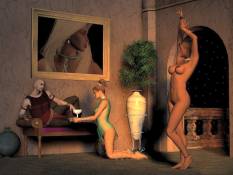
Drinks
Ale:
The Forkbeard himself now, from a wooden keg, poured a great tankard of ale, which must have been of the measure of five gallons. Over this he then closed his fist. It was the sign of the hammer, the sign of Thor. The tankard then, with two great bronze handles, was passed from hands to hands among the rowers. The men threw back their heads and, the liquid spilling down their bodies, drank ale. It was the victory ale.
---Marauders of Gor, p 82
The Forkbeard greets you! shouted Ivar. I blinked. The hall was light. I had not understood it to be so large. At the tables, lifting ale and knives to the Forkbeard were more than a thousand men.
---Marauders of Gor, p 194
Bazi tea:
Tea is extremely important to the nomads. It is served hot and highly sugared. It gives strength then, in virtue of the sugar, and cools them, by making them sweat, as well as stimulating them. It is drunk three small cups at a time, carefully measured.
---Tribesmen of Gor, p 38
Is it ready? I asked. I looked at the tiny copper kettle on the small stand. A tiny kaiila dung fire burned under it. A small, heavy, curved glass was nearby, on a flat box, which would hold some two ounces of the tea. Bazi tea is drunk in tiny glasses, usually three at a time, carefully measured. She did not make herself tea, of course... She lifted the kettle from the fire and, carefully, poured me a tiny glass of tea.
---Tribesmen of Gor, p 139
Blackwine:
I had heard of black wine, but had never had any. It is drunk in Thentis, but I had never heard of it being much drunk in other Gorean cities...Then I picked up one of the thick, heavy clay bowls...It was extremely strong, and bitter, but it was hot, and, unmistakably, it was coffee.
---Assassins of Gor, p 106
Too, I had brought up a small bowl of powdered bosk milk. We had finished the creams last night and, in any event, it was unlikely they would have lasted the night. If I had wanted creams I would have had to have gone to the market.
---Guardsman of Gor, p 295
'Second slave,' I told her, which, among the river towns, and in certain cities, particularly in the north, is a way of indicating that I would take the black wine without creams or sugars, and as it came from the pouring vessel, which, of course, in these areas, is handled by the "second slave," the first slave being the girl who puts down the cups, takes the orders and sees that the beverage is prepared according to the preferences of the one who is being served.
The expression "second slave," incidentally, serves to indicate that one does not wish creams or sugars with one's black wine, even if only one girl is serving.
---Guardsman of Gor, pp 244-245
Chocolate:
This is warmed chocolate," I said, pleased. It was very rich and creamy. "Yes, Mistress," said the girl. "It is very good," I said. "Thank you, Mistress," she said. "Is it from Earth?" I asked. "Not directly," she said. "Many things here, of course, ultimately have an Earth origin. It is not improbable that the beans from which the first cacao trees on this world were grown were brought from Earth." "Do the trees grow near here?" I asked. "No Mistress," she said, "we obtain the beans from which the chocolate is made, from Cosian merchants, who in turn, obtain them in the tropics.
---Kajira of Gor, p 61
Falarian:
Among these petitioners came one fellow bringing with him the promise of a gift of wine, a wine supposedly secret, the rare Falarian, a wine only rumored among collectors to exist, a wine supposedly so rare and precious that its cost might purchase a city.
---Mercenaries of Gor, 15:158
Fermented milk curds:
By one fire I could see a squat Tuchuk, hands on his hips, dancing and stamping about by himself, drunk on fermented milk curds, dancing, according to Kamchak, to please the sky.
---Nomads of Gor, p 28
Ka-la-na:
Do you know the wine? I asked.
No, she said.
I turned the bottle so that she might read the label. It was a small bottle of Boleto's Nectar of the Public Slave Gardens. Boleto is a well-known winegrower from the vicinity of Ar. He is famous for the production of a large number of reasonably good medium-grade ka-la-nas. This was one of the major wines, and perhaps the best, served in Ar's public slave gardens: indeed, it had originally been comissioned for that market: hence the name.
---Mercenaries of Gor, 25:360
I turned and, among the furnishings of the tent, found a bottle of Ka-la-na, of good vintage, from the vineyards of Ar, the loot of a caravan raid. I then took the wine, with a small copper bowl, and a black, red-rimmed wine crater, to the side of the fire.
---Captive of Gor. p 331
...and drops of a red, winelike drink made from the fruit of the Ka-la-na tree.
---Tarnsman of Gor, p 68
Kal-da:
Kal-da is a hot drink, almost scalding, made of diluted Ka-la-na wine, mixed with citrus juices and stinging spices. I did not care much for this mouth-burning concoction, but it was popular with some of the lower castes, particularly those who performed strenuous manual labor.
I expected its popularity was due more to its capacity to warm a man and stick to his ribs, and to its cheapness (a poor grade of Ka-la-na wine being used in its brewing) than to any gustatory excellence. Moreover, where there was Kal-da there should be bread and meat. I thought of the yellow Gorean bread, baked in the shape of round, flat loaves, fresh and hot; My mouth watered for a tabuk steak or, perhaps, if I were lucky, a slice of roast tarsk, the formidable six tusked wild boar of Gor`s temperate forests.
---Outlaw of Gor, p 76
Liqueurs:
The liqueurs of Turia are usually regarded as the best, but I think this is largely a matter of taste. Those of Cos and Ar, and of certain other cities, are surely very fine.
---Kajira of Gor, p 406
Mead:
In the north generally, mead, a drink made with fermented honey and water, and often spices and such, tends to be favored over paga.
---Vagabonds of Gor, p 16
'Here Jarl, said Thyri, again handing me the horn. It was filled with the mead of Torvaldsland, brewed from fermented, honey, thick and sweet.
---Marauders of Gor, p 90
Milk:
When the meat was ready, Kamchak ate his fill, and drank down, too, a flagon of bosk milk
---Nomads of Gor, p 139
... kaiila milk, like verr milk, is used by the peoples of the Tahari; it is reddish and has a strong salty taste, features which one supposes are connected with some sort of climatological adaptation; it has a high iron content; men do not drink it unless water is plentiful;
---Tribesmen of Gor, 4:
Palm wine:
"One of her most delicious exports is palm wine."
---Explorers of Gor, p115
Rence beer:
At such times there is drinking of rence beer, steeped, boiled and fermented from the crushed seeds and the whitish pith of the plant.
---Raiders of Gor, p 18
Sa-Paga:
a strong, fermented drink brewed from the yellow grains of Gor's staple crop, Sa-Tarna
---Outlaw of Gor, p 74
I decided, if worse came to worst, that I could always go to a simple Paga Tavern where, if those of Tharna resembled those of Ko-ro-ba and AR, one might, curled in a rug behind the low tables, unobtrusively spend the night for the price of a pot of Paga, a strong, fermented drink brewed from the yellow grains of Gor's staple crop, Sa-Tarna, or Life-Daughter.
---Outlaw of Gor, p 74
The beast returned from the cabinet with two glasses and a bottle.
---Beasts of Gor, p 371
The girls filled their vessels, which, like the hydria, or water vessel, are high-handled, for dipping, in a large kettle hung simmering over a fire near the entrance to the enclosure. Warm paga makes one drunk quicker, it is thought... Some Cosians tend to be fond of hot paga.
---Vagabonds of Gor, p 16
Sul- Paga:
Sul paga is, when distilled, though the sul itself is yellow, is as clear as water
---Slave Girl of Gor, p 134
Sul paga, as anyone knew, is seldom available outside of a peasant village, where it is brewed. Sul paga would slow a thalarion. To stay on your feet after a mouthful of Sul paga it is said one must be of the peasants, and then for several generations. And even then, it is said, it is difficult to manage. There is a joke about the baby of a peasant father being born drunk nine months later.
---Slave Girl of Gor, p 414
Ta-wine:
One girl held our head back, and others, from goblets, gave us of wines, Turian wine, sweet and thick, Ta wine, from the famed Ta grapes, from the terraces of Cos, wines even, Ka-la-nas, sweets and dry, from distant Ar
---Tribesmen of Gor, p 213
Turian wine:
I did not much care for the sweet, syrupy wines of Turia, flavored and sugared to the point where one could almost leave one's fingerprint on their surface.
---Nomads of Gor, p 84
Water:
Another useful source of water is the liana vine. One makes the first cut high, over one's head, to keep the water from being withdrawn by contraction and surface adhesion up the vine. The second cut, made a foot or so from the ground, gives a vine tube which, drained, yields in the neighborhood of a liter of water.
---Explorers of Gor, p 311
White wine:
In the hall was a open circle of small tables, at which a handful of guests, on cushions and mats, reclined. There were four men and two women at these tables, other than the Lady Florence, the hostess, and her guest of the past several days, the Lady Metpomene. The tables were covered with cloths of glistening white and a service of gold. Before each guest there were tiny slices of tospit and larma, small pastries, and in a tiny golden cup, with a small golden spoon, the clustered, black, tiny eggs of the white grunt. The first wine, a light white wine, was being deferentially served by Pamela and Bonnie.
---Fighting Slave of Gor, pp 275-276
design and pages done by cieraStorm ©copyright 2008