| The Morgan Project |
| Custom Loudspeaker System Design (a.k.a. Resto-Modding Classic Audio Furniture) |
| In early 2004, I was commissioned to update and re-configure a classic audio system, owned by a client who had purchased said system in 1960- and was still using it, up to 8 hours a day, most days of the week! However, after 44 years, the electronics were getting a bit "tired"... and that motivated a desire to have all-new, state-of-the-art stuff. Central to this system upgrade, was the re-constuction of the speaker cabinets... which had originally contained very high-end (for its day, it was about the highest-end there was!) JBL driver hardware, in cabinets that had been custom built (by an extremely capable craftsman!). But, as good as the original hardware was in its time, there is a great deal more now known about audio design, and many products with capabilities not even remotely possible, in 1960! I took it as my goal, to build a system that would be visually indistinguishable from the original, but have absolutely state-of-the-art performance... bass down to BELOW 20 Hz with complete authority and clarity, pinpoint soundstaging, and virtually unlimited dynamic ability. To accomplish this, I determined that a bi-amped system would be ideal, for several reasons. Among those, was the ability to completely "tune the bass" to the room- to adjust the bass quantity and balance, to EXACTLY match the rest of the sonic spectrum, WIHOUT having to resort to non-optimum cabinet placements (for soundstaging and other considerations). Also, the bi-amped setup allowed for the use of very articulate, moderate size, tube amplification for the upper ranges, without any concern of "saturating" the amplifier... there would be no reason for the upper-end amp to have to handle the current-heavy bottom end. As a result, the system would have a much more "effortless" feel, thoughout the bandwidth. Here is a "visual log" of my progress, in creating this system. |
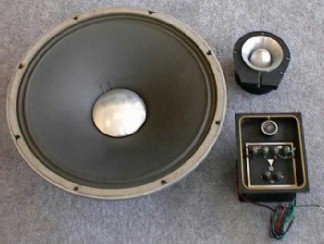 |
| Original System Components, circa 1960 |
 |
| The original parts in this system were known, in JBL parlance, as the '030' system. This was, for its time, a typical-format 2-way system, with a high-efficiency 15" 'D130' woofer, and a '075' bullet-horn, ring-radiator tweeter. Seperating the signals to each, sending bass to the woofer and treble to the tweeter (with a crossover point of about 2400 Hz) was the 'N2400' crossover network. |
| (BTW: For anyone worrying about the fate of the above set of components, no need for concern. I sent the driver system out to the western United States, to an enthusiastic collector of vintage JBL components. They are in good hands, and are providing much enjoyment to their new owner...) |
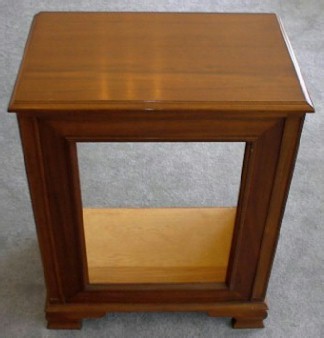
| These are the quite-remarkable original cabinets, after disassembly. The original craftsman who built these, was obviously quite capable, and quite motivated to create virtually "bomb-proof" structures. In addition, the level of finish is outstanding... and they have been well-taken-care-of over the years, as well. As far as dimensions and structure are concerned, the cabinets are right at 2.5 feet tall, just under 2 feet wide, and just over a foot-and-a-half deep, with a rear-mounted bolt-in front baffle arrangement and a bolt-in rear panel. |
 |
| In With the New Gear! |
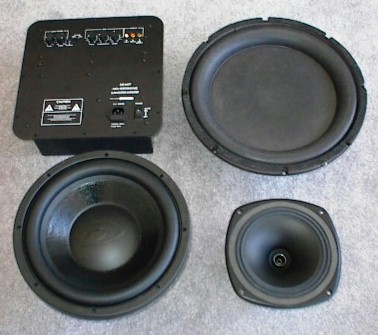
| These are the "prime movers" behind this project. One of each will be installed in each cabinet, as will be shown below. In the top row, are the "ancillary" components for the active-powered bass section. The left component is the new 500 watt high-efficiency subwoofer ampifier, complete with parametric equalizer. To the right is the 15" passive radiator, which will be mass-loaded to tune the cabinet resonance to quite significantly BELOW 20 Hz, to insure a smooth, well-behaved bottom end response... extending to well below "audible" frequency limits! Additionally, the passive radiator will insure a complete absence of "cabinet talk", which can be problematic with conventional "vented" enclosures"- in these, sounds reflected inside the cabinet can "escape" through a ported vent. No such issue, with the totally-sealed passive radiator arrangement! In the bottom row, are the main drivers of the system. To the left, is the 12" high-excursion subwoofer driver, with a 2.5" voice coil, rubber surround, flat spider, and magnetic-motor-shorting-rings, for very-low-distortion bass output, even at room-shaking levels. To the right is the "real treat" of this project- a Tannoy dual-concentric 8" driver, from one of the most high-end Tannoy model lines. Being a Tannoy dealer here, were were able to source this relatively-rare component (indeed, we got two, of what were said to be THREE TOTAL avaliable drivers, in the North American continent, at that time!). The advantage of the dual-concentric, is that the waveguide-loaded tweeter is nested in the center of the midbass driver structure- which allows ALL signals to come from an apparent "point source"... none of the usual "sonic confusion" and interference effects which unavoidably arises from seperate midbass and treble drivers spread out on a baffle. In essence, the concentric driver emits a coherent, single-origin wavefront, over the entire critical mid-range band... which results in the possibility of "pin-point" staging and extremely coherent dynamic response. |
| Building the New Structure |
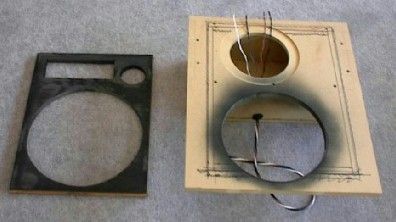 |
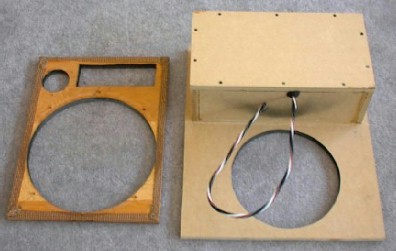
| Here is a comparison of the original baffle (which contained the JBL 15" and JBL horn driver, along with a tuning vent) and the new driver. Since the new system has TWO significant drivcr assemblies (each of which needs its own seperate enclosure), a sub-enclosure was built onto the rear of the new baffle, to accomodate the Tannoy 8" concentric driver in its own tightly sealed enclosure. The 12" subwoofer driver will use the remaing large "airspace" inside the main cabinet. |
 |
| From the rear, the new "dog-house" sub-enclosure for the dual concentric, is much more easily apparent. This enclosure is built to tune the Tannoy driver for a smooth, well-damped rolloff, in order to elegantly meet the subwoofer response, at around 125Hz. (Note also, the use of solid-core Audioquest speaker wiring, used throughout this system. With drivers of this calibre, it's well-worth-it.) |
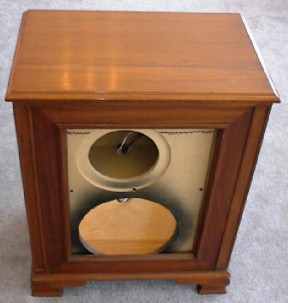 |
| Here is a shot of the cabinet, with the new baffle temporatily installed to check for fitment. There will be a thin grille-panel, which will cover the front of the drivers, between the baffle and cabinet opening. Also note, that the subwoofer driver will be mounted BEHIND the baffle... recessed rearward, to allow the MASSIVE excursion it's capable of, without anything contacting the grille fabric. |
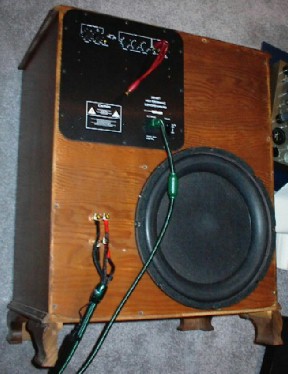 |
| Moving right along... here is the rear of the cabinet, showing the subwoofer amplifier and passive radiator installed. The quartet of speaker terminals is for bi-wire (ie, seperate connections for woofer and tweeter) connection to the crossover network, for the Tannoy dual-concentric driver. Due to the extreme forces which the cabinet will be subjected to, a substantial brace is installed inside, between the back of the dog-house sub-enclosure, and the rear panel, just at the intersection of the amplifier and passive radiator. |
| In-Line Passive Highpass Crossover |
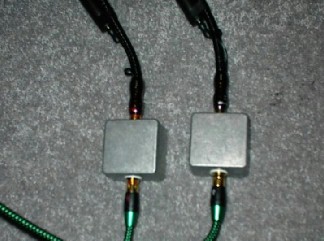 |
| To allow the "main" amplifier to drive the Tannoy dual-concentric driver, without the burden of low-bass signals, passive in-line crossovers were constructed, to filter out the range below about 125 Hz, from the amplifier inputs. These were constructed using polystyrene capacitors- considered to be among the very-best sounding types of capacitors available. Also, note the use of Audioquest "DBS" battery-biased interconnect cables... again, with a system of this calibre, it's possible to actually hear a significant difference in clarity, primarily as a reduction of background noise and low-level distortion, as a result of using such cabling. |
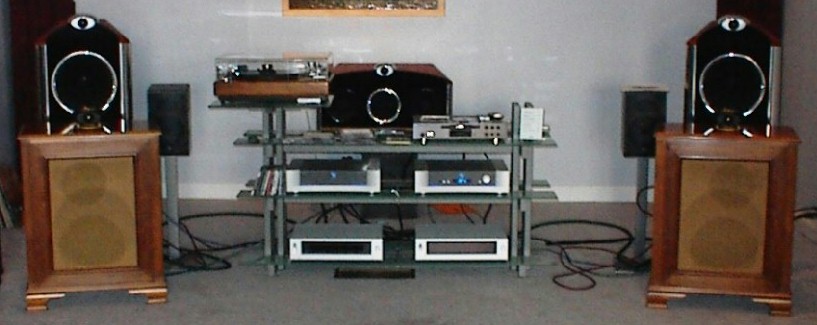 |
| Completed System, In Test |
| This is the entire speaker system, in its complete configuration, as tested in our store location before installation at the client's home. Note the addition of Tannoy supertweeters on top- a decision was made to "up the ante", as far as performance was concerned- the addition of the supertweeters made for an even-better soundstaging and imaging system, with even-better transient response. In its final form, this system is capable of response, plus or minus 3 decibels, from 15 Hz to 50 KHz... at anything from a whisper, to concert-hall levels plus. In all, the performance of the system even exceeded my own expectations. In fact, it led to a consideration- "what if we were not constrained by EXISTING cabinets?"- what could be done, with a clean-sheet-of-paper design... |
| "So...What if we wanted to build the BEST SPEAKER we can build, regardless of price?" |
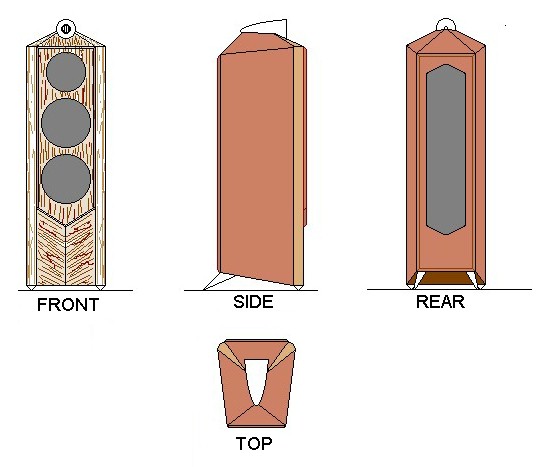 |
| Here's the "next generation". Totally new cabinet architecture... the structure will be just over 4 feet tall, with a modern, narrow-baffle design. I've been investigating... and I have found a NEW 8" concentric driver from a US company, that seems to have ADVANTAGES, over even the performance of the venerable Tannoy driver. That, coupled with a ribbon supertweeter (more efficient than the Tannoy supertweeter, which will allow a very high-efficiency arrangement... as in 95 dB sensitivity!) on top in its own incorporated structure, two 10" subwoofer drivers on the front, and three 10" passive radiators on the rear, should give cone area and resultant output capacity that should even exceed the original design in both bass power and dynamics. The same 500 watt amp module will be incorporated, INSIDE the cabinet, tucked away from view behind sculptured grille panels... no connecting hardware will be visible, with grilles-on. I am, at this time, in process with a cabinet builder, who is building the first prototype set of cabinets. Shortly, we will get to hear what this system is capable of! |