
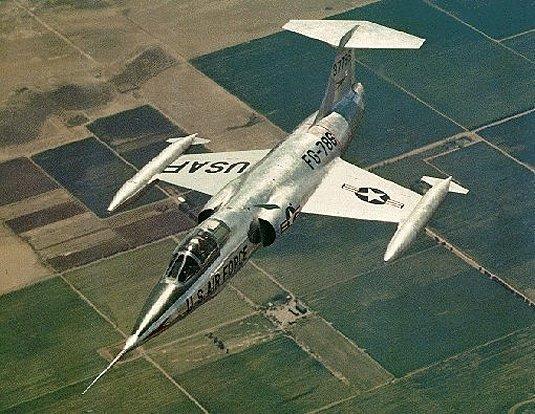
Evolved in response to a Korean War US Air Force requirement for a fast-climbing interceptor, the Starfighter was designed with a barrel-like fuselage containing the avionics, pilot, afterburning turbojet and fuel, and with unswept but diminutive flying surfaces of exceptionally low thickness/chord ratio. The XF-104 prototype first flew in March 1954 on the power of a 10,200 lb. (4,627 kg) thrust Wright XJ65-W-6, but four years of testing and evaluation followed before the F-104A entered service with a fuselage lengthened by 5' 6" (1.7 m) and power provided by the 14,800 lb. (6,713 kg) afterburning thrust General Electric J79-GE-3A turbojet.
Production amounted to 153 aircraft, and a few of these elderly fighters (armed with a single 20 mm M61A1 cannon and two AIM9 Sidewinder) remain in service as interceptors with the Taiwanese air force.
The F-104D Starfighter is a two-seat conversion trainer variant of the F-104C tactical strike version, and powered by the 15,800 lb. (7,167 kg) afterburning thrust J79-GE-7 turbojet.
The earlier Starfighter versions had not been very successful in US service, but with the development of the F-104G variant the type became a major commercial and military success, for this multi-role fighter was accepted for widespread European service. Features of the design were a strengthened structure, an enlarged empannage and other aerodynamic improvements, advanced avionics, superior weapons capability (in terms of quantity and type), and a more powerful engine.
1,127 of this model were built, mostly in Europe, the number being swelled by 200 basically similar CF-104 aircraft (J79-OEL-7 turbojet and inflight refueling capability) built under license in Canada by Canadair and 210 F-104J aircraft mostly built under license in Japan by Mitsubishi.
On May 18, 1958, an F-104A set a world speed record of 1,404.19 mph, and on December 14, 1959, an F-104C set a world altitude record of 103,395 feet. The Starfighter was the first aircraft to hold simultaneous official world records for speed, altitude and time-to-climb.
|
|
|
|
||||||
|
Full name |
|
Lockheed-Martin F-104 Starfighter |
||||||
|
|
|
|||||||
|
Type |
Multi-role combat aircraft |
|||||||
|
|
|
|||||||
|
Origin |
USA |
|||||||
|
|
|
|||||||
|
Length |
54' 9" (16.69 m) |
|||||||
|
|
|
|||||||
|
Wing span |
21' 11" (6.68 m) |
|||||||
|
|
|
|||||||
|
Height |
13' 6" (4.11 m) |
|||||||
|
|
|
|||||||
|
Empty Weight |
14,903 lb. (6,760 kg) |
|||||||
|
|
|
|||||||
|
Max Take Off Weight |
31,000 lb. (14,060 kg) |
|||||||
|
|
|
|||||||
|
Powerplant |
One 17,900 lb. (8,119 kg) afterburning thrust General Electric J79 GE-19 turbojet |
|||||||
|
|
|
|||||||
|
Speed |
Mach 2.2 |
|||||||
|
|
|
|||||||
|
Range |
Combat radius 777 miles (1,250 km) with maximum fuel |
|||||||
|
|
|
|||||||
|
Armament |
4,310 lb. (1,955 kg) of mixed ordinances including AIM-9 Sidewinder, Kormoran and Penguin anti-ship missiles, AGM-65 Maverick, clusterbombs and LAU rocketpods |
|||||||
|
|
|
|||||||
|
Crew |
1 |
|||||||
|
|
|
|||||||
|
Unit cost |
Currently unavailable |
|||||||
|
|
|
|||||||


