 |
|
History of The Raptor
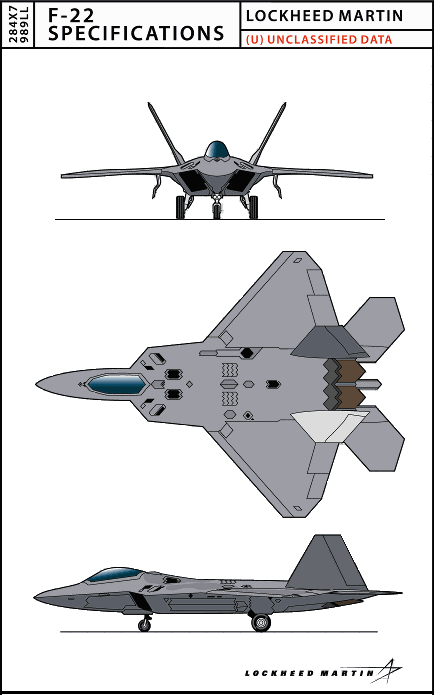
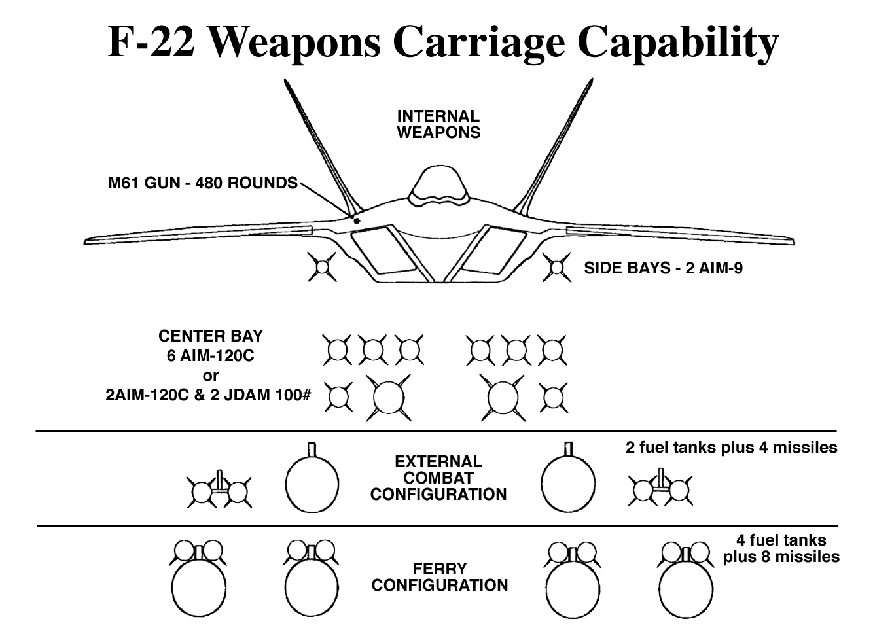
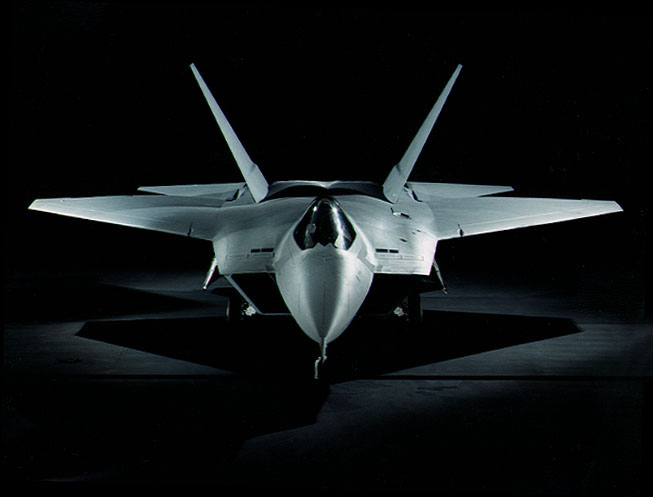
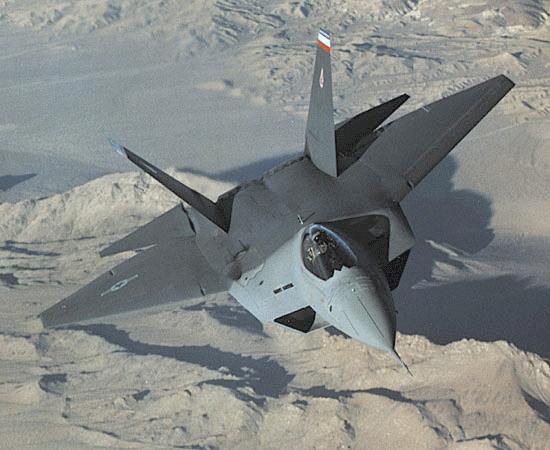
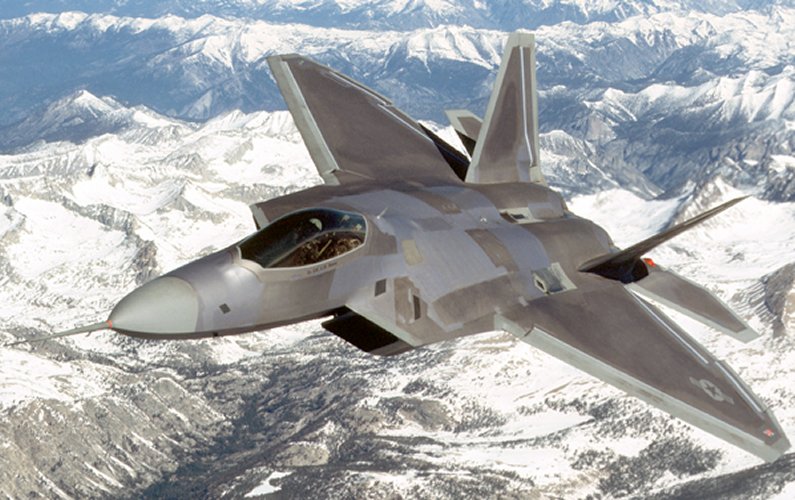
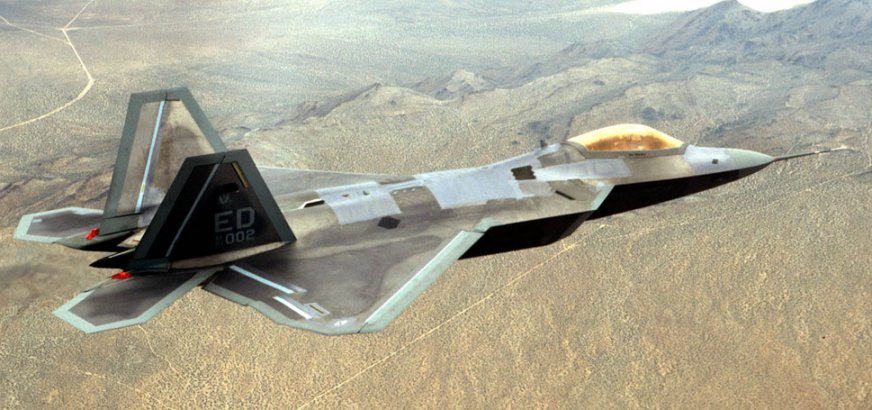
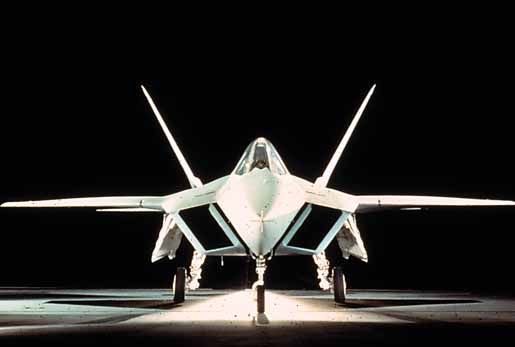
By 1980, the F-15 was widely acknowledged as the world's finest fighter, and this state of affairs seemed likely to persist for many years after. By the end of the century, however, despite more powerful engines and improved weapons systems, it would become increasingly obsolete. What would be needed was a new fighter capable of operating in the face of advanced air defense systems, without incurring an unacceptable loss rate. This problem was to be attacked on two fronts; speed and stealth. Maximum speeds have been largely irrelevant over the past three decades. They take forever to reach, and if you ever do, the fuel warning light comes on and you have to slow down. At the same time, it has always been true that an appreciable speed advantage gives the initiative in combat. Therefore the really important speed parameter is sustained cruise. The F-22A is slightly larger than the F-15 which it is to replace. The trapezoidal wing is swept back at 48 degrees on the leading edge and forward by 17 degrees o the trailing edge, in a radar-emission deflection measure. The nose is small and pointed, presumably because the active array radar takes up less space than a conventional antenna, and has a distinct shine around it. at the other end, the vectoring nozzles are angled to deflect radar, but they cannot be shielded by the afterbody in the same way as the YF-23. The F-22 is reported to handle well, and angles of attack of 60 degrees were reached at an early stage without problems. A supercruise speed of Mach 1.58 was attained during trails, and no problems in separation of gas ingestion were experienced with missile launching from internal bays, which are located on the outside of the engine ducts. For its primary air-to-air role, the F-22 will carry six
AIM-120C and two AIM-9 missiles. For its air-to-ground role, the F-22 can internally carry
two 1,000 pound-class Joint Direct Attack Munitions (JDAM), two AIM-120C, and two AIM-9
missiles. With the Global Positioning System-guided JDAM, the F-22 will have an
adverse weather capability to supplement the F-117 (and later the Joint Strike Fighter)
for air-to-ground missions after achieving air dominance.
An all-missile external loadout (two missiles on each of the stations) is possible and would not be difficult technically to integrate, but the Air Force has not stated a requirement for this configuration.
Prior to its selection as winner of what was then known as the Advanced Tactical Fighter (ATF) competition, the F-22 team conducted a 54-month demonstration/ validation (dem/val) program. The effort involved the design, construction and flight testing of two YF-22 prototype aircraft. Two prototype engines, the Pratt & Whitney YF119 and General Electric YF120, also were developed and tested during the program. The dem/val program was completed in December 1990. Much of that work was performed at Boeing in Seattle, Lockheed (now known as Lockheed Martin) facilities in Burbank, Calif., and at General Dynamics' Fort Worth, Texas, facilities (now known as Lockheed Martin Tactical Aircraft Systems). The prototypes were assembled in Lockheed's Palmdale, Calif., facility and made their maiden flight from there. Since that time Lockheed's program management and aircraft assembly operations have moved to Marietta, Ga., for the EMD and production phases.
The F-22 passed milestone II in 1991. At that time, the Air Force
planned to acquire 648 F-22 operational aircraft at a cost of $86.6
billion. After the Bottom Up Review, completed by DOD in September
1993, the planned quantity of F-22s was reduced to 442 at an
estimated cost of $71.6 billion.