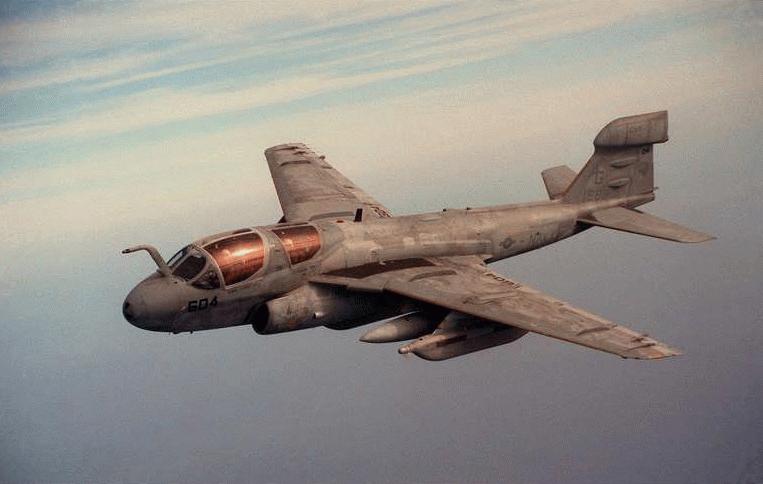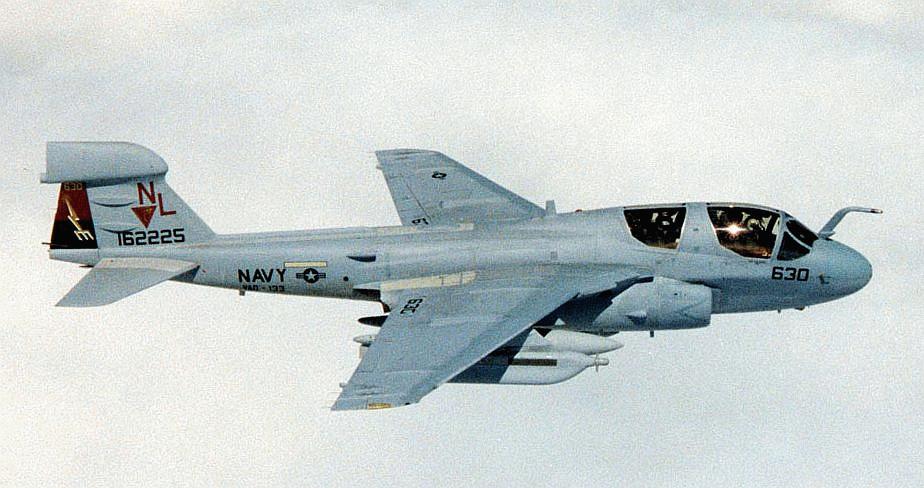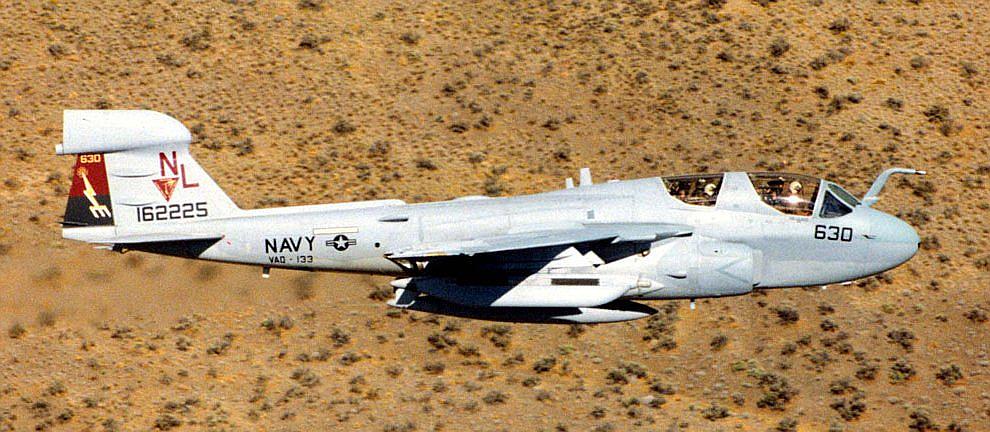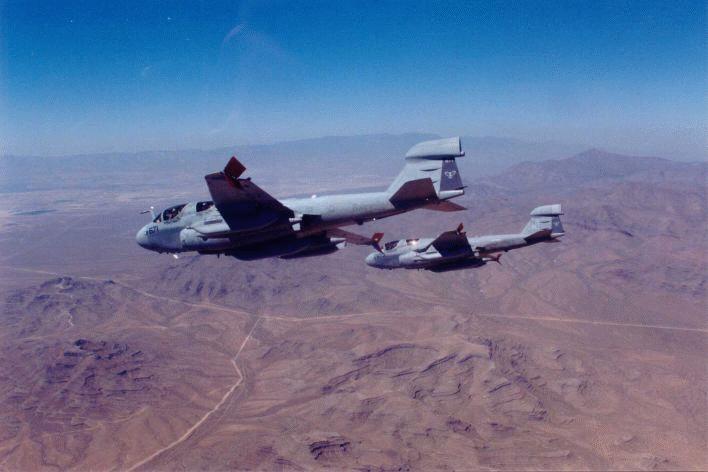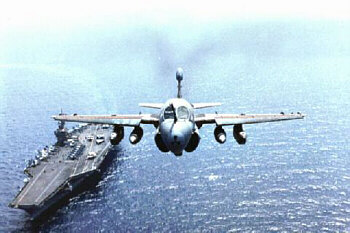
The EA-6B Prowler is the most sophisticated and advanced electronic attack aircraft in the world. Its purpose is to deny the enemy effective use of the electromagnetic spectrum. Built by Grumman Aerospace Corporation, it is designed for carrier and advanced base operations. It has the basic airframe of the A-6 with the addition of a rear cockpit, increasing the crew complement to four: one pilot and three electronic countermeasures officers (ECMOs).
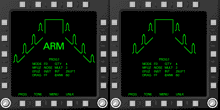
The EA-6B was proven in Vietnam, the Middle East, Southwest Asia and Bosnia where strike aircraft losses were dramatically reduced when the Prowler was on station. These conflicts made it evident that the winner of future military conflicts will be the force that most completely controls the electromagnetic spectrum. To achieve this, the EA-6B uses sensitive receivers which detect radar signals to determine if they should be jammed with high powered transmitters or destroyed using the AGM-88 High Speed Anti-Radiation Missiles (HARM).
Effective control of the electromagnetic spectrum will mean the difference between victory and defeat in future conflicts. The EA-6B is being continually improved to meet and counter the latest developments in electronic warfare, and will continue to be the nation's premier tactical jamming weapon system.
The EA-6B Prowler electronic warfare aircraft - which played a key role in suppressing enemy air defenses during Operation Desert Storm - enhances the strike capabilities not only of carrier air wings but of U.S. Air Force and allied forces as well. The decision to retire the Air Force EF-111A Raven and to assign all Department of Defense radar jamming missions to the Prowler adds to the significance of the EA-6B in joint warfare. With its jamming and High-Speed Anti-Radiation Missile (HARM) capability, the Prowler is a unique national asset that will be deployed from land bases and aircraft carriers. Its ability to monitor the electromagnetic spectrum and actively deny an adversary's use of radar and communications is unmatched by any airborne platform worldwide.
In the wake of DOD budgetary decisions to retire the F-4G Wild Weasel and phase out the EF-111 Raven, there will be increased reliance by the Joint Force Commander (JFC) on the EA-6B Prowler for the joint suppression of enemy air defenses (J-SEAD) role. It is understood that SEAD is much more than jamming and anti- radiation missiles. All services bring complementary capabilities to the overall J-SEAD effort, and all services reap the benefits of the resulting air superiority. This publication focuses on the unique capabilities of the EA-6B.
The Prowler is not optimized to provide a safe haven by virtue of an "umbrella of electrons". However, if used efficiently and effectively, this limited asset can provide the JFC with a decisive tactical advantage. The EA-6B is a multi-mission capable platform, that couples human interface with a sophisticated electronic warfare package. Whether the crew of four is assigned to a carrier-based Navy VAQ squadron, Marine Corps VMAQ squadron, or a newly formed, jointly manned Navy land-based squadron (also VAQ), they will come to the "battlefield" as a highly standardized crew that completed centralized training at NAS Whidbey Island, WA.
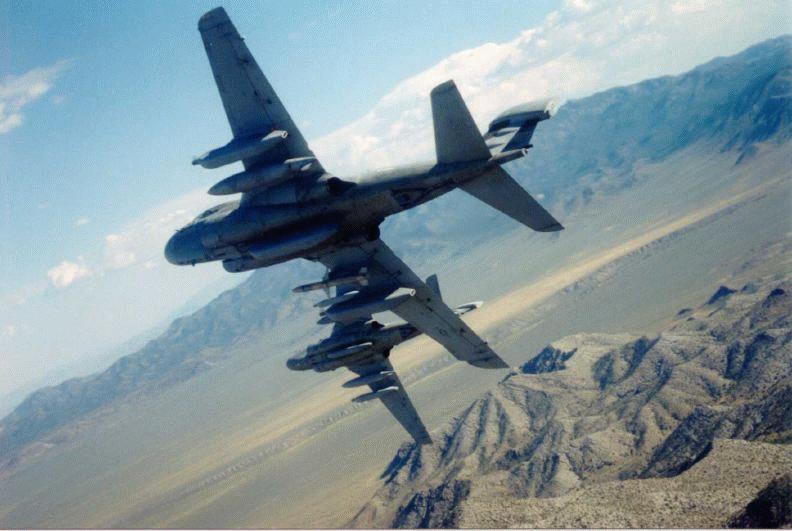
The Prowler is derived from the two-seater A-6 Intruder attack aircraft. The basic airframe was stretched and strengthened to accommodate a four-seat cockpit. Another distinguishing feature is the pod-shaped fairing at the top of the vertical fin.
The heart of the EA-6B is the AN/ALQ-99 Tactical Jamming System. The Prowler can carry up to five pods (one belly mounted and two on each wing). Each pod is integrally powered and houses two jamming transmitters that cover one of seven frequency bands. The EA-6B can carry any mix of pods, fuel tanks and/or HARM anti-radiation missiles depending on mission requirements.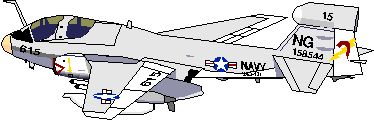 The EA-6B's tail fin pod houses sensitive surveillance receivers, capable of detecting hostile radar
emissions at long range. Emitter information is processed by the central mission computer. Detection,
identification, direction-finding, and jammer-set-on-sequence may be performed automatically or by the
crew.
The crew of the Prowler consists of the pilot and three electronic countermeasures officers (ECMOs).
The ALQ-99 jammers are operated by the two ECMOs in the aft cockpit. The ECMO in the right front
seat is responsible for navigation, communications, and defensive electronic countermeasures.
The EA-6B's tail fin pod houses sensitive surveillance receivers, capable of detecting hostile radar
emissions at long range. Emitter information is processed by the central mission computer. Detection,
identification, direction-finding, and jammer-set-on-sequence may be performed automatically or by the
crew.
The crew of the Prowler consists of the pilot and three electronic countermeasures officers (ECMOs).
The ALQ-99 jammers are operated by the two ECMOs in the aft cockpit. The ECMO in the right front
seat is responsible for navigation, communications, and defensive electronic countermeasures.
In the coming years, the Prowler fleet will be modernized and upgraded to keep the aircraft and its systems abreast of evolving threats and to maintain aircraft safety. The Block 89A upgrade program will address structural and supportability problems associated with aging aircraft and includes numerous avionics improvements for safety of flight and joint interoperability. Later improvements to the Prowler's AN/ALQ-99 tactical jamming system, including the Improved Capabilities (ICAP) III upgrade, new high and low frequency transmitters, and continuing structural enhancements, will ensure that the EA-6B remains the world's premier tactical electronic warfare platform and a force multiplier for years to come.
The Marine Corps EA-6B Prowler provides Airborne Command and Control (C2W) support to Fleet Marine Forces to include electronic attack (EA), tactical electronic support (ES), electronic protection (EP) and high speed anti-radiation missile (HARM).
The EA-6B's ALQ-99 OBS is used to collect tactical electronic order of battle (EOB) data which can be disseminated through the command and control system while airborne, and which can be recorded and processed after missions to provide updates to various orders of battle. The ALQ-00 TJS is used to provide active radar jamming support to assault support and attack aircrtaft, as well as ground units. Additional suppression of enemy air defenses (SEAD) capability is available with the employment of HARM.
Marine Prowlers may be land-based from prepared airfields, or they can operate from expeditionary airfields (EAF). They may also be sea-based, operating from aircraft carriers. Marine Prowlers are unique in their integration with the Tactical Electronic Processing and Evaluation System (TERPES). TERPES provides post-mission analysis of EA-6B ES data for reporting and updating orders of battle. It also provides post-mission analysis of jamming and HARM employment for reporting, assessing and storing mission data.
Specifications |
|
| Manufacturer: | Grumman Aircraft Corporation |
| Power plant: | Two Pratt & Whitney J52-P408 turbofan engines |
| Thrust: | 11,200 pounds (4,767 kilograms) per engine |
| Length: | 59 feet (17.98 meters) |
| Height: | 15 feet (4.57 meters) |
| Wing span: | 53 feet (16.15 meters) |
| Speed: | Maximum .99 mach; cruise .72 mach |
| Ceiling: | 40,000 feet - maximum (12,186 meters) 37,600 feet - Service ceiling |
| Performance |
2,750 ft - Minimum take-off distance 2,185 ft - Minimum landing distance |
| Weight |
33,600 lbs - Empty 61,500 lbs - Maximum TOGW (27,921 kilograms) 15,422 lbs - Internal fuel 10,000 lbs - External fuel 4,000 lbs - External fuel (typical) |
| Range: |
Unrefueled in combat configuration: 850 nautical miles (977.5 miles) Ferry range (5 drop tanks) 1,747 nm Refueled: unlimited (crew fatigue factor - approximately 8 hours) |
| Armament: | ALQ-99 Tactical Jamming System (TJS); High Speed Anti-Radiation Missile (HARM) |
| Sensors: | ALQ-99 On-board System (OBS) |
| Crew: | 4 |
| Introduction date: | ICAP configuration, 1977; current ICAP II configuration, 1984 |
| Unit Replacement Cost: | $52,000,000 |
| Inventory: | 100 PAA 120 total |