MiG-29 FULCRUM
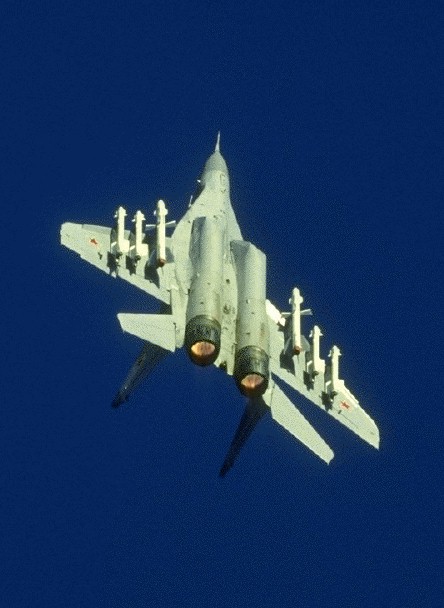
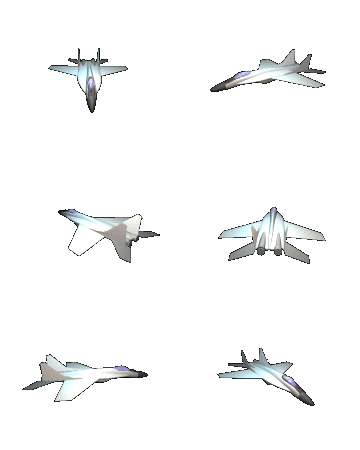
The MiG-29 is marketed worldwide and equals or surpasses the F-15C in several areas. The MiG-29's wings are swept-back and tapered with square tips. LERXs are wide and curved down to the front. LERX begins on the nose below the mid-mount point, and the wings’ trailing edges end at a high-mounted point. Twin jet engines are mounted low and to the sides of the fuselage. Diagonal-shaped air intakes give a box-like appearance. There is a large exhausts. The fuselage is made of a long, thin, slender body with long, pointed drooping nose. There is a high-mounted bubble canopy. The tail fins have sharply tapered leading edges, canted outward with angular, cutoff tips. Flats are high-mounted on the fuselage, movable, swept-back, and tapered with a negative slant.
The MiG-29 "Fulcrum" ("Tochka Opori" in Russian) was designed and built to be a single-seat supersonic, all-weather, air superiority fighter representing, with the MiG-31 "Foxhound", the latest and perhaps last fighter production items from the Mikoyan Design Bureau. The primary role of the MiG-29 is to destroy air targets at distances from 60 to 200 kilometers (30 to 110 NM) at all altitudes, on all profiles, in any weather, and under all ECM conditions. In addition, the basic MiG-29 is capable of limited air-to-ground operations and in advanced versions, has been optimized to attack both stationary and moving targets with precision guided munitions.
In total, over 800 were delivered to the Soviet / Russian Tactical Air Forces and around 500 airframes prepared for initial export customers. By 1989, it was serving in 12 different air forces around the world. Presently, it is the only Russian aircraft on operational duty in NATO and serves in 21 air forces. Brassey's reports that a total of 1216 MiG-29 single-seaters and 197 MiG-29UB dual-seaters were built by January 1985 (total of 1413). Since 1990, production was exclusively for export.
The US Department of Defense of the United States of America and the Ministry of Defense of the Republic of Moldova recently reached an agreement to implement the Cooperative Threat Reduction accord signed on June 23, 1997, in Moldova. The Pentagon pounced on the planes after learning Iran had inspected the jets and expressed an interest in adding them to their inventory. Although Iran already flies the less-capable Fulcrum A, it doesn't own any of the more advanced C-models. Of the 21 Fulcrums the United States bought, 14 are the frontline Fulcrum C's, which contain an active radar jammer in its spine, six older A's and one B-model two-seat trainer. This agreement authorized the United States Government to purchase nuclear-capable MiG-29 fighter planes from the Government of Moldova. This is a joint effort by both Governments to ensure that these dual-use military weapons do not fall into the hands of rogue states. From Oct. 20 to Nov. 2, 1997, loadmasters and aerial port experts squeezed two MiGs apiece, sans wings and tails, into the cargo holds of C-17 Globemaster III transports from Charleston Air Force Base, S.C. The Charleston airlifters delivered the MiGs to the National Air Intelligence Center at Wright-Patterson AFB near Dayton, Ohio. If the NAIC can discover how the Fulcrum works, Air Force pilots might gain an edge if they face the Fulcrum in future combat. The MiG-29 is a widely exported aircraft, flown by Iraq, Iran, North Korea and Cuba.
Nation: USSR Manufacturer: State Industries (Mikoyan-Gurevich Design Bureau) Type: Interceptor Year: 1983 Engine: 2 Tumansky R-33D afterburning turbofans, 18,300 lb thrust each Span: 37 ft 3 in Length: 56 ft 10 in Height: 15 ft 6 in Loaded Weight: 39,700 lb Max Speed: 1,520 mph Ceiling: 56,000 ft Range: 1,300 miles Sensors: Slot Back radar, IRST,RWR, Balistic bombsight Crew: 1 Armament: 1 30mm cannon, 6 wing pylons for AA-10/AA-11 AAM's or other stores
User Countries Russia Belarus Bulgaria CIS Croatia Cuba Czech Republic Germany Hungary India Iran Iraq Kazakhstan Malaysia Moldova North Korea Poland Romania Slovakia Syria Turkemenistan Ukraine Uzbekistan Yemen Yugoslavia
Sources
The info for this plane was taken from the following sources on the internet and all credit should go to them. If you want to know more about this aircraft, I suggest checking out these great sites.
A Real MiG Deal- Looking 'under the hood' of a Russian Fighter. Airman May 1998
Military Analysis Network
Fighter Aicraft, Mig-29
Watson's Military Airplanes