 |
|
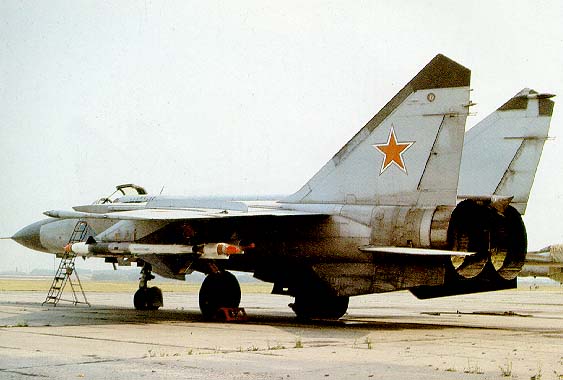
MiG-25 "Foxbat"
The MiG-25 "Foxbat-A" first entered service in 1970. It was made largely of steel and titanium to withstand the effect of kinetic heating, and was out fitted with an old fashion but very powerful radar as well as four examples of the largest air to air missiles ever deployed. Total production was in the order of 600 aircraft in several variants, including a recon variant. The MiG-25 has also seen limited service with several counties in the Middle East.
When the USSR learnt that the US had started work on the B-70 Valkyrie as a Mach 3 strategic bomber, it undertook the design of a fighter intended specifically to counter the US high altitude bomber. Even though the B-70 was cancelled in 1961 the Soviets pushed ahead with their new fighter. The MiG-25 first flew in April 1965 as the Ye-266 and later set several world records.
This was the USSR's answer to the design in the US of fast, high-flying
aircraft as the B-70, F-108 and SR-71. The MiG-25 lacked technological
refinement, but its performance caused much concern in the west.
Also used as reconaissance aircraft, which in the Middle-East proved
invulnerable for the Israeli F-4 Phantom IIs. The MiG bureau once contemplated
a six-seat transport development...
In 1970 bombing capability was added and became standard on MiG-25RB.
An automatic bombing system added all-weather precision attack capability
at supersonic speeds from heights of >65,000 ft. MiG-25RB can be fitted
with one of the reconnaissance/elint packs or airborne side-looking radar.
85 MiG-25RB are in serevice today. Aircraft has two R-15BD-300 engines and
4,800 gal of fuel internally (1,400 gal external tank can be fitted).
The exceptional advantages of the MiG-25RB and RBV were greatly appreciated
by their operators: extent of the ground area swept during a single flight
by either the cameras or the elint equipment, high-speed long-distance
flight, and near invulnerability to air defenses of the time.
On March 26, 1971 MiG-25 achieved a dash speed of Mach 3.2 at 63,000 ft
(19,200 m). On subsequent flights an altitude of 73,000 ft (22,250 m) was
achieved. In October of 1971 two soviet MiG-25 made reconnaissance flights
Sinai and Israel. On both occasions Israeli F-4E Phantoms failed in an
attempted intercept.

Type: High-performance all-weather interceptor Manufacturer: Mikoyan-Gurevich MiG-25 "Foxbat" Powerplant: Two 25,000-lb-thrust Tumansky R-31 afterburning turbojets Max Speed: Up to Mach 3, although normally limited to Mach 2.8 or 1,940 Ceiling: 80,000 ft Range: 1,050 mi subsonic subsonic with internal fuel Weights: Empty 44,000 lb; loaded 80,000 lb Weapons: Four AA-6 "Acrid" long-range air-to-air missiles, or
two AA-6 and two AA-7 "Apex" mmissiles; other missiles in other combinations Wing Span: 45 ft 9 in Length: 69 ft 10 in Height: 20 ft 4 in Wing Area: 612 sq ft

Specifications | |
| Countries of Origin | CIS (formerly USSR) |
| Variants |
|
| Similar Aircraft | |
| Crew | One |
| Role | |
| Length | 70 ft (21.34 m) |
| Span | 41 ft (12.6 m) |
| Ceiling | 24400 meters |
| Cruise range | 1560 nm |
| In-Flight Refueling | No |
| Internal Fuel | 14200 kg |
| Payload | |
| Sensors | Foxfire radar |
| Drop Tanks | na |
| Armament | |
| User Countries | |


