The McDonnell Douglas AV-8B Harrier II
History of The Harrier
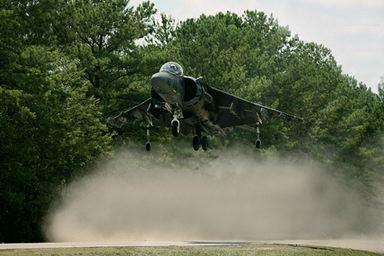
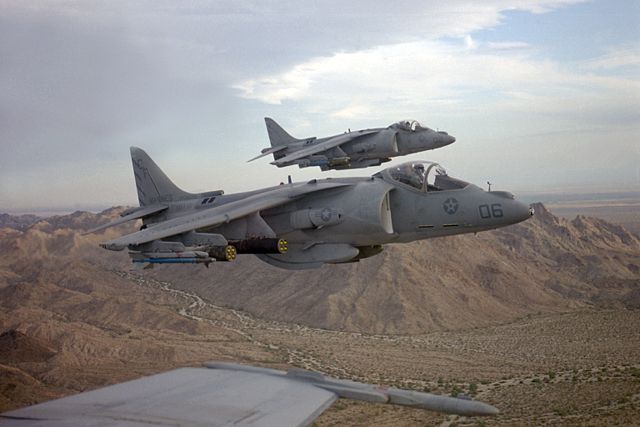
Since the Marine Corp first received the AV-8B they have consistently chapioned the VTOL Capability. Preliminary studies were made in the mid-1970's, and the prototype YAV-8B made its first flight from St. Louis in November 1978. The prime contractor for the project was McDonnell Douglas, who forged a partnership with British Aerospace. The USMC has ordered 328 Harrier II's, of which 28 are two seater trainers. Delivery of the Harriers began in January of 1984, the first unite to receive the type being VMAT-203 at Cherry Point, North Carolina. The Harrier has replaced the aging A-4 Skyhawk. STOVL means , Short Take Off Vertical Landing. The Harrier can take off vertically or roll off a commando ship at 55 MPH. If the Harrier ever encounters a threat my enemy fighters, it can defend itself Sidewinder or Ammram missiles. The harrier can also quickly deaccelerate causing the enemy to over shoot. In 1984 MCD was awarded a contract for a Night Attack version of the Harrier. The Night Attack version is equiped with a FLIR sensor with the pilot wearing Night Vision Goggles. All of the Harrier II's have been upgraded to the Night Attack standard.
The mission of the VMA STOVL squadron is to attack and destroy surface and air targets, to escort helicopters, and to conduct other such air operations as may be directed. Specific tasks of the AV-8B HARRIER II include:
- Conduct close air support using conventional and specific weapons.
- Conduct deep air support, to include armed reconnaissance and air interdiction, using conventional and specific weapons.
- Conduct offensive and defensive antiair warfare. This includes combat air patrol, armed escort missions, and offensive
missions against enemy ground-to-air defenses, all within the capabilities of the aircraft.
- Be able to operate and deliver ordnance at night and to operate under instrument flight conditions.
- Be able to deploy for extended operations employing aerial refueling.
- Be able to deploy to and operate from carriers and other suitable seagoing platforms, advanced bases, expeditionary
airfields, and remote tactical landing sites.
Specifications
Origin
McDonnell Douglas Corporation, St. Louis Missouri/British Aerospace, Kingston-upon-Thames, Surrey
Type
Single Seater STOVL Close Air Support
Engines
One 23,400 Rolls Royce F402-408 vector thrust turbofans
Thrust
F402-RR-406: 21,500 pounds/
F402-44-208: 23,400 pounds
Dimensions
Span 30ft 4in, Lenth 47ft 9in, Height 11ft 8in, Wing Area 230sq ft
Performance
Max speed S/L 602kt at altitude, ceiling 50,000ft
Combat Radius
close air support: 163 nautical miles (187.45 miles) with 30 minutes time on station
interdiction: 454 nautical miles (522.45 miles)
Crew
one
Unit Replacement Cost
$23,700,000
Armament
One 25mm GAU-12/U five barrel cannon with 300 rounds;combination of Mavricks and Hellfire for Air-Ground; Air-Air Combo of 6 Ammram and Sidewinders
History
First Flight 9th of November 1978; Service entry 1983