 |
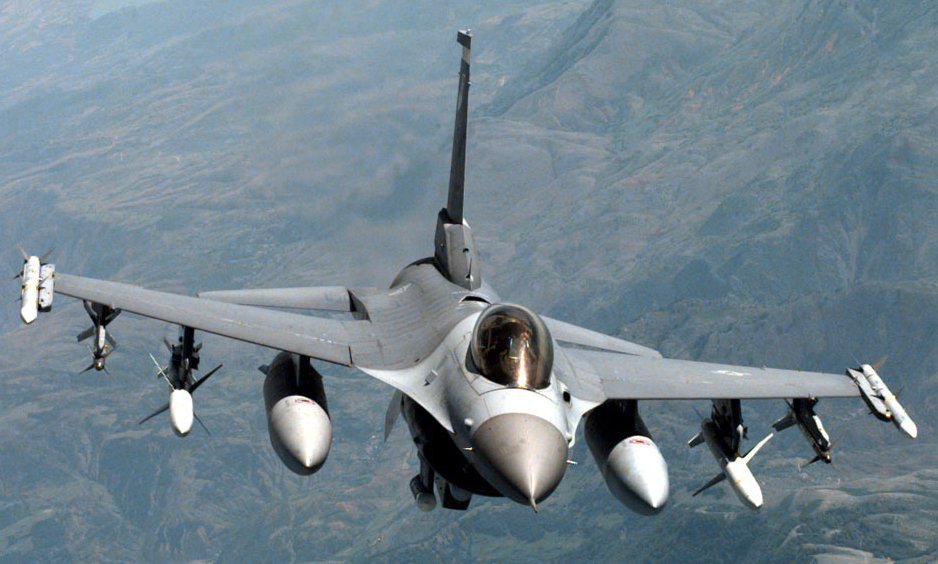
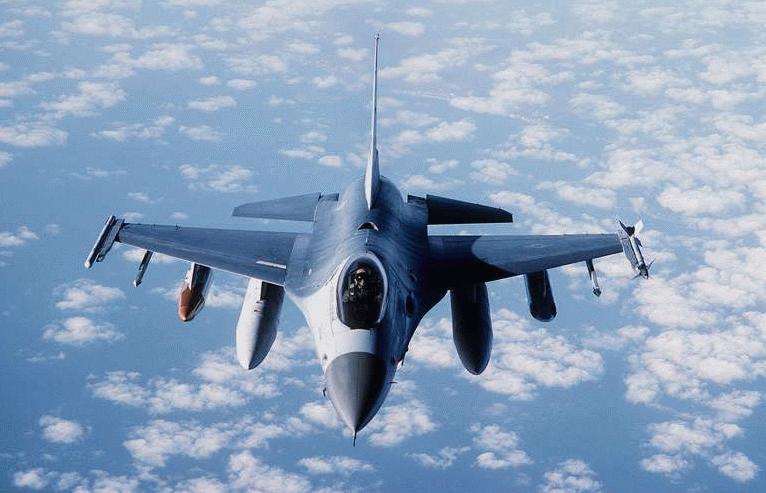
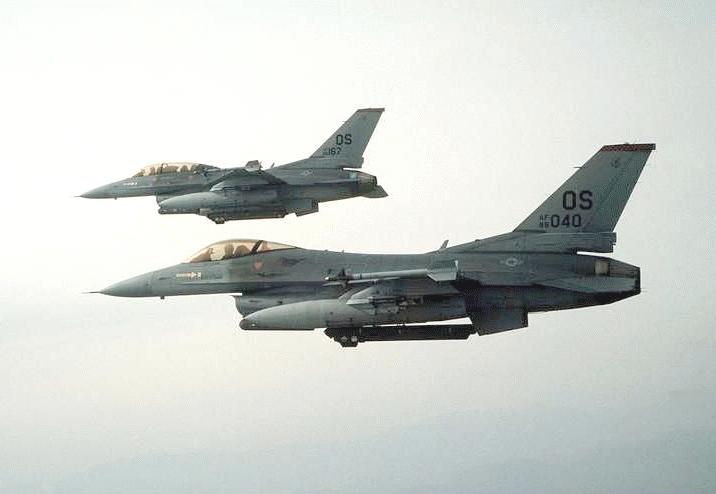
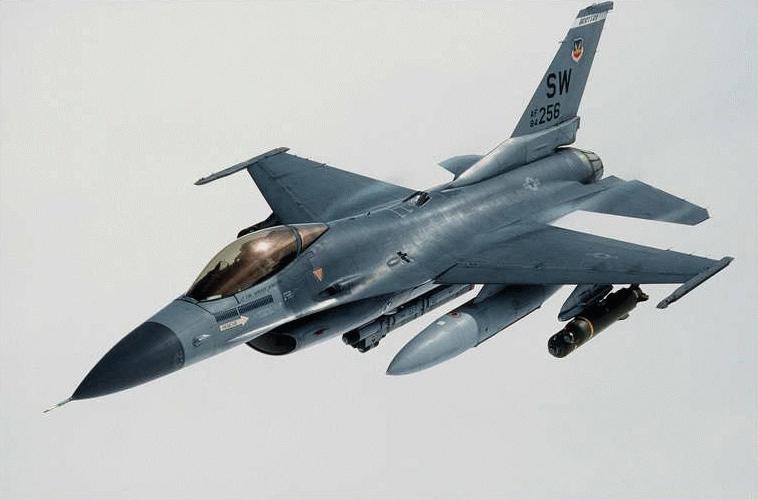
U.S. Air Force Photo
History of The Falcon
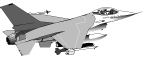
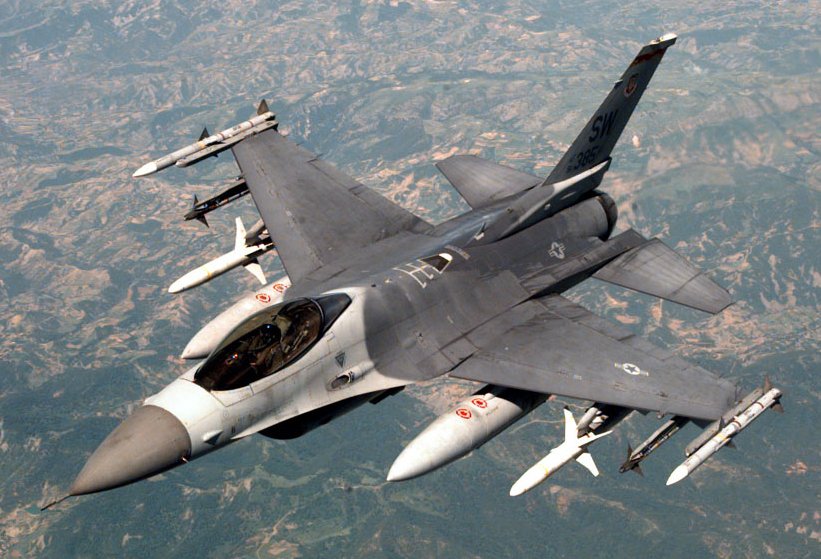
Over the next 11 months the YF-16 and YF-17 went through extreme tests. The YF-16 achieved altitudes over 60,000ft, 9g maneuvers, and speeds in excess of Mach 2. The YF-16 flew against many American Fighters as well a captured MiG 21. The YF-16 proved that it can out-perform any current fighter. On January 15 1975, after the many successful tests of the YF-16, General Dynamics was awarded a $417.9 million fixed price incentive contract for the production of 15 F-16s - Eleven single seat F-16As and four two-seater F-16Bs. A cost of $4.6 million per plane was projected for each of the 650 production aircraft ordered for the USAF. The F-16 was also expanded for Air-Ground roles. General Dynamics tried to sell the plane to the Navy, but failed and the Navy selected the F/A-18 Hornet, derived from the YF-17. Belgium, Denmark, The Netherlands, and Norway were waiting for the F-16 came into service so they can replace their aging F-104 StarFighters. Later the USAF equipped the F-16 with a far more capable radar, which the nose cone had to be enlarged. There were many differences between the F-16 and the YF-16 Prototype, which included 25% structural strength, the fuselage was increased by 13.7 inches, the wings were increased by 20sq.ft, and the horizontal tails by 15%. In 1982 the USAF Aerial Demonstration Squadron the "Thunderbirds"equipped themselves with the F-16 Fighting Falcon, replacing the T-38 Talon Trainers. The F-16 is official known as the Fighting Falcon, but to its pilots it"s called the "Viper" or the "Electric Jet". Production of the A and B models for the USAF ended in 1985, which the C/D models rolled off the assembly line. The C/D models included a far more capable APG-68 Radar, a glass cockpit, and it can carry newer weapons, such as the AGM-65D Maverick, AGM-88 HARM, and the AIM-120 Amraam. the Two seat variant of the F-16 can carry a Lantrin pod (Low Altitude Navigations and Targeting for Infa-Red for Night).
Variants
The original F-16 was designed as a lightweight air-to-air day fighter. Air-to-ground responsibilities transformed the first production F-16s into multirole fighters. The empty weight of the Block 10 F-16A is 15,600 pounds. The empty weight of the Block 50 is 19,200 pounds. The A in F-16A refers to a Block 1 through 20 single-seat aircraft. The B in F-16B refers to the two-seat version. The letters C and D were substituted for A and B, respectively, beginning with Block 25. Block is an important term in tracing the F-16's evolution. Basically, a block is a numerical milestone. The block number increases whenever a new production configuration for the F-16 is established. Not all F-16s within a given block are the same. They fall into a number of block subsets called miniblocks. These sub-block sets are denoted by capital letters following the block number (Block 15S, for example). From Block 30/32 on, a major block designation ending in 0 signifies a General Electric engine; one ending in 2 signifies a Pratt & Whitney engine.The F-16A, a single-seat model, first flew in December 1976. The first operational F-16A was delivered in January 1979 to the 388th Tactical Fighter Wing at Hill Air Force Base, Utah. The F-16B, a two-seat model, has tandem cockpits that are about the same size as the one in the A model. Its bubble canopy extends to cover the second cockpit. To make room for the second cockpit, the forward fuselage fuel tank and avionics growth space were reduced. During training, the forward cockpit is used by a student pilot with an instructor pilot in the rear cockpit.
- Block 1 and Block 5 F-16s were manufactured through 1981 for USAF and for four European air forces. Most Blocks 1 and 5 aircraft were upgraded to a Block 10 standard in a program called Pacer Loft in 1982.
- Block 10 aircraft (312 total) were built through 1980. The differences between these early F-16 versions are relatively minor.
- Block 15 aircraft represent the most numerous version of the more than 3,600 F-16s manufactured to date. The transition from Block 10 to Block 15 resulted in two hardpoints added to the chin of the inlet. The larger horizontal tails, which grew in area by about thirty percent are the most noticeable difference between Block 15 and previous F-16 versions.
The F-16C and F-16D aircraft, which are the single- and two-place counterparts to the F-16A/B, incorporate the latest cockpit control and display technology. All F-16s delivered since November 1981 have built-in structural and wiring provisions and systems architecture that permit expansion of the multirole flexibility to perform precision strike, night attack and beyond-visual-range interception missions. All active units and many Air National Guard and Air Force Reserve units have converted to the F-16C/D, which is deployed in a number of Block variants.
- Block 25 added the ability to carry AMRAAM to the F-16 as well as night/precision ground-attack capabilities, as well as an improved radar, the Westinghouse (now Northrop-Grumman) AN/APG-68, with increased range, better resolution, and more operating modes.
- Block 30/32 added two new engines -- Block 30 designates a General Electric F110-GE-100 engine, and Block 32 designates a Pratt & Whitney F100-PW-220 engine. Block 30/32 can carry the AGM-45 Shrike and the AGM-88A HARM, and like the Block 25, it can carry the AGM-65 Maverick.
- Block 40/42 - F-16CG/DG - gained capabilities for navigation and precision attack in all weather conditions and at night with the LANTIRN pods and more extensive air-to-ground loads, including the GBU-10, GBU-12, GBU-24 Paveway laser-guided bombs and the GBU-15. Block 40/42 production began in 1988 and ran through 1995. Currently, the Block 40s are being upgraded with several Block 50 systems: ALR-56M threat warning system, the ALE-47 advanced chaff/flare dispenser, an improved performance battery, and Falcon UP structural upgrade.
- Block 50/52 Equipped with a Northrop Grumman APG-68(V)7 radar and a General Electric F110-GE-129 Increased Performance Engine, the aircraft are also capable of using the Lockheed Martin low-altitude navigation and targeting for night (LANTIRN) system. Technology enhancements include color multifunctional displays and programmable display generator, a new Modular Mission Computer, a Digital Terrain System, a new color video camera and color triple-deck video recorder to record the pilot's head-up display view, and an upgraded data transfer unit. By mid-1999 Block 50/52 [aka Block 50 Plus] F-16s will carry the CBU-103/104/105 Wind-Corrected Munitions Dispenser, the AGM-154 Joint Stand-Off Weapon, and the GBU-31/32 Joint Direct Attack Munition.
- Block 50D/52D Wild Weasel F-16CJ (CJ means block 50) comes in C-Model (1 seat) and D-Model (2 seat) versions. It is best recognized for its ability to carry the AGM-88 HARM and the AN/ASQ-213 HARM Targeting System (HTS) in the suppression of enemy air defenses [SEAD] mission. The HTS allows HARM to be employed in the range-known mode providing longer range shots with greater target specificity. This specialized version of the F-16, which can also carry the ALQ-119 Electronic Jamming Pod for self protection, became the sole provider for Air Force SEAD missions when the F-4G Wild Weasel was retired from the Air Force inventory. The lethal SEAD mission now rests solely on the shoulders of the F-16 Harm Targeting System. Although F-18s and EA-6Bs are HARM capable, the F-16 provides the ability to use the HARM in its most effective mode. The original concept called for teaming the F-15 Precision Direction Finding (PDF) and the F-16 HTS. Because this teaming concept is no longer feasible, the current approach calls for the improvement of the HTS capability. The improvement will come from the Joint Emitter Targeting System (JETS), which facilitates the use of HARM's most effective mode when launched from any JETS capable aircraft.
- Block 60 - In May 1998 the UAE announced selection of the Block 60 F-16 to be delivered between 2002-2004. The upgrade package consists of a range of modern systems including conformal fuel tanks for greater range, new cockpit displays, an internal sensor suite, a new mission computer and other advanced features including a new agile beam radar.
The F-16 features the world's finest fighter engines. The F-16A is powered by the 24,000-lb class F100-PW-220. The F-16C offers a choice of two 29,000-lb class engines: the Pratt & Whitney F100-PW-229 or the General Electric F110-GE-129. Future engine improvements will likely produce a 31,000 to 35,000 lb of thrust class engine. The forward engine air inlet is sized to optimize the performance of the selected engine. All three engines have electronic engine controls and other advanced technologies that produce high thrust-to-weight, high-cruise efficiency, unrestricted operation by the pilot, quick response to throttle changes, ease of air starts, high durability (4000 TAC cycles), high reliability, low maintenance requirements, ease of maintenance (including self-diagnostics and fault reporting), and full thrust retention over time. These attributes translate into high performance, high pilot confidence, high in-commission rates, low operating and support costs, and excellent safety. Engine growth plans include improvements to thrust, reliability, maintainability and signature. Potential exists for adding a thrust-vectoring nozzle integrated with the flight control system.
F-16 Mission Missile Configurations
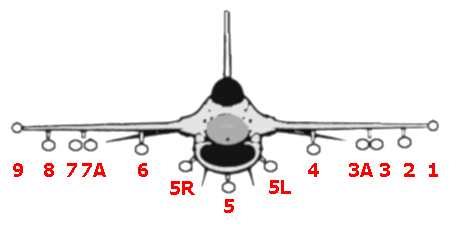
| F-16 Rail Stores Loadings | Right Wing | � | � | � | � | � | Center | � | � | � | � | � | Left Wing | |
| Rail ID | � | 9 | 8 | 7 | 7a | 6 | 5R | 5 | 5L | 4 | 3a | 3 | 2 | 1 |
| Defensive Counterair | � | AMRAAM | AMRAAM | Sidewinder | � | 370g Tank | � | � | � | 370g Tank | � | Sidewinder | AMRAAM | AMRAAM |
| Interdiction 1 | � | AMRAAM | GBU24 | � | 370g Tank | � | LANTIRN | � | 370g Tank | � | GBU24 | AMRAAM | ||
| Interdiction 2 | � | Sidewinder | AGM65 | � | 370g Tank | � | ECM Pod | � | 370g Tank | � | AGM65 | Sidewinder | ||
| Suppress Enemy Air Defense | � | Sidewinder | � | Harm | � | 370g Tank | � | LANTIRN | � | 370g Tank | � | Harm | � | Sidewinder |
Sources
The info for this plane was taken from the following sources on the internet and all credit should go to them. If you want to know more about this aircraft, I suggest checking out these great sites.American Fighters and Bombers
Military Analysis Network
F-16 Falcon
F-16 Page
F-16 Net
F-16