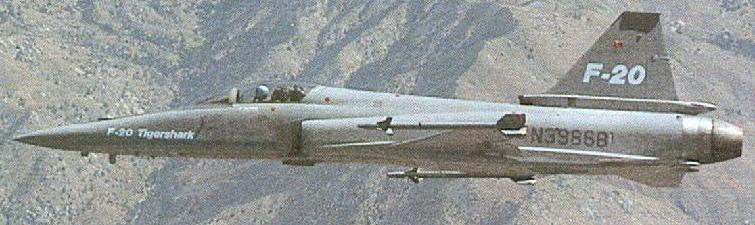
Northrop developed the F-20 Tigershark in response to a U.S. Government call for the private development of a tactical
fighter specifically tailored to meet the security needs of allied and friendly nations.
The first flight of the Tigershark was made August 30, 1982. The Mach 2 class F-20 Tigershark's basic single-seat configuration was formally designated the F-20A. The F-20 combined propulsion, electronics and armament technologies with improvements in reliability to sustain high sortie rates in adverse weather.
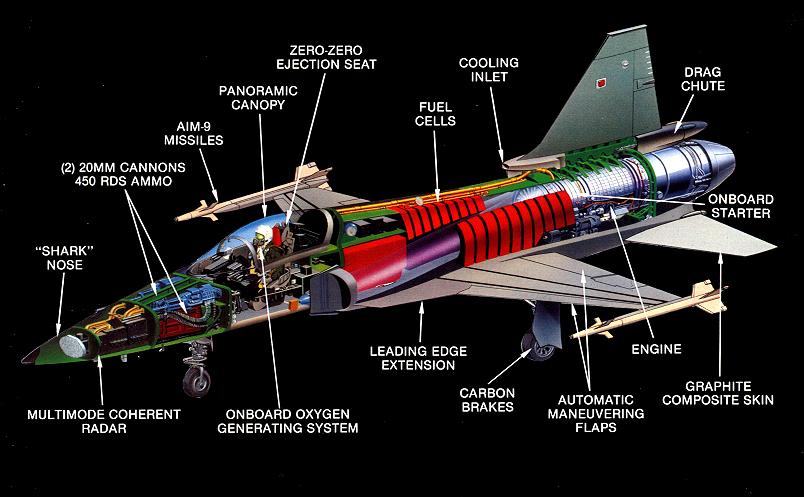
The F-20 incorporated a combination of advanced technology features. The F-20 could carry more than 8,300 pounds of external armaments and fuel on five pylons. It could carry six Sidewinder missiles on air-to-air missions. For air-to-ground missions, more than 6,800 pounds of armament could be
carried. Two internally mounted 20mm guns were standard equipment on the Tigershark.
The avionics system features a General Electric multimode radar, Honeywell laser inertial navigation system, General
Electric head-up display, Bendix digital display and control set and Teledyne Systems mission computer.
The F-20 is powered by a General Electric F404 engine, with 17,000 pounds of thrust. The F404 is recognized as one of
the world's most reliable advanced technology engines. It is also used to power the U.S. Navy/Marine Corps F/A-18A
Hornet strike fighter.
Once airborne, the F-20 pilot utilized his multimode radar, which could detect and
track targets at ranges of up to 48 nautical miles "look up" and 31 nautical miles "look down." The F-20 mission computer coordinated the aircraft's weapons systems. The head-up display placed critical weapons, target and flight data at the pilot's eye level. This allowed him to fight without
having to look down. Northrop designed a new panoramic canopy for the F-20 that gave the pilot a 50 percent increase in rearward visibility over previous Northrop fighters. An improved seat and headrest
design combined to substantially expand over-the-shoulder visibility, which is critical in air-to-air
combat.
Aerodynamic features of the F-20 included an enlarged leading edge extension to the wing, which
generated up to 30 percent of the lift maneuvers. The "shark-shaped" nose allowed the F-20 to
maneuver at much higher angles of attack than current operational fighters. The F-20 airframe could withstand nine G's.
The F-20 was reliable and easy to maintain.
Based on comparisons with the average of contemporary international fighters, the F-20
consumed 53 percent less fuel, required 52 percent less maintenance manpower, had 63
percent lower operating and maintenance costs and had four times the reliability.
Type: F-20
Function: fighter
Year: 1982
Crew: 1
Engines: 1 * 7711 kg G.E. F404-GE-100
Wing Span: 8.13 m
Length: 14.17 m
Height: 4.22 m
Wing Area: 17.28 m2
Empty Weight: 5089 kg
Max.Weight: 12475 kg
Max. Speed: 2124 km/h
Ceiling:
Max. Range: 2965 km
Armament: 2*g 20 mm 3175 kg
Sources
The info for this plane was taken from the following sources on the internet and all credit should go to them. If you want to know more about this aircraft, I suggest checking out these great sites. Military Plane Library Military Analysis Network Fighter Planes