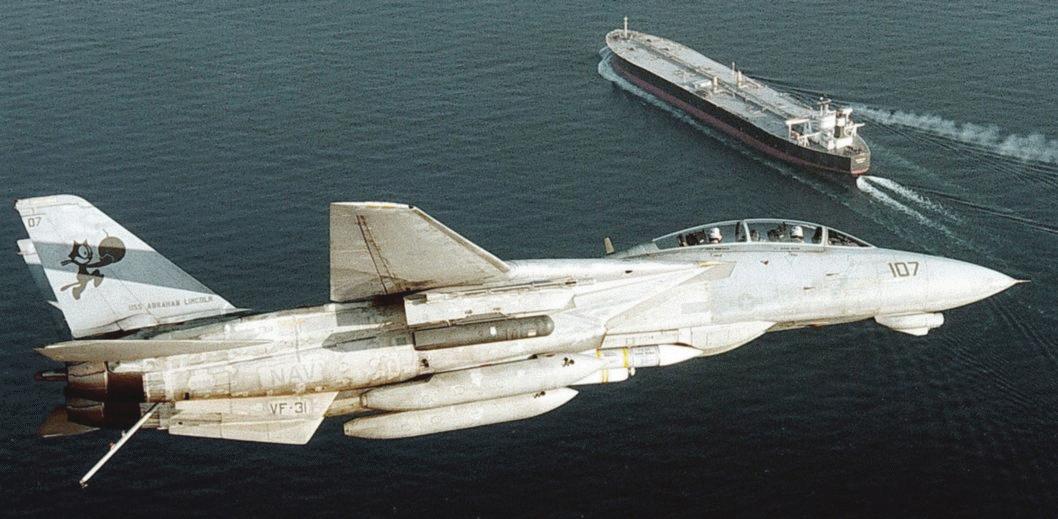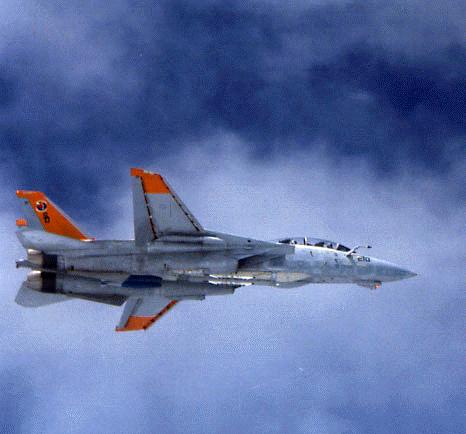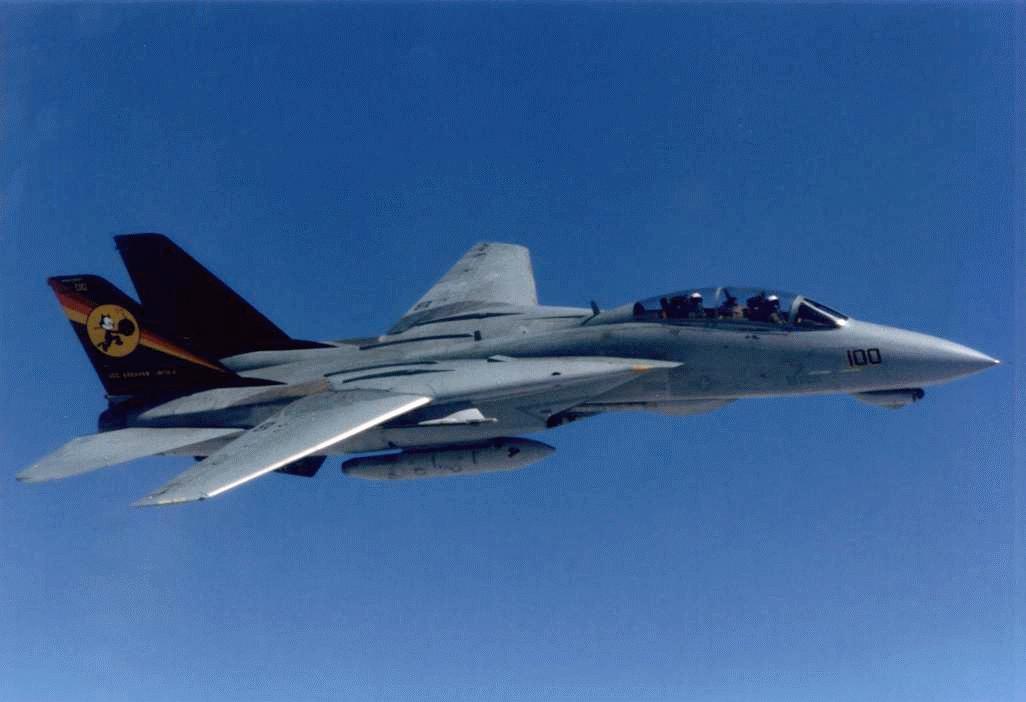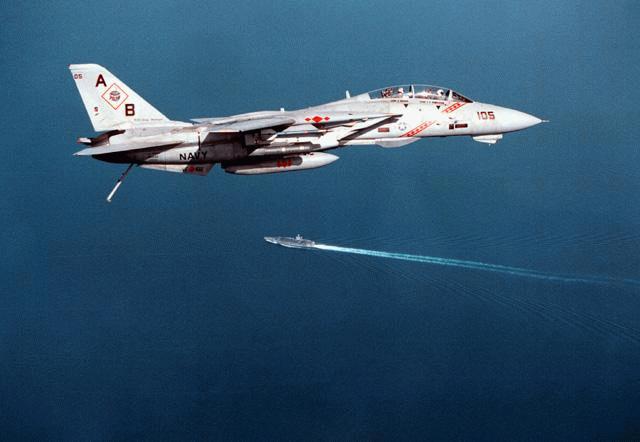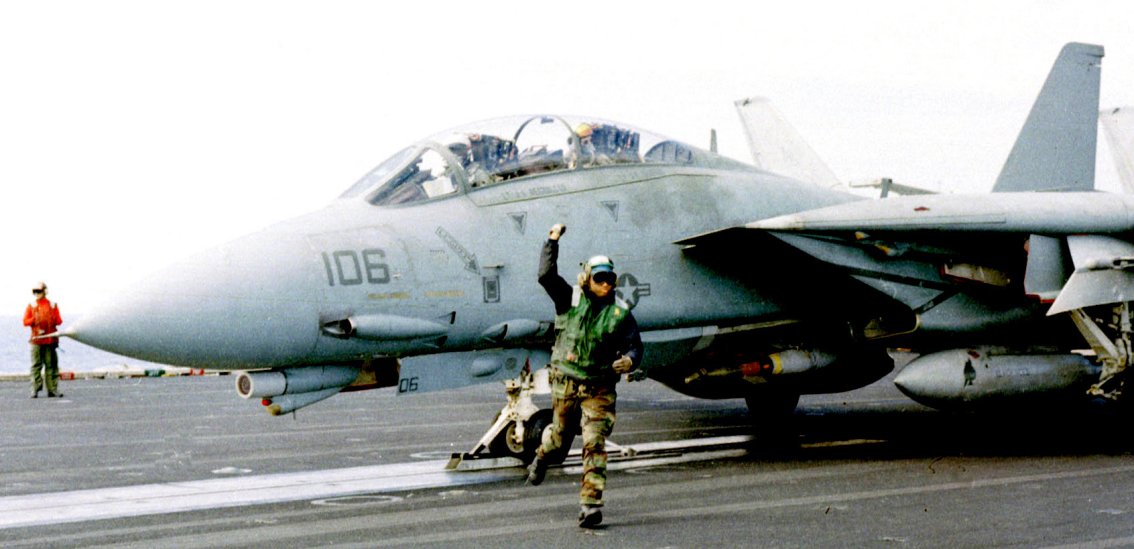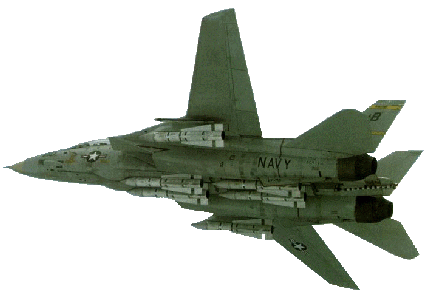
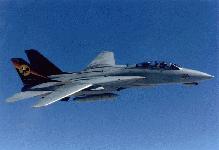
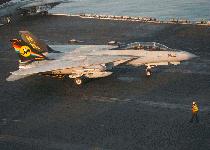
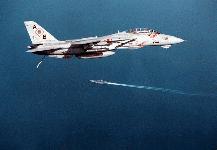
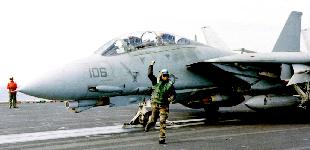
Specification: F-14 TomcatFlown for the first time on December 21, 1970 in prototype form, the first of 478 F-14A aircraft were delivered to the US Navy in October 1972 for operation in September 1974. Despite it's age, the Tomcat is still one of the most potent interceptors in the world. Boasting up to six AIM-54C Phoenix AAMs, the F-14A is capable of destroying six separate targets at ranges in excess of 100 miles. A total of 79 of the type were exported to Iran.
After problems with the initial TF30 engine, Grumman produced a Tomcat powered by a pair of GE-400 turbofans. The aircraft became the prototype for the F-14A+, or later the production F-14B. Test flights began in July 1981 with the aircraft entering service in November 1987. A vastly improved model, the F-14D Super Tomcat of which 37 were built, first took to the air on February 9, 1980 and includes enhanced radar and cockpit, a dual IRST/TV undernose pod, and increased AAM capability.
Tomcats are now being equipped for night-attack bombing duty with the use of LANTIRN (Low Altitude Navigation and Targeting InfraRed for Night) pods. Placed on an external point beneath the right wing, the LANTIRN pod will allow the F-14 to drop laser-guided bombs under the cover of darkness.
F-14A Production version. 557 aircraft delivered from October 1972 to March 1987. 32
currently in US Navy service are to be upgraded to F-14A+ standard.F-14A+ Super Tomcat F-14A with General Electric 27,600-lb (12,519-kg) static thrust
F110-GE-400 smokeless, turbofan engines. Re-engining reduces the max power loading for
an F-14A configured for fleet defense by 25%. F-14A+ can make catapult take-offs without
afterburner, has its DLI radius extended by 60%, and its CAP time on station by 35%. The
austere avionics upgrade includes the Litton AN/ALR-67 Radar Warning Receiver (RWR).
The flaps/slat system is strengthened to reduce its need for frequent maintenance.First delivered in December 1987. Effort included 38 new F-14A+ and 32 modified F-14A
aircraft that were to be upgraded to F-14D. In September 1989, an F-14A+ achieved
supersonic cruise without afterburner, holding Mach 1.08 for 2 minutes.F-14B Version with F401-PW-400 engines. 1 F-14A modified to this standard; none built.
F-14C Planned upgrade of F-14B to new avionics; not procured.
F-14D Production version with F110-GE-400 engines, digital avionics, AN/APG-71 radar.
The core of the digital avionics is a Navy-supplied Control Data AN/AYK-14 general-
purpose processor modified to increase its computing speed. New defensive avionics include
the ALR-67 RWR and Westinghouse ALQ-165 Airborne Self-Protection Jammer that uses
travelling-wave tubes for signal generation and is reprogrammable to meet new threats. A
digital inertial navigation system is also being fitted as is the Smiths Industries AN/AYQ-15
Stores Management System (SMS).The APG-71 is Hughes development of AWG-9 with monopulse angle tracking, greater
Electronic Counter Countermeasures (ECCM) capability through new antenna, and
high-speed digital signal processor originally developed for the APG-70 radar used in the
F-15 Eagle. A General Electric AN/AAS-42 Infrared Search and Tracking (IRST) system
operates in the 8-12 micron range and is intended to complement the Television Camera
System (TCS). The first IRST is planned for delivery in Fall 1991.Grumman would like to "mechanize" sensor control, creating a sensor fusion among the
IRST, APG-71, and the TCS that allows any of the 3 to take over as master sensor for more
efficient search patterns and routines; this is more likely to be a part of a Tomcat 21 program.
Soviet Su-27 Flanker** and MiG-29 Fulcrum** aircraft already possess a similar capability.The APG-71 will also be continually modified. Inclusion of a Joint Tactical Information
Distribution System (JTIDS) would allow 1 F-14D to pass on its radar-generated
information to other, "silent" F-14s.Cockpit upgrades include a Kaiser HUD using a combining glass and having a 30- x
23.5-deg field of view, Multi-Function Displays (MFD) similar to those fitted in the F/A-18
Hornet, Hands-On-Throttle-And-Stick (HOTAS) "switchology". The analogue Automatic
Flight Control System (AFCS) is due to be replaced by a triple-redundant digital AFCS;
other control system upgrades include digital wing and flap controllers, an aileron-rudder
interconnect, and digital automatic power compensation.The F-14D can carry the AIM-120 AMRAAM air-to-air missile, (although configuration
isn't planned until 1994), and is easily configured to fire the AGM-84 Harpoon anti-ship and
AGM-88 HARM anti-radar missiles.Quickstrike
Interim upgrade to F-14D to offset cancellation of A-12 Avenger and probable delays in
development of F/A-18E/F strike aircraft. F-14D radar would have additional air-to-ground
modes similar to those in F-15E's APG-70 radar (synthetic aperture, Doppler beam
sharpening, fixed-target track), weapons control system would permit launch of stand-off
ground-attack missiles, a 2-pod Forward-Looking IR (FLIR) navigation and attack system,
and a Loral Aeronutronic (formerly Ford Aerospace) Night Owl FLIR with laser
rangefinder/tracker would also be fitted along with a television camera system.The FLIR pods would be installed on the glove pylons. 300-US gal (1,136-liter) drop tanks
could be carried on the rear fuselage rails.In May 1991, the House recommended that $50 million in R & D funding for Quickstrike be
authorized.Tomcat 21
Grumman private-venture offering for long-range, air-to-ground variant revealed in late 1988.
Would be fitted with 30,000-lb (13,608-kg) class General Electric F110-GE-429 engines;
design would seek Mach 1.3 "super-cruise" capability without afterburner. Attack weapons
loads would be up to 6 1,970-lb (894-kg) Mk 84 bombs or AGM-84 Harpoon anti-ship
missiles, 5 AGM-84E SLAM long-range attack missiles, or 4 AGM-65 Maverick
air-to-ground missiles. As many as 8 AMRAAM could be carried on outboard pylons.Avionics improvements would include the 2-pod FLIR navigation and attack system and
Night Owl FLIR. Synthetic-aperture and inverse synthetic-aperture ground-attack targeting
modes would be added to the APG-71 radar.The glove vane housing in the fixed leading edges would be enlarged and covered to contain
an additional 2,600 lb (1,179 kg) of fuel. High-lift device revisions, including an increased-
chord slat and Fowler trailing-edge flaps, would be aimed at reducing approach speed to
118 kts (136 mph; 219 km/h) while carrying weapons. The aircraft's radar signature would
also be reduced through modifications that would add approx 1,000 lb (454 kg) to the
aircraft's empty weight. Max gross take-off weight would increase to 76,000 lb (34,473 kg).Attack Super Tomcat 21
Proposed attack variant with the A-12's AN/APQ-183 radar, thicker outer wing panels for
more fuel; 600 kt (691 mph; 1,111 km/h) or Mach 0.9 at low altitude without afterburner.ISSUES
The Tomcat's size, speed, and range, outstanding cockpit visibility, coupled with its
unparalleled radar and missile systems make it the premier fighter in Western service
according to many observers. Other observers have felt that ever since the VFX design was
first offered that it has been too large and too expensive.Whatever the merits of either position, it is clear that this controversial aircraft suffers from
problems associated with 1960s-era avionics and engines. The AWG-9 radar is unreliable
and lacks a medium pulse repetition frequency mode. The Phoenix missile, in both its original
AIM-54A and the recent "digital" AIM-54C and C+ versions, has had production and
cost-growth problems. The flap and slat system is a high-maintenance, low- reliability system,
especially when used in the combat maneuvering mode.The biggest problem has been the TF30 engine. The TF30 was originally intended as an
interim engine until the Advanced Technology Engine (ATE)/F100 engine was developed, at
which time production was to have shifted to the F-14B. When that program fell through
because of funding constraints, the F-14A remained mismatched to an relatively low-thrust
engine with poor throttle response and a propensity for compressor stalls. In 1984,
then-Secretary of the Navy John Lehman stated that the TF30 had accounted for 28% of all
F-14 crashes.In April 1989, Navy officials were reported to be considering an F-14D-minus that would
have F-14D avionics, but retain the TF30 engine. The newer F110 was said to be having
compressor blade and accessory gearbox problems that were delaying Navy acceptance. It
was further suggested that these problems lay behind Secretary of Defense Cheney's decision
to cancel the new-construction F-14Ds in favor of modernizing the F-14As and waiting for
the proposed naval variant of the Advanced Tactical Fighter (NATF).Proponents of the plan to end production argued that the F-14 is a 1960s-vintage design and
that funding for new fighters should be reserved for the NATF. Opponents contend that the
NATF would inevitably be delayed and, moreover, that Grumman would probably be forced
to end all new-aircraft design and production, leaving the US with only 1 naval fighter
manufacturer (McDonnell Douglas).The November 1989 Congressional Conference report authorized 18 more new-build
aircraft for FY1990, but stated that production was to end with that batch. Supporters of the
F-14D believed that the NATF will eventually be cancelled and that remanufacturing
contracts will maintain Grumman's ability to produce fighter aircraft until the Navy elects to
built the Tomcat 21.The cancellation of the A-12 Advanced Tactical Aircraft (ATA) in January 1991 revived
hopes that the Tomcat 21 or a similar design might be adopted in the interim. The February
1991 cancellation of the existing remanufacturing contract dimmed those hopes considerably,
although legislation to fund Operation Desert Storm included a requirement that the Navy
spend the money already appropriated for remanufacturing. Debate over the wisdom of
funding further remanufacturing or Tomcat upgrades formed part of the debate over future
Navy aircraft during all of the budget deliberations.
Prime contractor: Grumman Aerospace
Nation of origin: USAFunction: Multi-role fighter
Crew: 2
Year: 1970
In-service year: F-14A - 1974, F-14D - 1980Engine: Two General Electric F110-GE-400 afterburning turbofans, 27,000 lb thrust each
Dimensions
Wing span:
@ 20 degrees 19.56 m / 64 ft 2 in
@ 68 degrees 11.63 m / 38 ft 2 in
Length: 19.10 m / 62 ft 8 in
Height: 4.88 m / 16 ftWeight: 41,780 lb empty / 74,348 lb max. take off
Ceiling: 56,000 ft
Speed: 2,500 km/h / 1,563 mph at ceiling
Range: 3,220 km / 2,013 milesArmament: One 20mm M61A1 Vulcan six-barrel cannon with 675 rounds, plus up to four AIM-54C Phoenix AAMs, four AIM-7 Sparrow AAMs, four AIM-9 Sidewinder AAMs, cluster bombs, and two drop tanks
Sources
The info for this plane was taken from the following sources on the internet and all credit should go to them. If you want to know more about this aircraft, I suggest checking out these great sites.
F-14 Tomcat
Chris's F-14 Tomcat Page
Tomcat's World
Tomcat Alley
Click here for technical specs of the F-14 Tomcat
[BACK] [MAIN]