 |
|
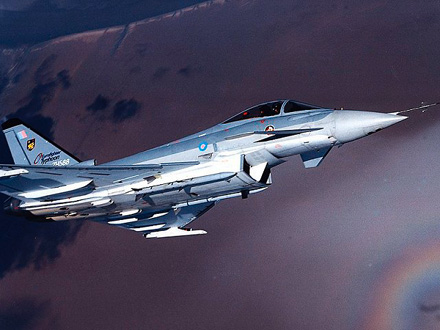
Eurofighter
In September 1998 the Eurofighter was also designated the Typhoon, though this nomenclature is intended only for use in export markets outside Europe. Eurofighter remains the offical name in Europe, and Typhoon will not automatically be the EF2000s name with the four partner air forces when it enters service in 2002/3.
Eurofighter production will make use of several innovations in production engineering. These include the use of a modern integrated design, manufacturing and management systems and the introduction of automated processes for the production of a number of aircraft components."
Eurofighter is a single-seat, twin-engine, agile combat aircraft which will be used in the air-to-air, air-to-ground and tactical reconnaissance roles. The design of Eurofighter Typhoon is optimised for air dominance performance with high instantaneous and sustained turn rates, and specific excess power. Special emphasis has been placed on low wing loading, high thrust to weight ratio, excellent all round vision and carefree handling. The use of Stealth technology is incorporated throughout the aircraft�s basic design.
Eurofighter�s high performance is matched by excellent all round vision and by sophisticated attack, identification and defence systems which include the ECR 90 long range radar and Infra Red Search and Track (IRST) system, advanced medium and short range air-to-air missiles and a comprehensive electronic warfare suite to enhance weapon system effectiveness and survivability. Eurofighter Typhoon is intentionally aerodynamically unstable to provide extremely high levels of agility, reduced drag and enhanced lift. The unstable design cannot be flown by conventional means and the pilot controls the aircraft via a computerised �fly by wire� system.
The Eurojet EJ200 military turbofan was designed specifically to match Eurofighter Typhoon�s mission requirements. The overall design ensures a small lightweight engine with the thrust and strength to match the typically on demand reheat temperatures generated during combat. The EJ200 engine combines high thrust with low fuel consumption. To reduce ownership cost over Eurofighter Typhoon�s in-service life of 25 years or 6,000 flying hours, and to ensure maximum availability, the important areas of Reliability, Maintainability and Testability have been given equal priority to performance and flight safety.
Since Eurofighter first flew in Germany on 27 March 1994 all seven development aircraft have flown. Aircraft in the flight test programme have completed over 790 sorties (658 hours). Full carefree handling and a speed of Mach 2.0 have been achieved as have air to air refuelling and weapons firings of Sidewinder and AMRAAM. Pilots have described the aircraft as 'exhilarating' to fly.

 CARBON FIBRE COMPOSITE
 ALUMINIUM LITHIUM
 TITANIUM
 GLASS REINFORCED PLASTIC
 ALUMINIUM CASTING

Specs
Nation: UK, Germany, Italy, Spain
Manufacturer: British Aerospace (UK), Daimler-Benz Aerospace (Germany), Alenia Aerospazio (Italy), CASA (Spain)
Type: Multirole Fighter
Year: est. 2002 service entry (RAF)
Engine: 2 Eurojet EJ200 afterburning turbofans, 13,490 lb thrust each
Span: 34 ft 5 in Length: 47 ft 7 in Height:
Loaded Weight: 21000 kg
Ceiling:
Range:
Crew: 1 or 2
Armament: 1 27mm Mauser cannon and (RAF info):
Air Interdiction: 2 Storm Shadow, 2 ALARM, 4 AMRAAM, 2 ASRAAM, 2 1,500 litre fuel tank, 1 1,000 litre fuel tank
Close Air Support: 18 Brimstone, 4 AMRAAM, 2 ASRAAM, 1 1,000 litre fuel tank
SEAD: 6 ALARM, 4 AMRAAM, 2 ASRAAM, 1 1,000 litre fuel tank
Maritime Attack: 4 Penguin, 4 AMRAAM, 2 ASRAAM, 2 1,500 litre fuel tank, 1 1,000 litre fuel tank
Performance Details:
| Maximum speed | : | 2125 km/hr |
| Time to 10,670m | : | 2.5 minutes |
| Runway requirement | : | 700m |
| T/O run, air combat mission | : | 300m |
| Combat radius, ground attack, lo-lo-lo | : | 601 km |
| Combat radius, ground attack, hi-lo-hi | : | 1389 km |
| Air defence with 3hr CAP | : | 185 km |
| Air defence with 10-min loiter | : | 1389 km |
| g limits, int fuel and two AIM-120 | : | +9/-3 |


