 |
History of The Strike Eagle
A multimission avionics system sets the F-15 apart from other fighter aircraft. It includes a head-up display, advanced radar, inertial navigation system, flight instruments, UHF communications, tactical navigation system and instrument landing system. It also has an internally mounted, tactical electronic-warfare system, "identification friend or foe" system, electronic countermeasures set and a central digital computer.
Through an on-going multistage improvement program the F-15 is receiving extensive upgrade involving the installation or modification of new and existing avionics equipment to enhance the tactical capabilities of the F-15.
The head-up display projects on the windscreen all essential flight information gathered by the integrated avionics system. This display, visible in any light condition, provides the pilot information necessary to track and destroy an enemy aircraft without having to look down at cockpit instruments.
The F-15's versatile pulse-Doppler radar system can look up at high-flying targets and down at low-flying targets without being confused by ground clutter. It can detect and track aircraft and small high-speed targets at distances beyond visual range down to close range, and at altitudes down to tree-top level. The radar feeds target information into the central computer for effective weapons delivery. For close-in dog fights, the radar automatically acquires enemy aircraft, and this information is projected on the head-up display.
An inertial navigation system enables the Eagle to navigate anywhere in the world. It gives aircraft position at all times as well as pitch, roll, heading, acceleration and speed information.
The F-15's electronic warfare system provides both threat warning and automatic countermeasures against selected threats. The "identification friend or foe" system informs the pilot if an aircraft seen visually or on radar is friendly. It also informs U.S. or allied ground stations and other suitably equipped aircraft that the F-15 is a friendly aircraft.
A variety of air-to-air weaponry can be carried by the F-15. An automated weapon system enables the pilot to perform aerial combat safely and effectively, using the head-up display and the avionics and weapons controls located on the engine throttles or control stick. When the pilot changes from one weapon system to another, visual guidance for the required weapon automatically appears on the head-up display.
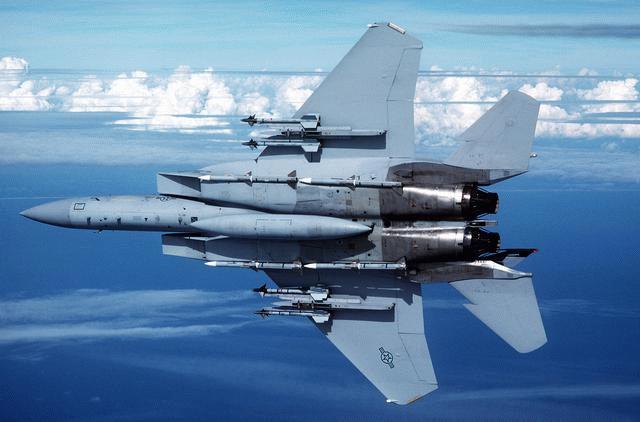
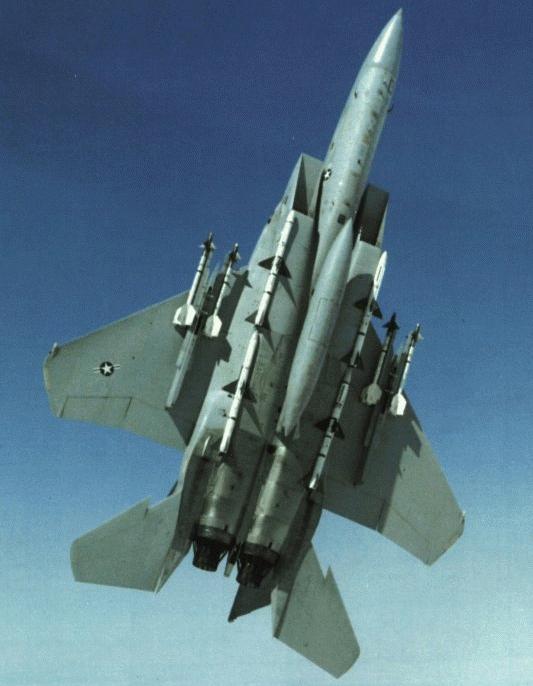
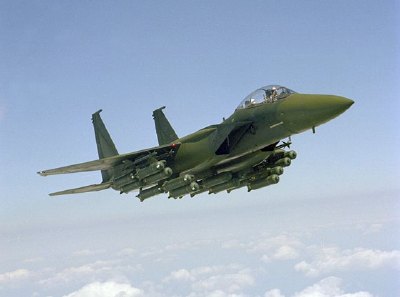
The Eagle can be armed with combinations of four different air-to-air weapons: AIM-7F/M Sparrow missiles or AIM-120 Advanced Medium Range Air-to-Air Missiles on its lower fuselage corners, AIM-9L/M Sidewinder or AIM-120 missiles on two pylons under the wings, and an internal 20mm Gatling gun (with 940 rounds of ammunition) in the right wing root.
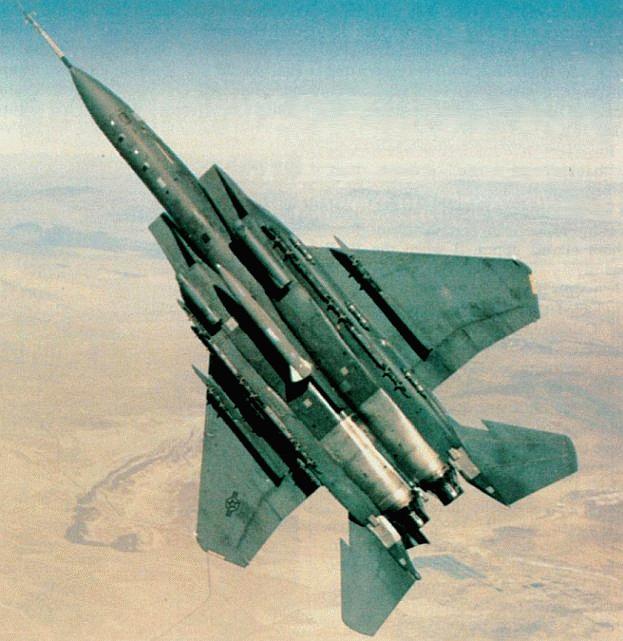
Low-drag, conformal fuel tanks were especially developed for the F-15C and D models. Conformal fuel tanks can be attached to the sides of the engine air intake trunks under each wing and are designed to the same load factors and airspeed limits as the basic aircraft. Each conformal fuel tank contains about 114 cubic feet of usable space. These tanks reduce the need for in-flight refueling on global missions and increase time in the combat area. All external stations for munitions remain available with the tanks in use. AIM-7F/M Sparrow and AIM-120 missiles, moreover, can be attached to the corners of the conformal fuel tanks.
The Eagle has been chosen by three foreign military customers to
modernize their air forces. Japan has purchased and produces an air-to-air F-15 known as the F-15J. Israel has bought F-15A, B, and D aircraft from USAF inventories and is currently obtaining an air-to-ground version called the F-15I. Similarly, Saudi Arabia has purchased F-15C and D aircraft and will soon acquire the air-to-ground F-15S. F-15C's, D's and E's were deployed to the Persian Gulf in 1991 in support of Operation Desert Storm where they proved their superior combat capability with a confirmed 26:0 kill ratio.
The F-15C has an air combat victory ratio of 95-0 making it one of the most effective air superiority aircraft ever developed. The US Air Force claims the F-15C is in several respects inferior to, or at best equal to, the MiG-29, Su-27, Su-35/37, Rafale, and EF-2000, which are variously superior in acceleration, maneuverability, engine thrust, rate of climb, avionics, firepower, radar signature, or range. Although the F-15C and Su-27P series are similar in many categories, the Su-27 can outperform the F-15C at both long and short ranges. In long-range encounters, with its superiorr radar the Su-27 can launch a missile before the F-15C does, so from a purely kinematic standpoint, the Russian fighters outperform the F-15C in the beyond-visual-range fight. The Su-35 phased array radar is superior to the APG-63 Doppler radar in both detection range and tracking capabilities. Additionally, the Su-35 propulsion system increases the aircraft�s maneuverability with thrust vectoring nozzles. Simulations conducted by British Aerospace and the British Defense Research Agency compared the effectiveness of the F-15C, Rafale, EF-2000, and F-22 against the Russian Su-35 armed with active radar missiles similar to the AIM-120 Advanced
Medium Range Air-to-Air Missile (AMRAAM). The Rafale achieved a 1:1 kill ratio (1 Su-35 destroyed for each Rafale lost). The EF-2000 kill ratio was 4.5:1 while the F-22 achieved a ratio of 10:1. In stark contrast was the F-15C, losing 1.3 Eagles for each Su-35 destroyed. (Although it must be noted that these tests are highly suspect because there are a variety of factors that can determine the outcome of a dogfight such as range of engagement, pilot skill, surprise, etc.)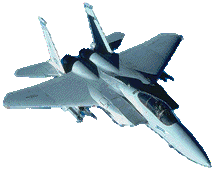 The McDonnell Douglas F-15 Eagle is one of the world's most formidable interceptor fighters. Although largely designed in the late 1960s and early 1970s, it still remains the primary air-superiority fighter serving with the USAF, and will remain so for the rest of this century. In service with the United States, Israeli, and Saudi Arabian air forces, the Eagle has scored an impressive number of air-to-air kills, perhaps approaching 100, with NO air-to-air losses. The McDonnell Douglas F-15 Eagle has its origin back in the mid-1960s, when the US aircraft industry was invited to study US Air Force requirements for an advanced tactical fighter that would replace the F-4 Phantom as the primary fighter aircraft in service with the USAF. Such an aircraft needed to be capable of establishing air superiority against any projected threats in
the post-1975 period. Without compromising the primary air-to-air combat role, the aircraft was to be capable of performing a secondary air-to-ground mission.
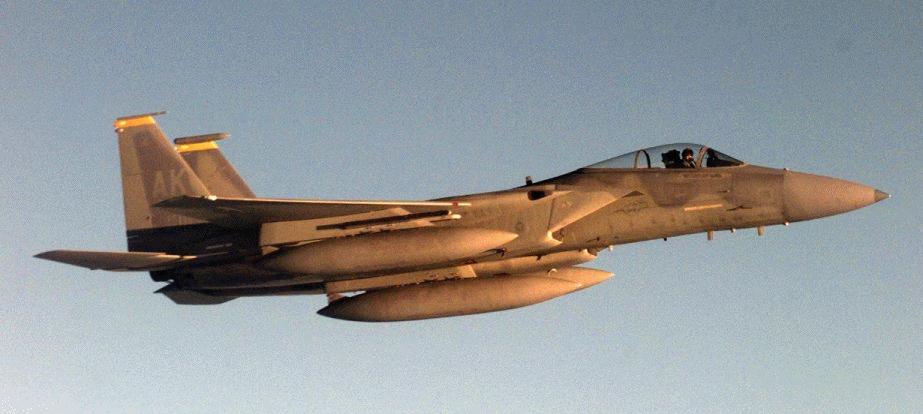
The McDonnell Douglas F-15 Eagle is one of the world's most formidable interceptor fighters. Although largely designed in the late 1960s and early 1970s, it still remains the primary air-superiority fighter serving with the USAF, and will remain so for the rest of this century. In service with the United States, Israeli, and Saudi Arabian air forces, the Eagle has scored an impressive number of air-to-air kills, perhaps approaching 100, with NO air-to-air losses. The McDonnell Douglas F-15 Eagle has its origin back in the mid-1960s, when the US aircraft industry was invited to study US Air Force requirements for an advanced tactical fighter that would replace the F-4 Phantom as the primary fighter aircraft in service with the USAF. Such an aircraft needed to be capable of establishing air superiority against any projected threats in
the post-1975 period. Without compromising the primary air-to-air combat role, the aircraft was to be capable of performing a secondary air-to-ground mission.

History
Jet fighters were thus not true replacements for the long-range piston-engined fighters of World War II, such as the North American P-51 Mustang, Republic P-47 Thunderbolt and Lockheed P-38 Lightning. This point was driven home in the 1960s, when the USAF attempted to win control of the air over North Vietnam. Some degree of control was eventually won, but at times the monthly kill ratio favored the enemy's Mikoyan-Gurevich MiG-17s and MiG-21s, and the USAF prevailed only by the extensive use of inflight refuelling for its fighters.
�
First Flight
The F-15 was also to have had Philco-Ford GAU-7A 25-mm Gatling gun with caseless ammunition. In this concept the projectile is bonded to a solid block of propellant, to eliminate the weight of the normal case and the time needed to extract it after firing.U
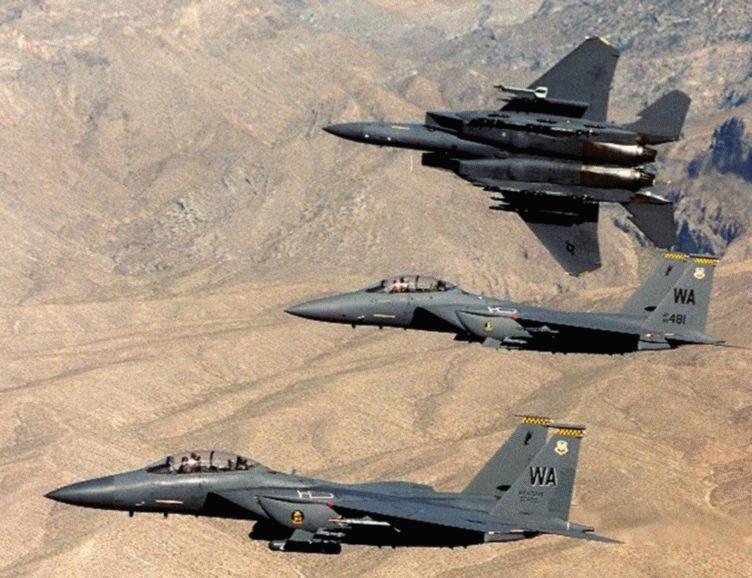
nfortunately, development problems with the gun and its revolutionary ammunition led to its cancellation, and the F-15 reverted to the well-proven General-Electric M61 Vulcan gun that arms most American fighters. The first F-15A was formally rolled out in June 1972, and had its maiden flight on 27 July, being followed by the first two-seater on 7 July 1973. Funding for the first 30 production aircraft was released late in 1973, and for a further 77 aircraft (to complete the first wing) a year later. The first of 729 production F-15s then planned (one in seven being a two-seater) left the ground on 25 November 1974. Initial operational capability was declared on July 1975, following delivery of the 24th aircraft. The first wing was fully equipped by the end of 1976. Having got the F-15 into service, this may be a convenient point to describe the aircraft that McAir had produced. In several respects the F-15 bears a strong family resemblance to the preceding F-4, despite being a completely new design. The highly tapered, moderately swept wing is broadly in line with F-4 practice, although it is set high on the fuselage and avoids the need for the steep outboard dihedral of its predecessor. A better clue to the F-15's ancestry comes from the semi-recessed Sparrow missiles and the way the jetpipes are cut short, with the tail mounted well aft. In the case of the F-4, there is a single fin mounted on what is effectively a vestigial fuselage or tail boom. For the F-15, the use of Vigilante-style intakes necessitated the use of twin vertical tails to avoid the destabilizing airflow from the flat upper surface of the cowlings, so the aircraft has been given twin tail-booms on either side of the afterburners, with half the vertical tail and half the tailplane mounted on each. One of the most important considerations in the design of the F-15 was operation at high angles of attack (AOA). This led to the choice of horizontal-ramp two-dimensional intakes, rather than the vertical ramps used on the F-4. A feature unique to the F-15 is that the intakes are hinged about the lower lip, and rotated downwards as AOA increases, which minimizes spillage, drag and its adverse effect on the vertical tails. Another important consideration was all-round view: the F-15 provided the best rear view of any fighter since the F-86, with the pilot seated high in a bubble canopy. Combat effectiveness also benfits from the use of an advanced head-up display (HUD) and the fact that most of the control functions needed in combat can be carried out without the pilot removing his hands from the control column and throttles. This HOTAS (hands-on-throttle-and-stick) system has controls for radar and missiles, gun, air-brake, microphone button and weapons release. The F-15 airframe is relatively conventional in construction, but the rear fuselage is largely built of titanium, which makes up 26.5 per cent of structure weight. Graphite composites are used in the airbrake and the tail surfaces, but represent only 1.0 per cent of the structure. Dash speeds of more than Mach 2.5 are permitted, as are indicated airspeeds of 936 mph (1506 km/h), and load factors of +9g and -3g. The aircraft has been flown to an AOA of +120� and -60� . In air-superiority configuration, the F-15 takes off in 900 ft (275 m) and lands in 2,500 ft (760 m). Perhaps the most dramatic demonstration of the aircraft's performance was the USAF "Strike Eagle" project of early 1975 in which an F-15 set new record times to eight altitudes, beating figures previously set by the F-4 for the lower five and the Soviet Union's E-266 (MiG-25 "Foxbat") for the upper three heights. The new times were: 27.57 sec to 9,845 ft (3000 m), 39.33 sec to 19,685 ft (6000 m), 48.86 sec to 29,530 ft (9000 m), 59.38 sec to 39,370 ft (12000 m), 77.04 sec to 49,215 ft (15000 m), 122.94 sec to 65,615 ft (20000 m), 161.02 sec to 82,020 ft (25000 m) and 207.8 sec to 98,425 ft (30000 m). The F-15 thus made its mark even before the first unit was fully equipped. In 1986 the USAF had nine F-15 squadrons in the continental USA, four in Europe, and three in the Pacific. Aside from the 57th Tactical Training Wing (tail code WA) at Nellis AFB, Nevada and the 58th TTW at Luke AFB, Arizona (code LA), the F-15 equipped the 1st Tactical Fighter Wing (code FF) at Langley AFB, Virginia, the 36th TFW (code BT) at Bitburg AB in Germany, the 49th TFW (code HO) at Holloman AFB, New Mexico, the 33rd TFW (code ED) at Eglin AFB, Florida, the 32nd Tactical Fighter Squadron (code CR) at Camp New Amsterdam in the Netherlands, and the 18th TFW at Kadena AB, Okinawa (code ZZ).�
Export customers
The F-15A and F-15B have also been sold to Israel under the "Peace Fox" program, which involved 51 aircraft, of which deliveries began in 1976. The F-15s are flown by No. 133 Sqn, apparently as escorts to strike and reconnaissance aircraft. They have been involved in several dogfights with Syrian MiG-21s and MiG-23s over Lebanon (with very statisfactory results), and escorted the F-16s making the strike against Iraq's Osirak nuclear powerplant on 7 June 1981, covering a radius of 600 miles (960 km). On 26 February 1979 the first of the new F-15Cs took to the air, and deliveries began in the middle of 1980. This second single-seat model has its internal fuel increased from 11,635 lb (5278 kg) to 13,455 lb (6103 kg) under the PEP-2000 program. The F-15C also has provisions for FAST (Fuel And Sensor Tactical) packs on each side of the fuselage, each giving an additional 5,000 lb (2268 kg) of fuel. With FAST packs in place and three 600-US gal (2271-litre) tanks on pylons, the F-15C's gross weight is increased to 66,700 lb (30255 kg). This gives an endurance of over five hours, and an unrefuelled ferry range of 3,080 miles (4957 km). The F-15C and the corresponding F-15D two-seater also have a programmable radar signal processor, giving a fourfold increase in computer capacity, and the ability to continue tracking one target while searching for others at the same time. The Japanese Air Self-Defence Force (JASDF) acquired 88 F-15s to replace four squadrons of F-104Js and operate alongside six squadrons of F-4EJs, the latter apparently being tasked with the less difficult targets. Deliveries began in July 1980. This "Peace Eagle" program includes 12 F-15DJ two-seaters, which, like the first two F-15J single-seaters, will be built at St. Louis by McAir. The remaining 86 F-15Js will be constructed by Mitsubishi Heavy Industries. The first F-15J, which is identical to the F-15C aside from some avionics changes, was handed over in July 1981, and the first operational squadron was activated at Nyutabaru AB in late 1982 or early 1983. The third export customer for the F-15 is Saudi Arabia, which took 62 F-15Cs and 15 F-15Ds delivered between early 1982 and late 1984, with two further F-15Cs as attrition reserves. These aircraft replaced three BAe (BAC) Lightning squadrons based at Dharan, Taif and Khamis Mushayt. Their primary role is be air defence, but the Royal Saudi air force has also requested FAST packs, inflight refuelling provisions, multiple ejection racks (MERs), glide bombs and cluster bomb units (CBUs).Sources
The info for this plane was taken from the following sources on the internet and all credit should go to them. If you want to know more about this aircraft, I suggest checking out these great sites.American Fighters and Bombers
Military Analysis Network
McDonnell Douglas F-15 Eagle
Nick's F-15E Stike Eagle Page