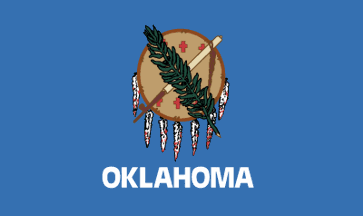
A co-worker of mine shared an awesome testimony early this week (January 2006). Her daughter lives in Tulsa, OK and I asked her how she is doing with the recent prairie fires that has burned many acres around TX and OK. She then told me that "CNN" (other media too) has blown this coverage out of proportion-they've been exagerrating the seriousness. The stories that they don't share don't get attention-A bunch of Christians decided to consider a time to just pray that God will have his hand on this natural disaster. They prayed that the wind will stop blowing the fires. After they prayed, the wind stopped and this prevented the fires from spreading-cool, huh? It gets better! The day after, I was watching news coverage on these fires and saw them reporting snow that fell on this region-awesome answer to prayer!
Related Sites: Wildfires destroy Oklahoma City homes
Texans evacuated as winds, dry conditions fan flames
Monday, January 2, 2006; Posted: 2:21 a.m. EST (07:21 GMT) , CNN "Wildfires have burned in 24 Oklahoma counties since Tuesday, and have claimed 250,000 acres of prairie and 200 homes since November, Oklahoma's emergency management agency reported.
Residents face "extreme fire weather conditions" again Monday, with the potential for fires to spread rapidly.
Central Oklahoma has had only a quarter-inch of rain since the end of October. High temperatures in recent days have ranged around 80 degrees, and strong, gusty winds have hampered firefighters' efforts, state Fire Marshal Robert Doke said." "OKLAHOMA SNOW (KFDX) "
Tuesday, January 10, 2006 Relief for Oklahomans came in the form of snow overnight. Oklahoma City received from 1 to 3 inches, and the farther north, the more snow. More than 10 inches has been reported along the Oklahoma-Kansas line. Although the snow is helpful, state officials say fire dangers remain critical."
My co-worker then shared another encouraging story about the devestating "Oklahoma Bombing" back in 1995 (I first heard of this when I came home from track&field practice during high school). She told me that they picked a time where the whole state of Oklahoma will stop what they are doing (driving, working, eating, etc..) and have a "moment of silence" for the bombing. My co-worker shared that the state froze for about a minute. It was quiet and calm during this time, which I added that you could probably hear God too!
Oklahoma City Bombing
"Edited by EMMY Award Winner- Ward Mankin on the day of the bombing- KOCO-TV- Oklahoma City "
*remembered this during High School
Wikipedia " was a domestic terrorist attack on April 19, 1995 aimed at the U.S. government in which the Alfred P. Murrah Federal Building, an office complex in downtown Oklahoma City, Oklahoma, was bombed. The attack claimed 168 lives and left over 800 people injured. Until the September 11, 2001 attacks, it was the deadliest act of terrorism on U.S. soil.
Shortly after the explosion, Oklahoma State Trooper Charlie Hanger stopped 26-year-old Timothy McVeigh for driving without a license plate and arrested him for that offense and for unlawfully carrying a weapon.[1] Within days after the bombing, Timothy McVeigh and Terry Nichols were both arrested for their roles in the bombing. Investigators determined that they were sympathizers of a militia movement and that their motive was to retaliate against the government's handling of the Waco and Ruby Ridge incidents (the bombing occurred on the anniversary of the Waco incident). McVeigh was executed by lethal injection on June 11, 2001. Nichols was sentenced to life in prison. A third conspirator, Michael Fortier, who testified against McVeigh and Nichols, was sentenced to 12 years in prison for failing to warn the U.S. government. As with other large scale terrorist attacks, conspiracy theories dispute the official claims and point to additional perpetrators involved.
The attacks led to widespread rescue efforts from local, state, and federal and worldwide agencies, along with considerable donations from across the country. As a result of the destruction of the Alfred P. Murrah Federal Building, the U.S. government passed legislation designed to increase protection around federal buildings and to thwart future terrorist attacks. Under these measures, law enforcement has since foiled sixty domestic terrorism plots.[2] On April 19, 2000, the Oklahoma City National Memorial was dedicated on the site of the Murrah Federal Building to commemorate the victims of the bombing and annual remembrance services are held at the time of the explosion."
".. Francisco V�squez de Coronado first explored the region for Spain in 1541. The U.S. acquired most of Oklahoma in 1803 in the Louisiana Purchase from France; the Western Panhandle region became U.S. territory with the annexation of Texas in 1845.
Set aside as Indian Territory in 1834, the region was divided into Indian Territory and Oklahoma Territory on May 2, 1890. The two were combined to make a new state, Oklahoma, on Nov. 16, 1907.
On April 22, 1889, the first day homesteading was permitted, 50,000 people swarmed into the area. Those who tried to beat the noon starting gun were called �Sooners,� hence the state's nickname.
Oil made Oklahoma a rich state, but natural-gas production has now surpassed it. Oil refining, meat packing, food processing, and machinery manufacturing (especially construction and oil equipment) are important industries. Minerals produced in Oklahoma include helium, gypsum, zinc, cement, coal, copper, and silver..."
"..The state's name is derived from the Choctaw words okla and humma, meaning "red people",[5] and is known informally by its nickname, The Sooner State. Formed from the Indian Territory on November 16, 1907, Oklahoma was the 46th state to enter the union. Its citizens are known as Oklahomans, and its capital and largest city is Oklahoma City.
A major producer of natural gas, oil and food, Oklahoma relies on an economic base of aviation, energy, telecommunications, and biotechnology.[6] It has one of the fastest growing economies in the nation, ranking third in per capita income growth and leading in gross domestic product growth.[7][8] Oklahoma City and Tulsa serve as Oklahoma's primary economic anchors, with nearly 60 percent of Oklahomans living in their metropolitan statistical areas.[9] The state holds a mixed record in education and healthcare, and its largest universities participate in the NCAA and NAIA athletic associations, with two collegiate athletic departments rated among the most successful in American history.."
Thank you for visiting GoodnewsUSA! Please feel free to e-mail me (Sal) at [email protected] on any comments, suggestions (e.g. any new websites),complaints, or anytype of feedback to improve this website.