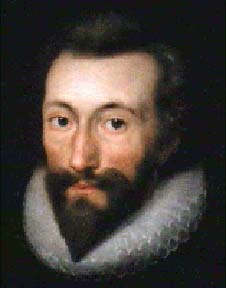
The poetry of John Donne has captivated and evoked emotions in readers for over three and a half centuries. Different critics have had varying views on Donne’s work and there are many different ways in which it can be interpreted. This is one of the features of Donne’s poetry that has made it such a standout from other metaphysical poets and all poets in general – that his poetry can have so many different meanings to readers with many different points of view. From a feminist point of view to a religious one or the views of Donne’s contemporaries, many critics have put forward their thoughts and ideas on the poetry of Donne over the years. At any one time it is impossible to put forward a definitive reading or even one that encompasses all others, such is the diversity with which this poetry can be examined.
I believe Donne is a great poet and one who still appeals to the modern reader, simply because of his incredible ability to blend extraordinary intelligence, a good sense of humor and a sense of the dramatic to express his love for his wife or his devotion to his god. He uses his intelligence to produce amazingly captivating arguments and complex conceits, which seem ridiculous at first before they are explained fully by Donne and form a logical comparison. An example of one of his conceits is the famous comparison of a pair of compasses to a pair of lovers. Donne’s ability to make such an unlikely comparison work underlines his great intelligence. Another way he shows his intelligence is through the pseudo-logical (logical on the surface but not when looked at more closely) arguments that he constructs. For example in “The Sunne Rising” Donne presents an argument that seemingly proves that the Sun has very little importance to him despite the fact that humans rely on the Sun to live.
Donne’s vivid use of imagery is another feature of his poetry, which makes it great. In such poems as “A Valediction: forbidding mourning” and “Batter my heart, three person’d God” Donne uses a variety of imagery to enhance his poetry. In “A Valediction: forbidding mourning” Donne uses quiet, solemn imagery to set the scene of a mans deathbed, surrounded by friends. This scene sets up the poem and helps to strengthen Donne’s argument to his lover, that they should part quietly with dignity. In “Batter my heart, three person’d God” Donne uses his imagery in a more forceful way. With dramatic imagery of the forge, he orders God to “break, blow and burn” and to “ravish” him which creates a very strong image of Donne being purged by God so that he will be “chast” or pure when he enters heaven. Donne’s use of dramatic imagery shows his ability to create a sense of the dramatic in his poetry. This is another feature of Donne’s poetry that appeals to the modern reader. Rather than being too focused on the intellectual as contemporary criticism would present Donne, he gives his poetry passion which draws the reader into the poem and makes the poetry as real today as it was when Donne wrote it. For example in “The Sunne Rising” Donne begins with the bombastic address to the sun “Busie old foole, unruly Sunne”. This also occurs in “Batter my heart, three person’d God” where in the opening line commands God to batter his heart. Both of these poems have extremely dramatic openings, which serve to seize the readers attention from the first line. It is this dramatic element which still interests and lures modern readers to the poetry today.
Donne made an enormous contribution to both love poetry and to religious poetry. He greatly influenced the poets who followed him and he changed the way many of these poets perceived love and religion and the way that they wrote about them. Donne’s main contribution to love poetry was his reaction against love poetry, that was written before his time, that centered mainly on exalting beautiful women and admiring them from afar. Donne was more interested in discussing the nature of love itself and in admiring the physical presence of his lover. He used the ideas of both the sensual and intellectual sides of love and put them side by side in his poetry. I believe Donne also emphasizes the need for unity and equality in true love, although this line of thought is not reflected in feminist criticism. As well as having a great contribution to poetry Donne also manages to express his beliefs and reveal his perspectives on love and devotion.
In “A Valediction: forbidding mourning” Donne shows us his perspective of love which includes two parts, intellectual intimacy and physical intimacy. Firstly he argues that physical separation will not harm true love by saying that he and his lover are “Inter-assured of the mind” meaning that they have a strong intellectual and spiritual relationship whereas “Dull sublunary lovers love / (Whose soule is sense) cannot admit / Absence”. Here Donne is telling his lover that their intellectual love transcends the mere sensual love of all other lovers. However, later on in the same poem Donne alludes to the sensual aspect of love when he uses the compass imagery to make reference to the male erection as he is drawn near to his lover – “And growes erect, as it comes home”. It is this way of looking at the different aspects of love that Donne distinguished himself from the poets before him and set new boundaries for those to come.
Donne’s perspective on death and judgement, also made a contribution to religious poetry. He was the first poet to bring a sense of fear and uncertainty, of facing God and of death, into his poetry. This fear can be seen in “This is my playes last scene” where Donne tells us that he thinks that “gluttonous death, will instantly unjoynt / My body, and soule” when he dies. This combined with Donne’s statement that God’s face “already shakes my every joynt (with fear)” together show, that Donne feels he may be unworthy of God’s grace and may not be admitted into heaven. It also shows that he was willing to write about this fear in his poetry which wasn’t done before his time. This set a precedent for poets like Gerard * Manely Hopkins who wrote of his own doubts about his faith and his religion.
Thus Donne not only presented his perspective in his poetry but in doing so he made great contributions to both love and religious poetry. Donne’s poetry contains a sense of the dramatic, captivating imagery and intellectual skill that still attracts and interests readers over three hundred years after he composed his first poem.