

_jpg.jpg)


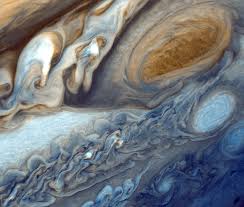
hydrogen and helium, with methane, ammonia, H2S, and water as
condensable aerosols. These gases interact in complex ways to produce
rotating horizontal bands and spinning cyclones (such as the Great Red Spot).
The Red Spot is discussed in the Oct. 1990 Sky & Telescope, pp. 359-364.
It has a rotational period of days. In order of decreasing condensation height
(as well as saturation vapor pressure), the condensable gases are CH4, NH3, NH4SH (NH3H2S),
and H2O. Below Jupiter's 150 km thick gaseous atmosphere, layers of liquid hydrogen and liquid metallic hydrogen
are thought to be present, followed by a rocky core. The central pressure of Jupiter is Mbar.
Jupiter has a magnetic field 10 times as strong as Earths and a small ringlet discovered by Voyager 1.
Jupiter also emits 1.7 as much radiation as it receives from the sun. In addition,
it emits sporadic bursts of non-thermal radio noise at 22.2 MHz (decametric),
in addition to a constant non-thermal emission at 300-3000 MHz (decimetric).