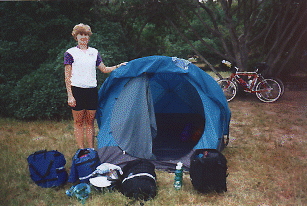
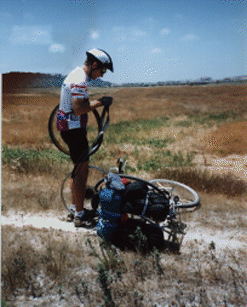
Since we had never done a long tour on our bikes before, Jim and I asked experienced tourists a lot of questions to determine what to take. We tried to avoid the novice pitfall of taking too much unnecessary stuff and kept the list to a minimum. After picking the brains of other tourists and a few practice trips, we came up with the following list. We were pretty happy with what we decided to take because there was really nothing that took up considerable space that we didn't use.
Linda has a 1994 Trek mountain bike. Red - since color is very important. Jim decided to take his 1988 Raleigh mountain bike instead of his newer Kona mountain bike. For this trip we got quite a few add ons. We took the knobby tires off both bikes and put on tires with inverted treads. We took off the standard pedals and put on Onza clipless pedals. These pedals have 6 degrees of float which is easier on the knees, and they give more power then toe clips. Then we put on aero bars and bar ends to increase the comfort factor. Linda got a new saddle designed specially for women, better brake pads (Ritchey Logic), and a new chain and cogs. Linda used a cycling computer to judge the mileage and see how fast (or slow) we went. We expected to average about 10 miles an hour, but averaged a little faster than that.
After totally tweaking the bikes, we put Blackburn mountain racks on the back of each one, and a Low Rider rack on the front of Jim's. We have Zefal fenders on the front and back.
After being good consumers and researching different brands of panniers, we decided to buy the more expensive Jandd panniers for our main panniers because they have a simple attachment to the rear rack, straps that are stitched into the seams, and all the hardware can be easily replaced. We both used Jandd panniers on the rear, and Jim had Nashbar panniers on the front. Linda had a small Trek handle bar bag that converts into a fanny pack for those trips off the bike. We both had small wedge packs under our seats to keep tools and an extra tube.
Linda kept her sleeping bag and both ThermaRest mattresses on the rear rack fastened with 1" flat webbing. Jim kept his sleeping bag and the tent on his rear rack fastened with 1" flat webbing with Fastex buckles. We each topped off the load with bungee cords to place laundry and frequently needed items without undoing the Fastex buckles.
On our training trips, we didn't have the front panniers or the Fastex buckles. Jim got used to riding with the front panniers quickly, and the buckles made fastening his load down each day a lot easier. Linda got a smaller ThermaRest mattress than she used on the practice trips which reduced the wind resistance and bulk when it was strapped on the bike.
We expected the Washington, Oregon and Northern California coasts to be chilly in the mornings and evenings. The clothes that we brought were lightweight and had the ability to be worn in town as well as in camp. We washed out our cycling clothes each night and finished drying them on the bike the next day. The following is an average of what Jim and I took.
With the strenous cycling every day, we expected to be eating 3000 to 4000 calories a day! With that in mind, eating was one of the most important things we did each day, in addition to being loads of fun. Since neither Jim nor I had cooked on a small stove for extended periods of time, the challenge was to find interesting things to make without getting bored of the same thing. Of course there were a few restaurants along the way that we couldn't pass up!
Our MSR Whisperlite stove burns gasoline as well as white gas, but we had no problem getting white gas along the way and used that the entire time. The stove has a shaker jet that automatically cleans as it is shaken around. The shaking in the panniers seemed to keep it pretty clean as we didn't have any problems with it clogging. Here is a list of our kitchen.
MSR International stove
33 oz fuel bottle, 11 oz fuel bottle
MSR 2 pan stainless steel cookset with pot grabber
Collapsible water container for camp use (could have done without)
2 REI insulated mugs
2 non-insulated mugs
2 plates with slight lip
2 big spoons, 2 small forks
Small round plastic cutting board (fits into pan for storage)
For this trip we bought a light North Face tent with the No Hitch Pitch (NHP)
system. This allowed us to leave the poles threaded through the tent and made for a very fast set up each night. We opted for the 3 person tent which gave us a little more room with all our gear. The large vestibule worked out great because we were able to put all our bags in there each night and keep them out of the rain and damp air. We each got new lightweight sleeping bags. Linda's is specially designed for women, with more insulation on the feet and cut wider in the hips and narrower at the shoulders.
2 Sierra Designs Lite Loft sleeping bags (rated to 20 degrees F)
As preparation for this trip, Jim took a bike maintenance class from REI. This gave him a little knowledge to fix the problems that might come our way. Fortunately, when rear wheel disaster occurred, we were close enough to a bike shop so we could limp in. Linda had 4 flats during the trip, Jim had 3, and he also had 2 broken spokes before his rear wheel gave out completely.
Avenir multi-tool (several allen wrenches, and screwdrivers)
3 size socket(?) wrench
Spoke wrench
Chain tool
Extra spokes
Small adjustable wrench
Replacement nuts and bolts for all racks or anything else on the bike
 Linda has a 1994 Trek mountain bike. Red - since color is very important. Jim decided to take his 1988 Raleigh mountain bike instead of his newer Kona mountain bike. For this trip we got quite a few add ons. We took the knobby tires off both bikes and put on tires with inverted treads. We took off the standard pedals and put on Onza clipless pedals. These pedals have 6 degrees of float which is easier on the knees, and they give more power then toe clips. Then we put on aero bars and bar ends to increase the comfort factor. Linda got a new saddle designed specially for women, better brake pads (Ritchey Logic), and a new chain and cogs. Linda used a cycling computer to judge the mileage and see how fast (or slow) we went. We expected to average about 10 miles an hour, but averaged a little faster than that.