| Home | your puppy | |||||||||||||||||||||||
| education | older dogs | Sammy | ||||||||||||||||||||||
| The History of the Golden Retriever | ||||||||||||||||||||||||
| The breed originated from a series of matings carried out by the scottish Lord Tweedmouth from 1864 onwards. The starting point was his aquisition of a good looking yellow Flat Coated Retriever which he took to his estate at Guisechan, near Inverness in Scotland. He mated this dog to a Tweed Water Spaniel, a breed now long extinct, and then bred on from the offspring of this mating using the occasional outcross to an Irish Setter, a second Tweed Water Spaniel and a black Flat Coated Retriever. The dogs produced proved to be grand workers, biddable and attractive. Puppies from the matings were given to friends and family, notably his nephew, Lord Ilchester, who also bred them. The dogs bred true to type, and so the forerunners of the breed we know today were established. It was not until 1908 that the breed came into the public eye. Lord Harcourt had formed a great liking for the breed, and had gathered on to his estate at Nuneham Park, Oxford, a collection of the dogs descended from the original matings. He decided to exhibit them at the Kennel Club Show in 1908, where they created great interest. They were entered in a class for Any Variety Retrievers, and described as Yellow Flatcoated Retrievers. The term "Golden Retriever" was first coined around this time, and has been attributed to Lord Harcourt. Once they had been seen by the general public, there were many people that wanted to own one for themselves, and the breeds popularity was assured. One of the people that saw them and aquired one for herself was Mrs. Charlesworth, who became the greatest enthusiast the breed has ever had. From 1910 when she aquired her first Golden, until her death in 1954, she championed the cause of the breed against allcomers, and nagged her fellow enthusiasts remorselessly to keep the breed as a true dual purpose dog. She it was who organised her fellow enthusiasts into forming a Golden Retriever Club in 1911, writing a breed standard, and campaining for the breed to be registered with the Kennel Club as a separate breed (the Kennel Club had previously registered them as Flat Coated Retrievers). The breed was finally accepted by the Kennel Club in 1913. |
||||||||||||||||||||||||
![]() |
||||||||||||||||||||||||
| Breed characteristics | ||||||||||||||||||||||||
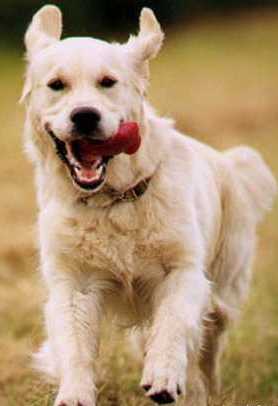
| The Golden Retriever is an athletic, strong dog with a broad, powerful head, strong neck and well developed fore and hindquarters allowing him to carry heavy game across land and water. He is slightly longer than tall. The water-repellent coat is dense, with the outer coat straight / wavy. The Golden Retriever is a large breed, although being one of the smallest in his group. Fully grown, he will reach a shoulder height of about 43 - 47 cm and a weight of 26 - 40 kg. |
||||||||||||||||||||||||
| Character | ||||||||||||||||||||||||
| The Golden Retriever is an obedient and devoted family companion. He is also a great sporting dog, who loves a day out in the field. He is very lively and boisterous and enthusiastic. He is eager to please and enjoys learning. He especially likes games that involve retrieving and loves to carry things in his mouth. The Golden Retriever is a confident dog, without ever being aggressive. He is very friendly and good with children and other dogs. |
||||||||||||||||||||||||