As you go through the pages, YOU will find photos in the library under Artifax and more. Also look under Heritage Railroads

| G | H | I | J-K |
"FAIRLIE-MASON" Type - An 0-6-6-0 double-ended locomotive built in 1871 by William Mason Of Taunton, Massachusetts, for standard guage lines. Because of the limited amount of fuel it could carry and the difficulty of getting coal into the grates, only one, the Janus, was ever built, and it was scrapped in 1877.
"FAIRLIE" Type - An 0-4-4-0 a double-ended locomotive designed for narrow-guage lines, by Robert Fairly of Ireland in 1866. The first"Fairlie in America was used by the Denver & Rio Grande Railroad in the 1870s, but it did not find favor because of its complexity.
FEEDWATER HEATER - An auxiliary heater invented about 1910, which brought cold water from the tender nearly to the boiling point before being pumped into the boiler.
FIREBOX - The furnace in which fuel was burned to convert water into steam in the boiler
FIRE BOY - See Fire Man.
FIRE DOOR - The door in the firebox through which fuel was thrown on the fire.
FIREMAN - One who stoked the fire, maintained the water level in the boiler, and, in early days, applied the handbrake on the tender.
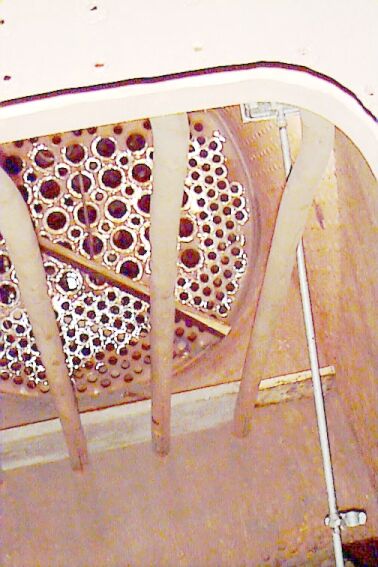
FIRE TUBE or FLUE - A tube in a steam boiler through wich hot gasses passed to heat the surrounding water.
"FISH BELLY" - A short-span rail whose lower surface undulated ("UNDULATED" to move or cause to move in a wave like motion") providing greater thickness between the ties than above them, for uniform strength.
FLANGE - A rim projecting at right angles from the inside edge of a locomtive wheel to guide it along the track. Earlier, when wagons moved along the rails, the flanges were located either on the inner or outer edges of the rails themselves.
FLEXIBLE BOILER - A boiler with two parts connected by a flexible boiler joint, developed by Samuel M. Vauclain in 1910 for high wheeled 2-6-6-2s.
FLEXIBLE BOILER JOINT - A connection between two parts of a flexible boiler which allowed the forward end of the boiler to swivel when the locomotive rounded a curve, or accomodate itself to dips and rises. Samuel L. Vauclain invented the first flexible boiler joint in 1910.
FLUE - see fire tube.
FLY-BALL GOVERNOR - An automatic device to decelerate by centrifugal ("CENTRIFUGAL" moving or directed away from a center or axis.)force a engine running above a desired speed.
FLYWHEEL - A large heavy wheel on an engine crankshaft to convert shuttling action to a smooth rotative force.
"FORNEY" TYPE -see "tank" type ( when I get there)
"FRICTION WHEEL" DESIGN - A wheel-and-axel assembly that rotates as one. Introduced by Ross Winans in the 1830s, the assembly is misnamed, since it reduces friction rather than increasing it.
FUEL BUNKER -A compartment in a locomotive for storing fuel. Also the coal section of a tender.
Back To Top
G
GAB-HOOK - Part of the valve-gear mechanism on early locomotives.
GEAR TRAIN - A group of gears with intermeshed teeth, used either to reduce or increase rotative speed, or to relay motion from one shaft or axle to another.
"GIG-TOP" - A shelter on top of a fuel car for the brakemen, the upper section of which was canvas streched over hickory bows. The first gig-top was on the Stevens built in the 1830s.
"GRASSHOPPER" TYPE - The first American engine of this type, the Atlantic, was developed in 1832 by Phineas Davis. The "grasshopper" an extremely powerful engine for its time, derived from the motion of its walking beams and the lon rods, which resembles a locust's hind legs. (Have Photo).
GRATE - Paralell bars, usually of cast iron, to hold fuel at the bottom of a fire box.
Back To Top
H
HALF CRANK - An L-shaped axle projection functioning as a crank but having only one side member at right angles to the axle. A familiar example is the half cranck on which a pedal of a bicycle is mounted.
"HAYSTACK" Boiler - A boiler whos most conspicuous feature is a large dome above the furnace resembling a haystack. Officially it was named the Bury boiler, for its designer.
HAZELTOB boiler - An early 19th century upright boiler that applied the heat of a central fire to a water jacket whos inner wall was covered with studs exposed to the flames. The boiler developed in Hazelton, Pennsylvania , was more practical for stationary engins than for a moving locomotive, whos jouncing often caused ruptures.
HEAD END - The front of a locomotive or train. To "head-end" is to pull a train.
HEADER - A reservoir devided into two compartments and occupying part of the smoke box. It was used in a super heater designed by Wilhelm Schmidt in Germany in 1910.
"HELPER" - An extra locomotive used to assist trains on steep grades or with extra-heavy loads.
HIGH-PRESSURE ENGINE -An engine using pistons driven directly by the expansive force of steam.
HIGH-WHEELER - A locomotive with extra large driving wheels for higher velocities, popular in the nineteenth century. The first high-wheeler the "Crampton" type, had drivers 7 to 8 feed in diameter. Near the end of the century the quick acting brake brought about the construction of outstanding high-wheelers, generly of the 4-4-0 type.
"HOG" or "PIG" -A locomotive with an extra large boiler built in 1910.
"HOGGER" or "GRUNT" - The engineer on a "hog" or "pig".
HOPPER CAR - A freight car with its floor sloping to one or more doors designed for unloading the contents (such as coal or ore) by gravity.
"HORSE'S NECK" - The term was applied specifically to th two upright rocker arms mounted at the front of Isaac Dripp's Monster. As they nodded in response to the engine's piston thrusts, they suggested the neck action of a team of plodding horses.
"HUDSON" type - A 4-6-4 locomotive. The Milwaukee Road b developed the first plans for an engine of this wheel arrangement several Years before the New York Central put the type into production and gave it the generic name in 1927.
Back To Top
I
IMPULSE TURBINE - A rotary engine driven by steam jets directed at its blades.
INCLINED PLANE - An inclined track on which trains are raised or lowered to another level.
INDEPENDANT SYSTEM - A braking system of the latter nineteenth century using momentum as a decelerating force. The engines were equipped with steam brakes, and when they slowed down, the cars behind them compressed spring-loaded buffers as they bunched together. In turn, the buffers actuated the secondary brakes.
INJECTOR - An appliance without activated parts, by which water could be added to the boiler when the locomotive was not in motion. Invented in 1852 by Henri Giffard for his unsuccessful dirigible, the injector was first produced for steam engines in England in the latter part of the decade.
INTERCEPTING VALVE - A device invented by James Muhfeld for use on his Mallet type 2400 or Old Maude. It delivered highe pressure steam to all cylinders at starting, and as the need for tractive effort decreased, its passages were realigned for compound
operation.
"IRON FIREMAN" -An automatic stoker.
Back To Top
J-K
"JIMMY" - A four- wheeled coal car. JOINTED BOILER - See flexible boiler joint.
JOURNAL BOX - An iron or steel box enclosing the journal of an truck axle, the journal bearing, and the lubricant for the journal.
"KETTLE" - Any small locomotive.
"KILLINGSWORTH" Type - A four-drivered locomotive originally designed by George Stephenson to haul coal from Killingsworth, England, mines. Use of this type spread to continental Europe.
Back To Top