
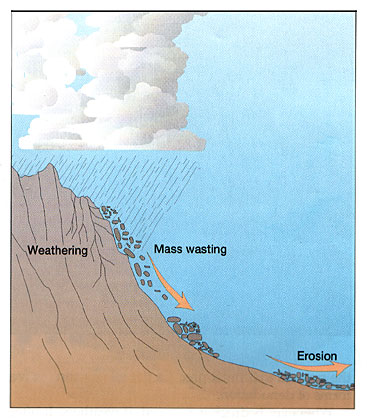
Mechanical weathering is the cause of the disintegration of rocks. The primary process in mechanical weathering is abrasion - the process by which clasts and other particles are reduced in size. However, chemical and physical weathering often go hand in hand. For example, cracks exploited by mechanical weathering will increase the surface area exposed to chemical action. Furthermore, the chemical action at minerals in cracks can aid the disintegration process.In chemistry, concentration is the measure of how much of a given substance there is mixed with another substance. This can apply to any sort of chemical mixture, but most frequently the concept is limited to homogeneous solutions, where it refers to the amount of solute in a substance.To concentrate a solution, one must add more solute, or reduce the amount of solvent for instance, by selective evaporation. By contrast, to dilute a solution, one must add more solvent, or reduce the amount of solute.Unless two substances are fully miscible there exists a concentration at which no further solute will dissolve in a solution. At this point, the solution is said to be saturated. If additional solute is added to a saturated solution, it will not dissolve except in certain circumstances, when supersaturation may occur. Instead, phase separation will occur, leading to either coexisting phases or a suspension. The point of saturation depends on many variables such as ambient temperature and the precise chemical nature of the solvent and solute.Analytical concentration includes all the forms of that substance in the solution.
Thermal Expansion
FreezeThaw Weathering
Frost Wedging
PressureRelease
HydraulicAction
Biotic Weathering
Chemical Weathering
Hydrolysis
Biological
Building Weathering
Thermal expansion, also known as onion-skin weathering, exfoliation, insolation weathering or thermal shock, often occurs in areas, like deserts, where there is a large diurnal temperature range. The temperatures soar high in the day, while dipping greatly at night. As the rock heats up and expands by day, and cools and contracts by night, stress is often exerted on the outer layers. The stress causes the peeling off of the outer layers of rocks in thin sheets. Though this is caused mainly by temperature changes, thermal expansion is enhanced by the presence of moisture.Thermal shock is the name given to cracking as a result of rapid temperature change. Glass and ceramic objects are particularly vulnerable to this form of failure, due to their low toughness, low thermal conductivity, and high thermal expansion coefficients. However, they are used in many high temperature applications due to their high melting point.Thermal shock occurs when a thermal gradient causes different parts of an object to expand by different amounts. This differential expansion can be understood in terms of stress or of strain, equivalently. At some point, this stress overcomes the strength of the material, causing a crack to form. If nothing stops this crack from propagating through the material, it will cause the object's structure to fail. Borosilicate glass such as Pyrex is made to withstand thermal shock better than most other glass through a combination of reduced expansion coefficient and greater strength, though fused quartz outperforms it in both these respects. Some glass-ceramic materials include a controlled proportion of material with a negative expansion coefficient, so that the overall coefficient can be reduced to almost exactly zero over a reasonably wide range of temperatures.Reinforced carbon-carbon is extremely resistant to thermal shock, due to graphite's extremely high thermal conductivity and low expansion coefficient, the high strength of carbon fiber, and a reasonable ability to deflect cracks within the structure.

A rock in southern Iceland fragmented by freeze-thaw action.This process can also be called frost shattering. This type of weathering is common in mountain areas where the temperature is around freezing point. Frost induced weathering, although often attributed to the expansion of freezing water captured in cracks, is generally independent of the water-to-ice expansion. It has long been known that moist soils expand or frost heave upon freezing as a result of water migrating along from unfrozen areas via thin films to collect at growing ice lenses. This same phenomena occurs within pore spaces of rocks. They grow larger as they attract liquid water from the surrounding pores. The ice crystal growth weakens the rocks which, in time, break up. Intermolecular forces acting between the mineral surfaces, ice, and water sustain these unfrozen films which transport moisture and generate pressure between mineral surfaces as the lens aggregates. Experiments show that chalk, sandstone and limestone do not fracture at the nominal freezing temperature of water of slightly below 0�C, even when cycled or held at low temperature for extended periods, as one would expect if weathering resulted from the expansion of water as froze. For the more porous types of rocks, the temperature range critical for rapid, ice-lens-induced fracture is -3 to -6�C, significantly below freezing temperatures.Freeze induced weathering action occurs mainly in environments where there is a lot of moisture, and temperatures frequently fluctuate above and below freezing point that is, mainly alpine and periglacial areas. An example of rocks susceptible to frost action is chalk, which has many pore spaces for the growth of ice crystals. This process can be seen in Dartmoor where it results in the formation of tors.
Formerly believed to be the dominant mode, ice wedging may still be a factor for weathering of nonporous rock, although recent research has demonstrated it less important than previously thought. Frost action, sometimes known as ice crystal growth, ice wedging, frost wedging or freeze-thaw occurs when water in cracks and joints of rocks freezes and expands. Water can exert pressures up to 21 megapascals MPa 2100 kgf/cm� at -22 �C. This pressure is often higher than the resistance of most rocks and causes the rock to shatter.When water that has entered the joints freezes, the ice formed strains the walls of the joints and causes the joints to deepen and widen. This is because the volume of water expands by 9% when it freezes.When the ice thaws, water can flow further into the rock. When the temperature drops below freezing point and the water freezes again, the ice enlarges the joints further.Repeated freeze-thaw action weakens the rocks which, over time, break up along the joints into angular pieces. The angular rock fragments gather at the foot of the slope to form a talus slope or scree slope. The splitting of rocks along the joints into blocks is called block disintegration. The blocks of rocks that are detached are of various shapes depending on rock structure.To measure thermo shock the impulse excitation technique proofed to be a useful tool. It can be used to measure Young's modulus, Shear modulus, Poisson's ratio and damping coefficient in a non destructive way. The same test-piece can be measured after different thermo shock cycles and this way the detoriation in physical properties can be mapped out.
Pressure Release of granite.In pressure release, also known as unloading, overlying materials not necessarily rocks are removed by erosion, or other processes, which causes underlying rocks to expand and fracture parallel to the surface. Often the overlying material is heavy, and the underlying rocks experience high pressure under them, for example, a moving glacier. Pressure release may also cause exfoliation to occur.Intrusive igneous rocks e.g. granite are formed deep beneath the earth's surface. They are under tremendous pressure because of the overlying rock material. When erosion removes the overlying rock material, these intrusive rocks are exposed and the pressure on them is released. The outer parts of the rocks then tend to expand. The expansion sets up stresses which cause fractures parallel to the rock surface to form. Over time, sheets of rock break away from the exposed rocks along the fractures. Pressure release is also known as exfoliation or sheeting these processes result in batholiths and granite domes, an example of which is Dartmoor.A glacier is a large, slow moving river of ice, formed from compacted layers of snow, that slowly deforms and flows in response to gravity. Glacier ice is the largest reservoir of fresh water on Earth, and second only to oceans as the largest reservoir of total water. Glaciers cover vast areas of polar regions but are restricted to the highest mountains in the tropics. Elsewhere in the solar system, the vast polar ice caps of Mars rival those of the Earth.Geologic features created by glaciers include end, lateral, ground and medial moraines that form from glacially transported rocks and debris U-shaped valleys and cirques at their heads, and the glacier fringe, which is the area where the glacier has recently melted into water.The word glacier comes from French via the Vulgar Latin glacia, and ultimately from Latin glacies meaning ice.
This is when water generally from powerful waves rushes into cracks in the rockface rapidly. This traps a layer of air at the bottom of the crack, compressing it and weakening the rock. When the wave retreats, the trapped air is suddenly released with explosive force. The explosive release of highly pressurised air cracks away fragments at the rockface and widens the crack itself.Salt crystallization or otherwise known as Haloclasty causes disintegration of rocks when saline see salinity solutions seep into cracks and joints in the rocks and evaporate, leaving salt crystals behind. These salt crystals expand as they are heated up, exerting pressure on the confining rock.Salt crystallization may also take place when solutions decompose rocks for example, limestone and chalk to form salt solutions of sodium sulfate or sodium carbonate, of which the moisture evaporates to form their respective salt crystals.The salts which have proved most effective in disintegrating rocks are sodium sulfate, magnesium sulfate, and calcium chloride. Some of these salts can expand up to three times or even more.It is normally associated with arid climates where strong heating causes strong evaporation and therefore salt crystallisation. It is also common along coasts. An example of salt weathering can be seen in the honeycombed stones in sea walls.
One of the most well-known solution weathering processes is carbonation, the process in which atmospheric carbon dioxide leads to solution weathering. Carbonation occurs on rocks which contain calcium carbonate such as limestone and chalk. This takes place when rain combines with carbon dioxide or an organic acid to form a weak carbonic acid which reacts with calcium carbonate the limestone and forms calcium bicarbonate.
Living organisms may contribute to mechanical weathering as well as chemical weathering, see 'biological' weathering below. Lichens and mosses grow on essentially bare rock surfaces and create a more humid chemical microenvironment. The attachment of these organisms to the rock surface enhances physical as well as chemical breakdown of the surface microlayer of the rock. On a larger scale seedlings sprouting in a crevice and plant roots exert physical pressure as well as providing a pathway for water and chemical inlfitration. Burrowing animals and insects disturb the soil layer adjacent to the bedrock surface thus further increasing water and acid infiltration and exposure to oxidation processes.In general, the symbiosis is considered obligatory for successful growth and reproduction of the fungus however, the significance for the algal symbiont is less clear. For some algae, the symbiosis may be obligatory for survival in a particular habitat in other cases, the symbiosis might not be advantageous for the alga. Thus, there is some controversy as to whether the lichen symbiosis should be considered an example of mutualism or parasitism or commensalism. Nonetheless, the lichen is typically a highly stable association which probably extends the ecological range of both partners.There is evidence that lichens might involve a controlled form of parasitism of the algal cells. In laboratory settings, cyanobacteria grow faster when they are alone rather than when they are part of a lichen. But there is also a mutualistic side to the relationship the fungus part of the lichen provides the alga with water and minerals that the fungus absorbs from whatever the lichen is growing on, its substrate. As for the alga, it uses the minerals and water to make food for the fungus and itself.
Chemical weathering involves the change in the composition of rocks, often leading to a 'break down' in its form. This type of weathering happens over a period of time.Rainfall is naturally slightly acidic because atmospheric carbon dioxide dissolves in the rainwater producing weak carbonic acid. In unpolluted environments, the rainfall pH is around 5.6. Acid rain occurs when gases such as sulphur dioxide and nitrogen oxides are present in the atmosphere. These oxides react in the rain water to produce stronger acids and can lower the pH to 4.5 or even 3.0. Sulfur dioxide, SO2, comes from volcanic eruptions or from fossil fuels, can become sulfuric acid within rainwater, which can cause solution weathering to the rocks on which it falls.One of the most well-known solution weathering processes is carbonation, the process in which atmospheric carbon dioxide leads to solution weathering. Carbonation occurs on rocks which contain calcium carbonate such as limestone and chalk. This takes place when rain combines with carbon dioxide or an organic acid to form a weak carbonic acid which reacts with calcium carbonate the limestone and forms calcium bicarbonate. This process speeds up with a decrease in temperature and therefore is a large feature of glacial weathering.Carbonation on the surface of well-jointed limestone produces a dissected limestone pavement which is most effective along the joints, widening and deepening them.Hydration is a form of chemical weathering that involves the rigid attachment of H+ and OH- ions to the atoms and molecules of a mineral.When rock minerals take up water, the increased volume creates physical stresses within the rock. For example iron oxides are converted to iron hydroxides and the hydration of anhydrite forms gypsum.A freshly broken rock shows differential chemical weathering probably mostly oxidation progressing inward. This piece of sandstone was found in glacial drift near Angelica, New YorkA freshly broken rock shows differential chemical weathering probably mostly oxidation progressing inward. This piece of sandstone was found in glacial drift near Angelica, New York
Hydrolysis is a chemical weathering process affecting Silicate minerals. In such reactions, pure water ionizes slightly and reacts with silicate minerals. An example reaction Mg2SiO4 + 4H+ + 4OH- 2Mg2+ + 4OH- + H4SiO4 . Olivine forsterite + four ionized water molecules ions in solution + silicic acid in solution.This reaction results in complete dissolution of the original mineral, assuming enough water is available to drive the reaction. However, the above reaction is to a degree deceptive because pure water rarely acts as a H+ donor. Carbon dioxide, though, dissolves readily in water forming a weak acid and H+ donor. Mg2SiO4 + 4CO2 + 4H2O 2Mg2+ + 4HCO3- + 4H4SiO4 . Olivine forsterite + carbon dioxide + water Magnesium and bicarbonate ions in solution + silicic acid in solution.This hydrolysis reaction is much more common. Carbonic acid is consumed by silicate weathering, resulting in more alkaline solutions because of the bicarbonate. This is an important reaction in controlling the amount of CO2 in the atmosphere and can affect climate.Aluminosilicates when subjected to the hydrolysis reaction produce a secondary mineral rather than simply releasing cations.2KAlSi3O8 + 2H2CO3 + 9H2O Al2Si2O5OH4 + 4H4SiO4 + 2K+ + 2HCO3-.Orthoclase aluminosilicate feldspar + carbonic acid + water Kaolinite a clay mineral + silicic acid in solution + potassium and bicarbonate ions in solution.Within the weathering environment chemical oxidation of a variety of metals occurs. The most commonly observed is the oxidation of Fe2+ iron and combination with oxygen and water to form Fe3+ hydroxides and oxides such as goethite, limonite, and hematite. This gives the affected rocks a reddish-brown coloration on the surface which crumbles easily and weakens the rock. This process is better known as 'rusting'.
A number of plants and animals may create chemical weathering through release of acidic compounds.The most common form of biological weathering is the release of chelating compounds, i.e acids, by plants so as to break down aluminium and iron containing compounds in the soils beneath them.citation needed Extreme release of chelating compounds can easily affect surrounding rocks and soils, and may lead to podsolisation of soils.Chelation from Greek ????, chel�, meaning claw pronounced is the binding or complexation of a bi- or multidentate ligand. These ligands, which are often organic compounds, are called chelants, chelators, chelating agents, or sequestering agent. The ligand forms a chelate complex with the substrate. The term is reserved for complexes in which the metal ion is bound to two or more atoms of the chelating agent, although the bonds may be any combination of coordination or ionic bonds.Virtually all biochemicals exhibit the ability to dissolve metal cations. Thus proteins, polysaccharides, and polynucleic acids are excellent polydentate ligands for many of the metal ions. In addition to these adventitious chelators, several are produced to specifically bind certain metals. Such chelating agents include the porphyrin rings in hemoglobin or chlorophyll and the Fe3+-chelating siderophores secreted by microorganisms.In earth science, chemical weathering is attributed to organic chelating agents, e.g. peptides and sugars, that have the ability to solubilize the metal ions in minerals and rocks. Most metal complexes in the environment and in nature are bound in some form of chelate ring, e.g. with humic acid or a protein. Thus, metal chelates are relevant to the mobilization of metals in the soil, the uptake and the accumulation of metals into plants and micro-organisms. Selective chelation of heavy metals is relevant to bioremediation, e.g. removal of 137Cs from radioactive waste.
Buildings made of any stone, brick or concrete are susceptible to the same weathering agents as any exposed rock surface. Also statues, monuments and ornamental stonework can be badly damaged by natural weathering processes. This is accelerated in areas severely affected by acid rain.What happens when different rocks in an outcrop undergo weathering at different rates.The term acid rain is commonly used to mean the deposition of acidic components in rain, snow, fog, dew, or dry particles. The more accurate term is acid precipitation. Distilled water, which contains no carbon dioxide, has a neutral pH of 7. Liquids with a pH less than 7 are acidic, and those with a pH greater than 7 are basic pH. Clean or unpolluted rain has a slightly acidic pH of 5.6, because carbon dioxide and water in the air react together to form carbonic acid, a weak acid. The extra acidity in rain comes from the reaction of air pollutants, primarily sulfur oxides and nitrogen oxides, with water in the air to form strong acids like sulfuric and nitric acid. The main sources of these pollutants are vehicles and industrial and power-generating plants.Since the Industrial Revolution, emissions of sulfur and nitrogen oxides to the atmosphere have increased.Occasional pH readings of well below 2.4 the acidity of vinegar have been reported in industrialized areas.Industrial acid rain is a substantial problem in China, Eastern Europe, Russia and areas down-wind from them. These areas all burn sulfur-containing coal to generate heat and electricity.The problem of acid rain not only has increased with population and industrial growth, but has become more widespread. The use of tall smokestacks to reduce local pollution has contributed to the spread of acid rain by releasing gases into regional atmospheric circulation. Often deposition occurs a considerable distance downwind of the emissions, with mountainous regions tending to receive the most simply because of their higher rainfall. An example of this effect is the low pH of rain compared to the local emissions which falls in Scandinavia.Acid rain was first found in Manchester, England. In 1852, Robert Angus Smith found the relationship between acid rain and atmospheric pollution.Though acid rain was discovered in 1852, it wasn't until the late 1960s that scientists began widely observing and studying the phenomenon.
