|

Special Article
Breakout!
 Over
80 million people worldwide suffer from acne vulgaris (acne).
Stubborn acne gives not only discomfort to people, it also leaves scars along
with it. At
its worst, persistent acne eruptions may give not only cutaneous (skin) scars;
it may leave a deeper imprint on the emotion and self-esteem of a person. As
Marion Sulzberger, an important figure in the field of modern dermatology,
said: "...there is no single disease which causes more psychic trauma, nor
maladjustment between parents and children, more general insecurity and feelings
of inferiority and general sums of psychic suffering than does acne vulgaris."
("Psychogenic factors in
dermatological disorders", Medical Clinicians of North America 1948;
32:669) Over
80 million people worldwide suffer from acne vulgaris (acne).
Stubborn acne gives not only discomfort to people, it also leaves scars along
with it. At
its worst, persistent acne eruptions may give not only cutaneous (skin) scars;
it may leave a deeper imprint on the emotion and self-esteem of a person. As
Marion Sulzberger, an important figure in the field of modern dermatology,
said: "...there is no single disease which causes more psychic trauma, nor
maladjustment between parents and children, more general insecurity and feelings
of inferiority and general sums of psychic suffering than does acne vulgaris."
("Psychogenic factors in
dermatological disorders", Medical Clinicians of North America 1948;
32:669)
The Process of Acne
Unfortunately,
doctors don't understand all of the causes of acne. Nevertheless, the good news
is that they understand pretty well how acne develops. In this lieu, there are
several factors that characterize the development of acne:
-
too much
production of sebum resulting from the increase of the androgenic hormone
(testosterone)
-
abnormal
formation of keratin, a protein found in skin, hair and nails, in the
hair follicle
-
increase of
P. acnes (Propionibacterium acnes) in the hair follicle
-
inflammation
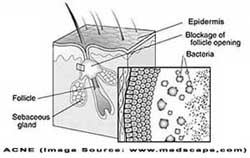 The skin
contains a very important gland called the sebaceous gland. This gland is
produces an oily substance called sebum, which lubricates and protects
the hair and skin so that they will not be parched. Sebum also prevents the
irritation of membranes by carrying away dead skin cells and debris of keratin
(found in the lining of hair follicles) to the surface of the skin. However,
when an increase in androgenic hormones (i.e. testosterone) occurs, the
sebaceous glands become enlarged and overproduces sebum. Since sebum carries
along dead skin cells and debris of keratin, too much of it may plug the
hair follicles rather than flow smoothly through the follicles. When the
follicles become plugged, they become an ideal environment for P. acnes
to flourish. As a result, an inflammation follows. This skin condition is what
we commonly know as acne vulgaris. The skin
contains a very important gland called the sebaceous gland. This gland is
produces an oily substance called sebum, which lubricates and protects
the hair and skin so that they will not be parched. Sebum also prevents the
irritation of membranes by carrying away dead skin cells and debris of keratin
(found in the lining of hair follicles) to the surface of the skin. However,
when an increase in androgenic hormones (i.e. testosterone) occurs, the
sebaceous glands become enlarged and overproduces sebum. Since sebum carries
along dead skin cells and debris of keratin, too much of it may plug the
hair follicles rather than flow smoothly through the follicles. When the
follicles become plugged, they become an ideal environment for P. acnes
to flourish. As a result, an inflammation follows. This skin condition is what
we commonly know as acne vulgaris.
Types of Acne
The
lesion of acne is called microcomedo. Acne lesions are categorized into
two: non-inflammatory and inflammatory.
Non-inflammatory lesions include whitehead (closed comedo) and
blackhead (open comedo).
Meanwhile,
there are 4 kinds of inflammatory lesions:
-
papule
(pink-to-red, raised palpable lesion with no visible accumulation of pus/fluid )
-
pustule
(also a palpable raised lesion similar to the papule, although unlike papules,
pustules have pus)
-
nodule
(tender, inflamed bump that may persist for weeks)
-
cysts
(large, pus-filled lesions that look like boils)
Treating Acne
 Acne
is known to clear up on its own even without treatment, but this takes a very
long time to happen. Therefore, the proper way of treating acne is to keep it
under control, and to help prevent any permanent damage to the skin (such as
acne scars that result from picking on the acne spots). Acne
is known to clear up on its own even without treatment, but this takes a very
long time to happen. Therefore, the proper way of treating acne is to keep it
under control, and to help prevent any permanent damage to the skin (such as
acne scars that result from picking on the acne spots).
Here are some
self-help tips to fight acne:
-
Use non-greasy
make-up.
-
Keep your hair
off your face, especially if it is greasy.
-
Avoid touching
your face too often.
-
Do not scrub
your face. This will only make your condition worse.
-
Don't squeeze
your pimples. This leaves deep dark scars on the face.
-
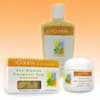 Use
Godiva Anti-Blemish Products. The Godiva
Anti-blemish line offers a natural way of helping prevent acne and lighten
acne scars. Its natural formula contains clinically proven actives like
lichocalcone and glabridin from licorice extract, and fruit acid
from sugar cane, citrus, and apple extracts. Licochalcone and fruit acid
help limit the causes of acne flare ups. Glabridin and fruit acid work
together to lighten acne scars. Use
Godiva Anti-Blemish Products. The Godiva
Anti-blemish line offers a natural way of helping prevent acne and lighten
acne scars. Its natural formula contains clinically proven actives like
lichocalcone and glabridin from licorice extract, and fruit acid
from sugar cane, citrus, and apple extracts. Licochalcone and fruit acid
help limit the causes of acne flare ups. Glabridin and fruit acid work
together to lighten acne scars.
-
Don't use more
or less than the prescribed treatment. Using more won't speed up results. Using
less will reduce its effects.
-
Don't be
impatient. It takes 4 to 6 weeks for the average pimple to develop. It will take
just about as long for acne treatments to really start working. It may take up
to 3 months for acne to clear significantly.
 Back to Issue
38
Back to Issue
38
|