|

To make an appointment, visit or call Godiva
Skin Station at any of the following outlets:
Makati Bel-Air
Ground Floor, Executive Building Center,
Sen. Gil Puyat Ave. corner Makati Ave., Makati City
Tel. No. 7151-6140;
890-9845;
09179649828
Hours:
Open Monday to Saturday,
9:30 a.m. to 10:00 p.m.
Sundays, 10:00 a.m.
to
8:00 p.m.
SM Fairview-Annex
Upper Ground Level
Tel. No. 939-1105
Hours:
Open Mondays to Sundays, 10:00 a.m. to 9:00 p.m.
Our
medical doctors are on duty from 2:30 p.m. to 6:30 p.m. on Tuesdays and
Thursdays in Makati Bel-Air branch, and 3:00p.m. to 7:00 p.m. on Saturdays in
SM Fairview branch.
_____________________
Missed an
issue of Beauty Bulletin? Just visit our
archive.
_____________________
Send in your contributions, testimonials or
comments/concerns to: [email protected].
If you do not wish to receive mail from us
in the future, simply reply to this message with the word “Remove” in the
subject line.
_____________________
Your feedback is valuable
to us
Ecstatic with your
experience at the Godiva Skin Station? Your feedback is always welcome. We are
interested in knowing your comments and questions, or even your testimonials
on Godiva Skin Station’s services. Just send an e-mail to
[email protected] and we’ll get back to you as soon as we
can.
Copyright 2006 Godiva, Inc. All rights reserved
Contact us: MCPO Box 3051 Makati City Philippines 1200
Phone: (632) 890-98-45
Websites:
www.godivaskincare.com;
www.i-godiva.com
Email:
[email protected];
[email protected]
|

Are You Safe in the
Beach?
 Summer’s fun, but
its withering heat is definitely a no-no! Summer’s fun, but
its withering heat is definitely a no-no!
For most of us,
the only way to counter the summer heat PLUS enjoy the sun season is to
head for the beach. Yeah, just imagine the sea, the waves and the breeze
to cool down and ease those stresses away…
But wait! Before
you venture into the water, let me just ask you one thing: are you
absolutely sure you're safe
in the beach? What’s that? “Yes!”?
Hmmm…What if I
tell you that the world’s most deadly marine animal can be found in our
shores, can you still say “yes”?
Marine Beauties, Scourge of
Swimmers
Jellyfish
are common marine creatures. They are found in numerous locations all
over the globe, including Philippine waters. They actually have no
brain, no muscles, no bones, and no ability to see and hear. However,
would you believe that despite their lack of essential senses, jellyfish
are one of the most feared creatures the world over?
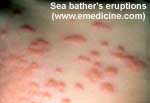 You
see, jellyfish sting can be quite discomfiting. It may leave not only
nasty skin scars but may also cause excruciating pain, swelling and
inflammation, blisters, ulcerations, possibly secondary infection, skin
rashes (i.e. sea bather's eruption), weakness, headaches,
vomiting, muscle spasms, fevers and chills, difficulty with breathing,
and even shock (trauma). You
see, jellyfish sting can be quite discomfiting. It may leave not only
nasty skin scars but may also cause excruciating pain, swelling and
inflammation, blisters, ulcerations, possibly secondary infection, skin
rashes (i.e. sea bather's eruption), weakness, headaches,
vomiting, muscle spasms, fevers and chills, difficulty with breathing,
and even shock (trauma).
If the tentacles of
jellyfish come in contact with the eyes, they may damage the cornea and
thus may lead to blindness!
But the worst thing
is, some jellyfish stings are fatal. That is, some stings are really
painful that swimmers become numb and thus drown. Other jellyfish venoms
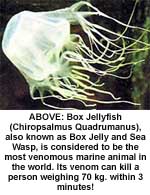
are potent enough to cause death, like that of a box jellyfish, which
can kill a person weighing 70 kg. in just three minutes (thus it is
called “the world's most deadly marine animal”).
And take note: box jellyfish lurk our waters. In
fact, an estimated 20-50 deaths are said to occur
annually here in the Philippines due to box jellyfish sting (this is according to a 1995 study
conducted by Dr. Paul Cornelius of the British Museum of Natural
History).
To cut to the chase,
jellyfish stings are hazardous. Therefore, one should be aware of the
things to do in cases of jellyfish stings.
SO WHAT CAN WE
DO?
Here are some self-help tips:
 Always
bear in mind that caring for a person
injured by jellyfish sting should begin immediately. Always
bear in mind that caring for a person
injured by jellyfish sting should begin immediately.
For
rescuers: do wear protective clothing.
Of course, if rescuers got stung, the purpose of “rescuing the
victim” will be defeated and instead, rescuers will also become victims,
too.
Remove
injured person from the water (to prevent drowning).
Rinse
the affected area with salt water or don’t rinse at all. DO
NOT USE FRESH WATER; it will only worsen the victim’s condition (as
fresh water will further activate nematocysts).
 Remove
remaining tentacles from the victim. DO NOT USE YOUR BARE
HANDS; instead, use protective gloves or forceps, because even detached
tentacles can still sting you! Remove
remaining tentacles from the victim. DO NOT USE YOUR BARE
HANDS; instead, use protective gloves or forceps, because even detached
tentacles can still sting you!
Apply white vinegar on the affected area;
this will kill the undischarged stinging cells and toxins and thus, will
help decrease the adverse reactions of the victim to the sting.
To
ease the victim’s pain, administer
over-the-counter pain medicines like acetaminophen (e.g.
Tylenol) or ibuprofen (e.g. Advil).
To
prevent the spread of jellyfish’ venom,
avoid further movement of the affected area (for example, if
the foot was stung, keep the victim still).
If
the victim seems to be ill or displays severe reactions (like
shock, vomiting, fever, loss of consciousness, and shortness of breath),
do the following:
-
Lay the victim down
-
If victim starts
vomiting, roll the victim onto his/her side (so that vomit is not
breathed in.
-
Call for an
ambulance, so that victim may be evaluated immediately by a doctor and
will be administered with proper medical treatment.
However, the best way to defend against jellyfish stings is still to
avoid getting stung! How?
Familiarize
yourself with the beach you’re planning to visit.
Learn about the possible marine risks in the area.
Be
proactive. Bring first aid supplies; injuries occur even when
you least expect them.
Do
not touch jellyfish and any other marine creatures. Watch out for them when you’re in
the water.
Wear
protective clothing (wet suits, lycra suits, and/or stockings) and
shoes.
 Wash
your swim suit with detergent and heat-dry after use (to kill
thimble fish or sea anemone larvae that cause sea bather’s eruptions). Wash
your swim suit with detergent and heat-dry after use (to kill
thimble fish or sea anemone larvae that cause sea bather’s eruptions).
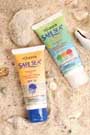
Use
a protective sunblock lotion/cream that has jellyfish sting
inhibitor,
like Godiva Safe Sea® Sunblock.

________________________________________
|
