|
|
N Skin Care Alert |
 |
Treating Melasma
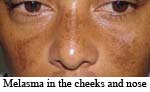 Melasma
has long been associated with pregnant women. But do you know that anyone --
non-infanticpating women and yes,
even men -- can also develop melasma? Melasma
has long been associated with pregnant women. But do you know that anyone --
non-infanticpating women and yes,
even men -- can also develop melasma?
Melasma
are dark, blotchy marks that appear on the face, especially in the forehead,
cheeks, upper lips, chin, and nose. They may also occur in other skin areas
often exposed to the sun, like the forearms and back. Their color, which also
determines their type, varies from brown (epidermal melasma), blue-gray (dermal melasma), or
brown-gray (mixed). Among these, it is commonly thought that dermal melasma
is harder to treat.
A
very common skin disorder, melasma often occurs among women. Those with brownish skin
tones are the most susceptible ones, like Hispanics, Asians, and those who live
in areas with intense sun exposure. Nevertheless, men also get affected by melasma,
but they make up only
a measly 10% of melasma sufferers.
The Culprits
How melasma
develops and what is its precise cause is not yet fully understood. However,
there are several important factors recognized to trigger the development of
melasma:
 Genetic predisposition.
In laymen's term, this simply means that melasma "runs in the blood" or
more appropriately, "in the genes". Accordingly, more than 30% of people with
melasma belong to families with a history of melasma.
Genetic predisposition.
In laymen's term, this simply means that melasma "runs in the blood" or
more appropriately, "in the genes". Accordingly, more than 30% of people with
melasma belong to families with a history of melasma.
Oh, and did I
mention that 90% of melasma patients are women? Anyway, women often develop
melasma during their reproductive years.
 Hormonal influences.
Melasma is very common in pregnant women. This is because during pregnancy,
there is an abnormal upsurge of female hormones, to which the skin reacts
"excitedly".
Hormonal influences.
Melasma is very common in pregnant women. This is because during pregnancy,
there is an abnormal upsurge of female hormones, to which the skin reacts
"excitedly".
Women who are
taking certain oral contraceptives can also develop melasma. In such cases, it
is advisable to discuss with your physician the possibility of using another
brand of pill or even shifting to other method of contraception.
Finally, melasma
among post-menopausal women are also likely to occur, in particular, among those
prescribed with progesterone-containing pill.
Sunlight exposure. UV radiation stimulates the
pigment-producing cells called melanocytes to make excess melanin,
the element that determines our skin's color. The darker the skin, the more
melanin it has.
Furthermore,
overexposure to the sun has been reported to worsen cases of melasma.
Minimize the Blotches!
Treating melasma
is not easy. There are many cases of resistance and recurrence, especially if
strict avoidance of sunlight is not observed.
Nevertheless, it
is very possible to lighten up and minimize melasma safely and effectively!
Introducing Godiva Melasma Minimizer Set.
Godiva Melasma Minimizer Set contains the
following (good for two months use):
 Two 100g GODIVA LicoWhite™ Transparent Soaps Two 100g GODIVA LicoWhite™ Transparent Soaps
65g GODIVA Fruit
Acid Revitalizing Complex
60g GODIVA Green
Tea Sunblock Cream
75g GODIVA
LicoWhite™ Skin Brightening Cream Tube
200 ml GODIVA
Licorice Skin Whitening Lotion.
How to benefit from
Godiva Melasma Minimizer Set? Just follow this easy-to-do regimen:
-
Cleanse with
Godiva LicoWhite™ Transparent Soap.
-
Smooth on
Godiva Fruit Acid
Revitalizing Complex
before bedtime on areas with melasma to accelerate production of fresher,
smoother skin.
-
After 5 minutes,
follow with
Godiva LicoWhite™ Skin
Brightening Cream to
even out skin discolorations.
-
Apply
Godiva LicoWhite™
Skin Brightening Cream
twice daily on the face and other sensitive body parts, such as the underarms.
For other body parts, apply
Godiva Licorice Skin Whitening Lotion.
-
Every morning, wear
Godiva Green Tea
Sunblock Cream
as a last step, whether you are staying indoors or outdoors.
Follow this regimen religiously
and your dark patches will soon fade in no time! More importantly,
avoid prolonged
and unnecessary sun exposure, because this will only worsen melasma.
By the way, Godiva products
have been clinically
proven to be
mild and safe for use even by moms-in-waiting. These products go only as far as the
epidermis, where the melanin is located, and they do not enter the bloodstream.
Melasma in women usually fades 3 to 6 months after delivery.
|
G
Did You Know? |
|
|
Chloasma or
Melasma?
Melasma is often present in pregnant women,
although it usually fades after delivery. But did you know that melasma during pregnancy
is called chloasma or "mask of pregnancy"? Chloasma is a synonymous term
of melasma, and it is derived from the Greek word chloazein
that means "to be green". On the other hand, the word melas in melasma is also
a Greek word that means "black". Since the color of melasma is not
green, clinicians prefer more the term melasma.
 Meanwhile,
the intensity of chloasma can be prevented by limiting unnecessary sun exposure.
However, it is wisest to APPLY DAILY a broad-spectrum, physical sunblock cream
(one with zinc oxide or titanium dioxide) that protects the skin
effectively by blocking both UVA and UVB rays, just like
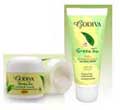
Godiva Green Tea Sunblock with SPF 25 and Zinc Oxide. Meanwhile,
the intensity of chloasma can be prevented by limiting unnecessary sun exposure.
However, it is wisest to APPLY DAILY a broad-spectrum, physical sunblock cream
(one with zinc oxide or titanium dioxide) that protects the skin
effectively by blocking both UVA and UVB rays, just like
Godiva Green Tea Sunblock with SPF 25 and Zinc Oxide.
|
_ Tell Us What You Think |
|
|
|
