|
IN THE NEWS
Melasma research reveals: Licorice lightens
faster than Hydroquinone
Many people believe that a 4 percent dosage of
hydroquinone is the most effective topical treatment for melasma. New
Philippine research suggests that another more effective remedy is available
for melasma patients. Those with other skin discoloration problems can also
get benefits from it.
Melasma is a hard to treat skin
discoloration caused by pregnancy, UV radiation exposure, hormonal treatments,
phototoxic drugs, and certain cosmetics.
 From January to April of 2002, a double blind
clinical trial was conducted. It was done under the supervision of Dr.
Katherine Frances E. Dela Rosa Ignacio of the Skin and Cancer Foundation,
Philippines. From January to April of 2002, a double blind
clinical trial was conducted. It was done under the supervision of Dr.
Katherine Frances E. Dela Rosa Ignacio of the Skin and Cancer Foundation,
Philippines.
"In view of the adverse side effects of
hydroquinone, the study seeks to find other lightening agents with the same
efficacy as hydroquinone but with lesser side effects," the summary reads.
A
commercially-prepared product of licorice with 40 percent glabridin content
(later identified as
Godiva Whitening Cream) was compared
with 4 percent hydroquinone, the maximum dosage allowed by the Bureau of Food
and Drugs (BFAD) for this powerful artificial drug. Glabridin comes from
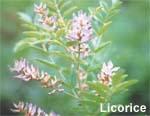
Licorice, a plant native to parts of Europe and China. Glabridin was
identified as a powerful whitening agent by Japanese scientists in the early
1990s.
A total of 36 patients of the charity hospital of
the Skin and Cancer Foundation were randomly selected. The majority of the
patients were in the 41 to 50 year age group (a little less than 67 percent).
Three out of four of them were female, 30 were married. All had melasma in
either the epidermal or epidermo-dermal stages. Their first examination served
as the baseline from which future data was compared. Skin color intensity was
measured using the Mx16 Mexameter. An average of three readings were taken.
Follow-up treatments were conducted after the first week, and monthly after
the second month. After the baseline visit, four examinations were done.
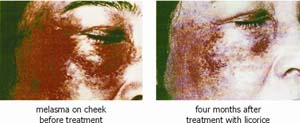 "After
seven days, there is a significant lightening versus the baseline with the
licorice cream in 20 out of 36 patients (55.55 percent) compared with just 2
out of 36 (5.55 percent) with hydroquinone. With hydroquinone as a gold
standard to compare with, licorice produced faster skin lightening, with
significant results after just 7 days, with hydroquinone catching up only on
the third month," the study summary concluded. "After
seven days, there is a significant lightening versus the baseline with the
licorice cream in 20 out of 36 patients (55.55 percent) compared with just 2
out of 36 (5.55 percent) with hydroquinone. With hydroquinone as a gold
standard to compare with, licorice produced faster skin lightening, with
significant results after just 7 days, with hydroquinone catching up only on
the third month," the study summary concluded.
What's noteworthy is that the commercial skin
cream used in the trial contained much less than the one percent purified
licorice extract. The 40 percent hydroquinone dosage requires a doctor's
prescription.
 "In
view of the demonstrated efficacy of 40 percent glabridin (licorice) and the
absence of adverse side effects, the licorice cream can be considered a useful
novel approach in melasma therapy," the study points out. "In
view of the demonstrated efficacy of 40 percent glabridin (licorice) and the
absence of adverse side effects, the licorice cream can be considered a useful
novel approach in melasma therapy," the study points out.
Why not conduct your own study to see if Godiva
Licorice Whitening Cream can work for you? It's available at
www.godivaskincare.com. See other
Godiva Licorice Whitening products
now! 
_______________________________________________________________________
Send your contributions, testimonials or
comments/concerns to: [email protected]
or
skincarejournal@i-godiva.com.
Tell your friends about our special
subscription promo. Who knows, they might be one of the
7 lucky winners per week to receive
7% OFF on their next GODIVA purchase. All lucky winners will be
notified via e-mail from godivaskincare.com on the first working day of every succeeding week.
The 7% discount/ prize may only be used during your next GODIVA purchase
and must be availed of within 30 days from receipt of
e-mail notification.
You are receiving
this e-mail because you subscribed to our newsletter through
www.godivaskincare.com. If you do not wish to receive mail from us
in the future, simply reply to this message with the word �Remove�
in the subject line .
Copyright 2003 Godiva, Inc. All rights reserved
Contact us: MCPO Box 3051 Makati City Philippines 1200 Phone: (632) 890-98-45
Websites: www.godivaskincare.com; www.i-godiva.com Email: [email protected];
[email protected]
|

