|
|
N Skin Care Alert |
 |
PHOTOAGING: The Invisible Foe
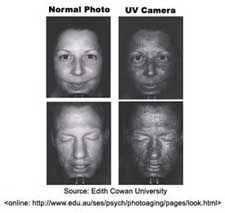
Look
at the images above. Can you spot the difference? As you will see, the pictures
on the left side show clear faces, while those in the right appear to be
speckled. How come?
Well, the images varied because on the one side, pictures were taken using
ordinary imaging lens, whereas on the other side, photos
were taken by an ultraviolet (UV) camera
that can see beyond the skin’s surface so that its true conditions may be
revealed.
Primarily, these photos were taken to
show what photoaging looks like.
What
is "Photoaging"?
Photoaging is a term that refers to the skin's aging
as a result of much exposure to the UV light of the sun.
It is also called “premature aging” or
“sun-induced aging”. Why? Actually, the human skin
naturally goes into a process called “chronological aging”, or the normal aging
of the skin. However, because of the sun’s damaging rays, the skin ages more
rapidly than usual. In particular,
with photoaging comes a reduced production of
collagen, a body substance that is vital for the skin’s strength and elasticity.
"Am
I Susceptible to Photoaging?"
Yes. Actually, we all are.
However, there are people who are more susceptible to photoaging, and they
include those who: have outdoor lifestyles (such as athletes), live in places with
sunny climates, and are lightly pigmented (i.e. fair-skinned people).
The
Effects of Photoaging
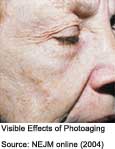 The damage
people get from the UV rays is not visible
to the naked eye (as shown by the images above). Nevertheless, this is NOT
good news! Even if a 20-year old person can still look attractive despite the
damage, about 20 years later the real effects of photoaging will manifest
themselves with a vengeance! Some of them include fine and coarse
wrinkles, skin roughness, mottled pigmentation, leathery
texture/coarseness, scaling, sallowness, and telangiectasia (enlargement of the
blood vessels that can be seen in the skin's surface) – conditions that should not have
occurred if only
the normal skin aging process had taken place. Worse, photoaging may well
indicate not only skin damage but also skin cancer. The damage
people get from the UV rays is not visible
to the naked eye (as shown by the images above). Nevertheless, this is NOT
good news! Even if a 20-year old person can still look attractive despite the
damage, about 20 years later the real effects of photoaging will manifest
themselves with a vengeance! Some of them include fine and coarse
wrinkles, skin roughness, mottled pigmentation, leathery
texture/coarseness, scaling, sallowness, and telangiectasia (enlargement of the
blood vessels that can be seen in the skin's surface) – conditions that should not have
occurred if only
the normal skin aging process had taken place. Worse, photoaging may well
indicate not only skin damage but also skin cancer.
Fighting Photoaging
Awareness is the key to fight photoaging. Also, proper preventive
measures should be adopted. These include: regular monitoring of the skin
to immediately detect any unusual changes; using clothes that provide sun
protection, like shirts with long-sleeves and/or neck collars,
trousers, long shorts, etc.; using sunglasses and wide-brimmed hats (to protect
the eyes and face); avoiding the sun's harshest hours (from 10 a.m. to 4 p.m.);
and last but definitely not the least, daily use of sunscreen/sunblock with sufficient SPF against broad UV
spectrum, like
Godiva
Green Tea Sunblock Cream.
|
G
Think About This |
 |
We have to stay
out of the noonday sun because...
-
Skin cancer, the worst condition a sun damage can cause, is
the most common cancer worldwide, especially in white populations.
-
Ultraviolet light A (UVA),
initially thought as harmless, makes the skin more susceptible to infections
and possibly cancer, and it leads, as well, to cutaneous (skin) aging as it
decreases the skin's elasticity. UVA levels are present throughout the day.
-
Ultraviolet light B (UVB),
which causes sunburn, premature aging, and skin pre-cancer and cancers,
usually penetrate the atmosphere significantly from 10 a.m. to 4 p.m.
-
Most of the sun damage
to the skin happens before the age of 20.
-
The closer a location is
to the equator, the stronger the UV rays are.
-
Even water, snow, sand,
and pavement reflect UV rays.
Fortunately, sunscreens and sunblocks had been
invented! These products protect the skin against harmful UV rays, thus helping
our skin look young. HOWEVER, not all
sunscreens/sunblocks are created equal.
Most chemical sunscreens block only UVB rays and
provide limited protection against UVA rays.
 That's why in choosing a sunscreen/sunblock, you
have to choose the one with a Sun Protection Factor (SPF)
of at least 15, an amount estimated to shield about 94 percent of UVB radiation.
It is also important to put on top of your list a sunscreen/sunblock with
Zinc Oxide as it physically blocks both UVA, UVB, and even UVC rays before they reach
the skin thus providing excellent protection. In fact, only zinc oxide protects
against UVA, UVB, and UVC rays! In addition, as compared to Titanium
Dioxide, another important sunscreen ingredient, Zinc Oxide is found to be more
superior. Finally, consider that
sunscreens/sunblocks wear off when people perspire or spend time in water, thus
it is advisable to look for those that are "waterproof" or "water-resistant". That's why in choosing a sunscreen/sunblock, you
have to choose the one with a Sun Protection Factor (SPF)
of at least 15, an amount estimated to shield about 94 percent of UVB radiation.
It is also important to put on top of your list a sunscreen/sunblock with
Zinc Oxide as it physically blocks both UVA, UVB, and even UVC rays before they reach
the skin thus providing excellent protection. In fact, only zinc oxide protects
against UVA, UVB, and UVC rays! In addition, as compared to Titanium
Dioxide, another important sunscreen ingredient, Zinc Oxide is found to be more
superior. Finally, consider that
sunscreens/sunblocks wear off when people perspire or spend time in water, thus
it is advisable to look for those that are "waterproof" or "water-resistant".
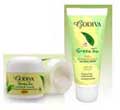
Good thing there's
Godiva
Green Tea Sunblock Cream! Godiva Green Tea Sunblock
Cream
comes in two forms: a 20 gram container equipped with
SPF 15, and a 60 gram tube equipped with SPF 25. It offers broad protection against
the UV spectrum, is sweat resistant and has zinc oxide
as its active ingredient. PLUS, it contains green tea extracts. Studies reveal that
green tea can protect human cellular DNA from damage caused by ultraviolet and
visible radiation.
|
_ Tell Us What You Think |
|
|
|
