
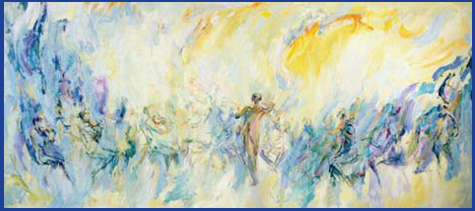
From Transitions : The Paintings of Peggy Smith,
Text by Peter J. Larocque, New Brunswick Museum,
Saint John, New Brunswick, 1996, 52 pages.
Artists are moulded by the situations in which they find themselves and Peggy Ellis Smith is no different. Her early ideas of art were profoundly influenced by her mother, who, while recuperating from tuberculosis in 1947-1948, began to paint after she received a set of oil paints and brushes. For Smith's mother, these items provided an opportunity for self-expression and afforded a small measure of independence - concepts which would come to be understood by Smith, who at the age of twelve, was painting along with her mother. When her family moved to Charlottetown from O'Leary, Prince Edward Island, where Smith was born, she was exposed to the works of prominent Canadian artist, Robert Harris (1849-1919). She frequented the city's Legislative Public Library and Provincial Public Library which housed, on the top floor, the Robert Harris Memorial Gallery. While attending the Prince of Wales College, she avidly continued to study and paint with the encouragement of her art teacher, Miss Eleanor Lowe.
Between 1951 and 1955, Smith studied under Lawren P. Harris, Edward B. (Ted) Pulford and Alex Colville in the Fine Arts Department of Mount Allison University at Sackville, New Brunswick.
Realizing she could not, at least initially, succeed as an independent artist, she applied to the University of Toronto where she enrolled and, in 1956, received a Diploma in Childhood Studies. Here too, she met Robert A. Smith, whom she married that same year. Amidst the births of her two first children, Derrian and Ben, Smith became involved with the Society of Co-operative Artists. Some of Smith's fondest memories of the era relate to her sketching musicians like guitarist, Ed Bickert, who frequented the popular after-hours jazz club, the House of Hambourg.
In September 1959, Smith, her husband and children, departed for England, where for the next five years she would continue to paint, teach and exhibit, albeit infrequently. Here as well, two more of Smith's children, Alan and Kate, were born. In 1964, she returned to Prince Edward Island. She taught adult art courses at St. Dunstan's University and catalogued the collection of Robert Harris works housed at Confederation Centre Art Gallery and Museum, an institution her mother was instrumental in establishing.
In 1965, Smith applied for a job which had been advertised by John Hooper, supervisor of art education in Saint John, New Brunswick. He offered her a full-time art teaching position in elementary and secondary schools. Smith was one of the artists who fell heir of the void left in the city as a result of the deaths of three preeminent artists; Jack Humphrey (died 1967), Julia Crawford (died 1968) and Miller Brittain (died 1968). She left teaching and began to operate a home-based, daycare facility. During this period, portrait commissions as well as her restoration business provided her with enough funds to survive and to continue painting.
Smith's longstanding love and appreciation of music had resulted in a prodigious amount of individual and group studies of musicians which included drawings of them during practice and performance. Her work gradually became more evocative of the moods suggested by the music rather than drawings of the events. During the Symphony rehearsals I explored aspects peculiar to watercolour while listening to music. (Artist's statement from brochure for exhibition, Sweet Aromas, City of Saint John Gallery, ABEC, 1-31 October 1992) Endeavouring to nourish these interpretations, she modified her painting technique; she began to paint a version of encaustic over papydura, a sculpting compound from France. Smith's painting style was also profoundly influenced by a series of short visits to Cuba which she undertook in 1991. The pace of her visits required that she use a fluid and quick-drying medium; watercolour.
For most of the past forty-five years, Peggy Smith has lived and painted in New Brunswick. Her understanding of her place in society requires that she make art; she is compelled to paint and this she does with almost unquenchable energy. Vital and decisive, her works' colours, forms and compositions depict intuitive and sincere reactions to the people, places and things which surround her. Throughout her career, she has endeavoured to sustain the development of her work by using the dynamic effects of many changes, or transitions. The cadence of these transitions has guided Smith's creative process and the spirit with which she shapes her observation into art.