Dali
Dali
Click on Dali for link
Dali
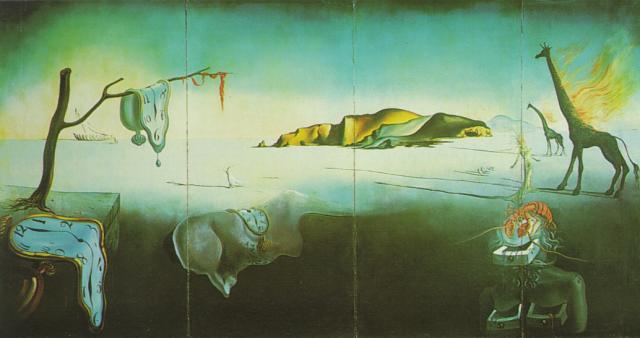
- oil on canvas mounted on masonite 4 panels - 240 x 120 cm (each) -
- Magidson & Associates, Inc., New York -
Dali
- oil on canvas
- 50 x 65 cm
- Morse Charitable Trust on loan to the Salvador Dal? Museum, St. Petersburg, Florida -
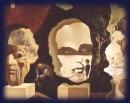
The work "Old Age, Adolescence, Infancy (The Three Ages)" was completed in 1940, near the time when Dal? and Gala fled from France in anticipation of the coming Nazi invasion. It was during this time that Dal? was being primed by Gala to move away from his surrealistic roots and towards more common and traditional themes. Although this painting is officially considered a Surreal work, it is an excellent example of the transformation that the artist was undergoing at the time. The painting currently hangs in the Salvador Dal? Museum in St. Petersburg, and is a valuable member of that collection.
The work utilizes Dal?'s now mature double imagery techniques to transform elements from the Catalan coastline into three separate and distinct faces that represent the three so called 'ages' of man. To the far right, a brick wall extends towards the center of the painting, and in what would appear to be a hole, a small cliff with trees emerges. On the face of the cliff is superimposed the image of a bowed, cloaked figure, whose head and clothing blend together with the cliff itself to create the double image of an elderly, mustached gentleman.
The center face, that of the adolescent, if formed from the combination of the towering cliffs in the background and the figures of both Lucia (Dal?'s nursemaid) and Dal? himself, both with their backs to us. The cliffs both have an eye superimposed on them, and Lucia's clothing is creased in such a way that these elements combine to form the face of a young man, perhaps in his twenties.
To the far right, the final face, that of the infant, is also formed from the combination of both scenery and a figure in the scenery. The cliffs to the far right form the edge of the face, while the figure of the netmender, sitting with her back towards us, helps to form up the nose, mouth and teeth of the smiling infant. The net itself looks like some sort of bib or collar. A second netmender figure is seen further to the right, and farther down the beach.
All together, these faces create an ambitious double image painting that makes extensive use of elements from Dal?'s past that were important to him. In many ways, he himself may have been trying to directly express how these elements had a profound effect on him, and were central to his being. Most important among these are the direct references to the Catalan coastline, which was the subject of many Dal?nian paintings throughout his career. Also important is the presence of Lucia, who nursed Dal? back to health as a child, and to whom he had a deep sentimental attachment.
In general, the author feels that Dal?'s use of these three allegorical faces is in itself a double meaning. On the surface, he may be discussing the inevitable effects of time on the human individual, but it is his choice of using the double imagery technique that is particularly telling. As World War II increased in intensity, Dal? must have certainly been disgusted with the bureaucracies and governments that had caused the conflict. As a Surrealist, Dal? had long ago turned away from such institutions, and is herein commenting on the double talk, double meaning, and inherent shortcomings of such a system.