Egyptian Gods and Goddesses
Chief god of Thebes; chief sun god and fertility. Patron of the pharaohs was later paired with Ra. He was a major deity during the New Kingdom period, represented as a man with the double plumed headress; the ram was sacred to him. Amun's wife was Mut and his son Khons.
Jackel-headed mortuary god and guide; protector of embalmers. Originally considered one of the four children or Ra he was also considered the son of Osiris and Nepthys causing her to hide him in the marshes to be found and raised by her sister Isis. Anubis followed Osiris on his travels and upon Osiris' death organized the burial and binding him with cloth (hence the first mummy). Thus Anubius became lord and creator of funeral rights, leading the honest dead to Osiris' throne; even taking pert in the judgement of the dead.
Goddess of the cataract area of Aswan; wife of Khnum; depicted as a woman with a crown of upright feathers.
Most renowned of Egypt's sacred animals and worshipped at Memphis Apis took the form of a black bull said to be the reincarnation of Ptah.
Monstrous snake of the otherworld that attempts to kill the sun at night. Possibly born by Neith.
Sun disk god; relatively minor except for Armana period where the pharaoh Akhenaten prompted sole worship of this god. Creator god of Helipolis similar to Ra. Note that after Akhenaten's reign attacks on the name of Aten was instigated by the pharaoh Horemheb.
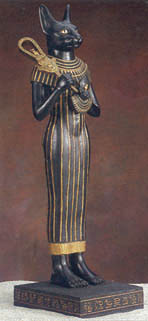
Cat goddess of magic and the home. Originally derived from the lion goddess Sekhmet. Her cult was centred at Bubastis in the Delta. Considered to be the daughter of Ra or sister and consort. Later considered wife of Ptah and sometimes mother of Anubis. A benevolent goddess Bast protected humanity from disease and evil spirits more importantly she was a goddess of fertility, sex and love, and enjoyed music and dancing. Mummifed cat were buried at her sanctuaries.
Dwarf protector god often depicted on upper thighs of musicians/prostitutes.
Jackal-headed son of Horus who protects the stomach. (seen on canopic jars)
Geb is the god of earth; paired with his sister Nuit; eldest son of Tefnut and Shu. Ra separated Geb from Nuit and his distress is said to cause earthquakes. Usually seen as beneficial deity who provides crops for humanity's fields and heals the sick. However it was feared he would trap the dead within his body preventing them from entering the underworld. Usually depicted as a bearded man often under the feet of Shu and coloured green to represent the vegetation that grew from him. Occasionally accompanied by a goose or portrayed as a bull. He and Nuit begat Osiris, Isis, Nepthys and Seth.
Baboon-headed son of Horus; protector of the lungs. (seen on canopic jars)
Goddess of many attributes but particularly as a protector of women and goddess of love and beauty. Represented as a cow-headed woman or woman with a headdress of cow horns queens were often depicted to her likeness. Hathor was the sky goddess and daughter of Ra and was a goddess of love, joy, dance and song. She nurtured the living and carried the dead to the underworld where she refreshed them with food and drink from the sycamore tree. When Ra grew old humankind plotted against him so Ra sent Hathor as Sekhmet upon the evil men. To end the bloodshed Ra drenched the battleground of beer mixed with pomegranate juice, looking like blood so Sekhmet drank the brew and became so inebriated she stopped the attack and was transformed back into Hathor hence the great jugs of beer and pomegranate juice drank at Hathor's feast.
God of Magic.
Goddess of midwifery symbolised by the frog.
Falcon-headed god; son of Isis and Osiris. Sun King and hero, avenging his father's death by Seth, the pharaoh was seen as Horus on earth.
Star of the East; Son of Horus and Sopdet
God of music and dance; son of Hathor.
Human-headed son of Horus; protects the liver. (seen on canopic jars)
Divine mother and wife; mistress of magic. Wife and sister of Osiris, mother of Horus. Represented as woman with throne headdress or cows horns. Daughter of Geb and Nuit. Usually depicted with large sheltering wings or the personification of a throne her lap being the throne of Egypt. Isis helped civilise Egypt by teaching women to grind corn and how to spin and weave. She taught people to heal and instituted marriage; when Osiris travelled she ruled wisely.
Upon hearing of her husband's death via Seth she cut off her hair, put on mourning clothes and went in search of the body. Eventually she gained her husband's corpse and hid it in a swamp but Seth found the body cutting it to fourteen pieces and scattering it. Isis and her sister Nepthys diligently collected the pieces and were able via embalmment to return Osiris to life and Isis conceived Horus before Osiris disillusioned by his brother returned to the underworld to rule. Hiding in a swamp Isis raised Horus and by some accounts Anubis until Horus avenged his father's murder. She pleaded with the gods until her son's throne was restored.
Deified mortal; wise sage; god of healing. Oversaw the building of the first pyramid and is attributed to the end of a seven year famine by advising the king to offer to Khnum. His name means he who comes in peace. Connected to Ptah.
Cosmic scarab beetle representing dynamic potential.
Ram-headed potter god; created mankind. Based in Elephantine and the cataract region.
Moon god.
Goddess of balance, justice, truth and harmony. Daughter of Ra she ruled over the judgement of the dead in Osiris' throne room, by forty-two judges. The heart of the deceased would be weighed against the feather of Maat by Anubis and the result recorded by Thoth in the weighing of the heart ceremony. If the heart was too heavy or too light it was swallowed Ammut an monster part lion part crocodile part hippopotamus would swallow the soul leaving the deceased to eternal nothingness.; if it balanced the deceased soul could live with the gods and fight against Apophis. Maat is depicted as a woman with a feather on her head and is often seen giving the breath of life, holding the ankh, symbol of life, to their noses.
Popular ancient god always depicted with a flail in his right hand and an erect phallus, with two upright plumes on his crown. God of the roads and protector of travellers worshipped in Koptos. Also god of fertility, growth and protector of the crops.
Falcon-haced with headdress of solar god on two plumes; local god of Hermonthis and later the pharaoh's war god.
Wife of Amun; vulture goddess.
Great mother, originally goddess of Sais in the delta with oval shield crossed with arrows as her emblem; goddess of war and the loom. Mother of Sobek and often said to have been mother of all gods particularly Ra; often seen as Mehueret the celestial cow. Neith also took the role as protectress of the dead.
Vulture headed goddess of upper Egypt; holds the symbol of eternity within her claws and with Wadjet protects the pharaoh.
Nature goddess and wife of Seth Daughter of Geb and Nuit. Sister of Isis she abandoned her husband after his murder of his brother Osiris and aided her sister in collecting all the pieces of his body. The goddesses became kites protecting the body until burial thus Nepthys became linked with the dead.
Sky goddess. Twin sister and wife of Geb. Ra attempted to separate them by placing Shu between. He claimed she would never bear children but Thoth intervened and gambled with the moon giving her five new days where she birthed Osiris, Seth, Isis and Nepthys.
Nun was the personification of the water abyss from with all life stems These waters created four pairs that created and egg from which air and a marvellous bird was born. Some say Ra rose from these waters to create life. Nun is depicted as a man standing in water with his arms raised to support the sun boat.
originally god of nature and the cycle of vegetation he inherited rule of the earth from his father Geb (mother was Nuit) and taught men to make bread and wine and oversaw the making of the first temples. He built towns and laid down fair and just laws; once Egypt was civilised he travelled civilising all via his charisma. His jealous brother Seth murdered him and disposed of the body which Isis found and hid in a swamp. Seth found the body and cut it into fourteen pieces and scattered them across the world. Isis and her sister, Seth's wife, Nepthys wandered the earth collecting the strewn pieces of Osiris' body and restored her husband to life (via embalmment) and was able to conceive Horus. Osiris however was disillusioned with his brother and returned to rule the underworld. God of the underworld who's principle cult was at Abydos, he also encompassed regenerative powers. Depicted as a mummified king with false beard, crown, with crook and flail and generally with a green face. Lord of death, resurrection and corn king. Symbolic of the past pharaoh and the flooding of the Nile.
Creator god of Memphis; shown as mummified man with false beard; patron god of craftsmen and the fine arts. Ptah is believed to be the inventor of the arts and designed and built many temples His consort was Sekhmet or Bastet and the bull Apis was believed to be a reincarnation of him. He was believed to protect humans from spirits.
Hawk-headed son of Horus; protects the intestines. (seen on canopic jars)
Supreme sun god of Heliopolis. Said to have come into being on the primordial mound that rose out of Nun and proceeded to plan creation. Each morning he was born and after bath and food travelled across the sky in his sun barque or boat and would spend the hours of the day inspecting his twelve provinces. After sun down he went to the underworld spending all the time fighting Apophis. From his spit Shu and Tefnut were born and after their wandering through Nun his tears begot the first humans. Ra created order out of chaos and is depicted as a falcon with a sun disk upon his head.
Combination of Ra and Horus; Harakhty means Horus of the horizon and was the sun god who rose each day from the east.
Lionness goddess of war, burning rays of the sun, vengance and healing; wife of Ptah. Worshipped in Memphis area.
Scorpion, healing goddess.
God of storms, destruction, violence and chaos. Killed his brother Osiris and chopped him to many pieces; married his sister Nepthys, rival to Horus. Son of Geb and Nuit; red hair and white skin. Upon his brother's death he declared himself king of Egypt until Horus was grown and sought revenge for his father, took Seth to battle and overcame him. Seth argued before the gods he was the only deity strong and brave enough to protect Ra. Some agreed but where swayed by Isis and when Osiris was consulted he threatened Ra with demons; Horus became king. Seth is said to live in the rough, arid desert. Seth is depicted as an animal with a long face and pointed ears.
Element of air supporting the sky goddess. The male half of the first divine couple, Tefnut is his mate. Ra created them by spitting them out of his mouth. The two went to explore Nun the great abyss and the tears wept on their return made the first humans. The begat Nuit and Geb, and Shu seperates the two. Shu succeeded Ra on the throne but the continued attacks of Apophis caused him to abdicate to his son after a week of terrible storms he lived in the sky and is sometimes depicted with the head of a lion.
Very ancient god of the dead in Memphis. Later associated with Ptah and Osiris; sometimes shown as a falcon headed man with crook, flail and sceptre.
Crocodile-headed god worshipped particularly in the Faiyum in Crocodiliopolis. Some stories say Seth hid himself in Sobek's body to escape punishment for murdering Osiris and Sobek was the son of Neith.
The star Sirius was seen as a goddess heralding the flooding of the Nile; equated with Isis.
Female element of water or moisture; tied to Shu.
Ibis or baboon headed god of learning, medicine, science, arts, magic, inventor of writing and patron god of scribes. Egyptian moon god said to be son of Ra or begot from the head of Seth. Usually regarded as vizier and scribe to Osiris, with his secret knowledge aided in Osiris' funeral and help Isis bring up Horus. Eventually Thoth succeeded Horus and gained three-thousand years of peace before residing in the moon. As the moon he was devoured by monsters who were however forced to disgorge him piece by piece. It is said he wrote a book of magic that gave the user power over the gods and recorded the judgement of the dead in the underworld.
Hippopotamus goddess; helpful and benevolent; patron of women in childbirth.
Cobra-headed goddess of Lower Egypt; with Nekhbet protected the pharaoh. Sometimes pictured as a lioness and said to have been Horus' nurse while Isis hid him from Seth.
Female form of Heka; goddess of magic.