)

| Geo | | Map | | Route | | Fact_sheet | | The Night Trek | | Rare Birds | | MyPix | | BirdList | | Linx |
|
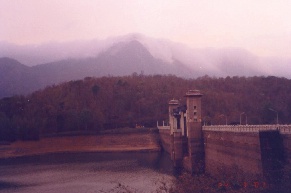
| Parambikulam Dam.. in twilight. Highest Peak of the Sanctuary in the Background.. KarimalaGopuram(1440m)- It's a challenge for Trekkers to reach the Peak |
|
|
Parambikulam WLS FACT-SHEET from World Conservation Monitoring Center.
|
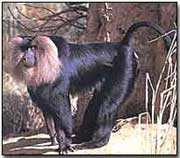
| Lion-tailed Macaque : |
|
A reclusive rainforest monkey..
Highly Endangered species, endemic to the Western Ghats.. (found nowhere else on earth) Habitat: High-canopied rainforests. A frugivorous animal.. it lives in a very matrilineal society where the females never leave the group. It's population is estimated to be around 4000 (pre-Y2K). |
|
More than half of the world's animal and plant species exist in rain forests. If we continue to destroy forests for farming and industry at the current rate - 100 acres per minute - 25 percent of all wildlife will be lost in 50 years. -Protecting the RainForest -> -Wildlife Conservation Society |
----
The Press Release from the Census Commissioner of India read..
Subject : Census of India 2001
Date: 26th of March, 2001, New Delhi
PROVISIONAL POPULATION RESULTS - CENSUS OF INDIA 2001
At 00.00 hours of 1st March, 2001 the population of India stood at 1027,015,247 comprising of 531,277,078 males and 495,738,169 females. Thus, India becomes the second country in the world after China to cross the one billion mark.
India added about 181 million persons between 1991-2001, which is more than the estimated population of Brazil, the fifth most populous country in the world. India's share of the world population is 16.7 percent.
... ... ...
----
While this was being published, we (Me, Luke) were involved in
'Primate Census 2001' @
PaRambikulam Wild Life Sanctuary, Palghat.. (March 23-26)
targetting 4 species of monkeys..
I came to know about this event from buddy Arvind, who had participated in
last year's census operation for Lion Tail Macaques @ Parambikulam. This
time around he got an e-mail from the Forest Dept, announcing the dates.
When I heard about his experience, I got real thrilled,
thought I shouldn't miss it..
Boy, such opportunities are hard to come by.. , u r gonna get to WALK right thru the middle of the forests and see the wildies right in front (or mayb even unaware of them stalking U ! :)..
Though I had done jungle safaris 6-7 times on open jeeps in Bandipur & Nagarhole National Parks (all Motorola-sponsored :), wasn't lucky to catch some real action, like when one of the jeeps of our group was attacked by a herd of elephants.. by the time my jeep reached the scene, there were just fresh pungent droppings.. and when I'd to be contended with pugmarks near a watchtower, after waiting to see some tiger quenching thirst from the lake nearby.. those safaris and hearing about the narrow escape from elephant attack had whetted my appetite for the real taste of the wild.. But it's a whole different ballgame when u r out on the same turf as some Faster, Stronger creatures.. when your instincts take over your Higher Intellect.. which may black-out when your eyes lock with that of a beast..
The thought of 3 days of trekking thru some prestine forests or, tourism-restricted parts on the foothills of Western Ghats, was exhilarating.. u'll even have the company of an expert tracker (a tribal guide).. who knows the Laws of the Jungle.. what more can u dream of ?? After going thru some websites, there were expectations of spotting the likes of elephant, bison, giant squirrel, sambar, spotted deer, mouse deer, and the elusive tiger, leopard etc.. apart from whole lota birds.. and it's summer.. perfect timing.. as far as chances of spotting and visibility are concerned !
+food and acco-in-whatever-way-available, will be taken care of by Forest Dept.. -as they say, Best things in life are for free !
Started out on Thursday evening from Bangalore by 8pm TN-state bus to Pollachi. {There's NO road access to the WLS from Kerala.. the only public transport available is a bus from Pollachi to Parambikulam (6am & 3:30pm), and the sanctuary gates will be closed from dusk to dawn.}.
We reached Pollachi before 5 next morning. Got into the bus to Parambikulam. On the way up the Anamalai range [part of IndiraGandhi WLS in TN, which is adjacent to PWLS] spotted some interesting birds, a Malabar pied Hornbill (vezhambal) being the most memorable.. got down @ Anappady, at the periphery of the WLS, it's Kerala-TN border.
For day one, there's only registration and introductory function in the evening. Today we r supposed to stay in a dormitory next to Wild Life Warden's office @ Anappady.
After breakfast, me & Luke went for a dekko.. around the place.. and that morning I had the first and best of birding.. can't forget the sheer joy of it.. We both hunting for 'em.. huh the splash of colours.. seeing most for the first time.. the likes of Paradise Flycatcher.. its aerial sortie is a delight to watch.. we followed one Blue Jay for a long time (also called Indian Roller.. it's the "State Bird of Karnataka") striking flash of blue when in flight arrests your attention.. that's what made us follow..
By evening there were more than 150 volunteers regd for census.. (mostly from neighbouring districts +students from Forestry colleges of Agricultural Uty.).
The function started off by Mr Pugazhendi, (IFS),The Wildlife Warden, welcomed the
gathering.. also mentioned..
"Salim Ali came to this Sanctuary to start
his study of Birds of Kerala.. The bungalow where he used to stay is
now converted to Salim Ali Centre, a very scenic place.." .
[ Dr Ali later authored the book titled 'Birds of Kerala' ]
Then there was an interesting guest lecture on
Primate Ecology by a scientist (Primatologist), Dr Ajith ..
He gave a presentaion about the fauna found in the sanctuary..
with more details about the primates including Slender Lorris, the nocturnal primate..
evolution, geographic distribution,
habitat types, food and social habits etc..
followed by detailed description of the Method used for census,
termed Line Transect Method..
Line Transect Method :
Groups of 2-3 guys guided by a tribal (tracker) will go deep in the jungle, to places marked out (a strech of around 2km ) earlier for the purpose, The marked portion inside the forest is called 'Line Transect', and there were 70 of em all over the sanctuary with total 285 sq.km spread.. while walking thru the Transect, once monkeys are seen on a tree, v 've to note down the perpendicular distance of the tree from Transect, also the count and other details.. those seen when v r outside Transect area, or coming back thru transect etc are not taken into account..
this has to be done twice a day, for two days.. early morn & evening.. finally researchers'll collate all the data from all the grps and by a scientific statistical method, estimate the total population..
For each species, if
N is the total number of monkeys spotted,
L, the lenght of the transect in km., and..
D the average of the perpendicular distances from the Line Transect, of the trees where the monkeys are spotted.. then ..
N / (L * 2D)
gives the average number-per-square-km distribution.. The values are arrived at by taking 4 samples of data over two days.. For the final estimation, factors like the habitat type are considered.. The population estimation is o'course done by the researchers/scientists.. field data collection is what we need to do..
 By next morning, the list with the 70 Transects, people appointed, their
guides, and the 17 base camps across the Sancutary were put up.
The Transects are coded with the type of forest..
Luke to Moist Deciduous Forest, Me to Evergreen.
Thomas Nelson, who coordinates the whole event gave briefing and tips about what
to look out for in each Transect area (habitat types) and some of his experiences there..
By next morning, the list with the 70 Transects, people appointed, their
guides, and the 17 base camps across the Sancutary were put up.
The Transects are coded with the type of forest..
Luke to Moist Deciduous Forest, Me to Evergreen.
Thomas Nelson, who coordinates the whole event gave briefing and tips about what
to look out for in each Transect area (habitat types) and some of his experiences there..
Apart from the monkeys.. he listed out the possibility of seeing other animals.. areawise.. Bisons (Gaur), Sloth Bears, Spotted Deers, Sambar Deers, Elephants, Giant Squirrel, Civet, Slender Lorris, King Cobra, Leopard and Tiger..
He mentioned about this plant called 'Aanamayakki' (Elephant nettle ), seen in the evergreen forests.. if your skin touches it's leaf, u'll experience excruciating pain, swelling, sleeplessness, and even fever !..
Nelson got bedridden for 3 days when he happened to come into contact during the Transect marking.. During those outings, he also spotted a King Cobra, the largest poisonous snake on earth, inside the evergreen.. near humid area close to a stream.. said to be it's habitat..
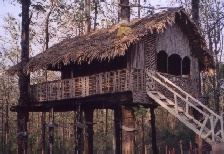
Because of lack of vehicles available, it took the whole day to dispatch people to places near their base camps., with their share of 2 days' food ration to each camp. Some base camps have 'guest house' (small house), some had to sleep on rocks (who all really slept is a ? mark), some on watch towers etc.. My camp was one proper house :(, Luke's was a so-called 'Karadi Bungalow' where Sloth Bears ( Karadi ) visit for shelter during monsoon.. with muddy marks of Bears' paws and back on the walls !
The Night Trek
By around 6pm, the 16 guys of my base camp were dropped near
Parambikulam dam. Raghu, our coordinator told it's around 6km trek to
the base camp, some had anxious moments since we had to cross two
elephant- areas in the jungle, and within half an hour, it'd be
real dark. As we crossed the dam, it started getting dark.. there were
some isolated song birds like Malabar Whistling Thrush and loud Jungle Fowls' calls which died down soon..
when passing thru a teak-forest, suddenly there was a snorting sound
from nearby.. some were dumb-struck.. others in a dilemma whether to
run or stay put.. 2 seconds later there was a rustling sound..there
were layers of dry leaves all over.. "a Bison".. Raghu informed..
then I could smell it..
so we started tasting the wild.. half an hour past, we were trudging along jeep tracks with all the luggage and ration.. cutting across a grassland.. a loud snorting.. first question flashed in mind.. 'Elephant ??'.. and the sound of a huge herd starting to run.. it seemed getting closer.. guides with big torch lights were in front.. and some others much behind.. I didn't know which way to run .. three of us in the middle started running towards guys in front.. backpack's pulling me down.. then someone directed the light.. sighh.. Bisons.. huge herd.. actually disappearing into the woods from the salt lick near the grassland.. whew.. safe. The sound was that of the Head of the herd giving a warning signal..
Then some Spotted Deers here and there.. torch-lights directed at the disturbance of dry leaves reveals many pairs of glowing eyes.. some staring.. some dashing off.. leaving streaks of yellow glow.. after more than an hour and half, we reached the house.. a large herd of spotted deers moved away from near the compound.. there's trench dug around it.. when relaxing, awaiting dinner prepared by the guides, we realised that we'd walked too fast.. After a refreshing bath near a step-well in a marshy grass land in front, we gathered for a solar-lantern-lit dinner amidst stories of last year's incidents by Hamsa, a very jovial chap (one of the guides). Some of us slept on the terrace with soothing breeze wafting thru.. I snuggled up inside the sleeping bag.. |
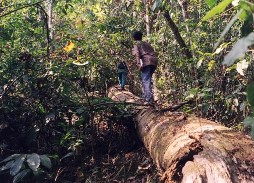 Woke up early to the calls of birds.. The house is only for cooking and as
shelter.. for rest everything, u turn to Nature :) ...
Now could see that this place
faces the steep slopes of Karimalagopuram, the highest peak inside the
sanctuary.. Manoharan, my guide pointed where on those slopes, the
Transect EG8 (Evergreen) lies.. After a tasty Upma breakfast, by 8 we
3 guys started the trek with Mano. It was steady climb initially,
which got steeper.. initially thru teak
forest, then thru shrubby patches and finally into Evergreen..
Woke up early to the calls of birds.. The house is only for cooking and as
shelter.. for rest everything, u turn to Nature :) ...
Now could see that this place
faces the steep slopes of Karimalagopuram, the highest peak inside the
sanctuary.. Manoharan, my guide pointed where on those slopes, the
Transect EG8 (Evergreen) lies.. After a tasty Upma breakfast, by 8 we
3 guys started the trek with Mano. It was steady climb initially,
which got steeper.. initially thru teak
forest, then thru shrubby patches and finally into Evergreen..
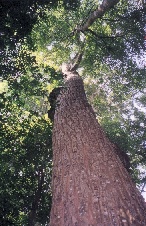 Elephantine droppings on more than a dozen places on our way up..
but only droppings :-( ..
had to trek for more than 1hr from my base camp to reach the Transect..
Envied Mano, moving so effortlessly thru tough terrain.. he's compact
built, well defined muscles..
once inside the evergreen, visibility is low to spot the monkeys
and trees are very tall.. about 50m.. high-canopied forest..
and can't hear any birds coz the whole place
reverberates with Cicada (insect) chirps.. that's a whole different world !
Though we could hear the Nilgiri Langurs within half a km of the
Transect, couldn't spot any. But saw the Giant Squirrel, and a pair of
very bright yellow birds, which couldn't be identified. Mano
showed me the dreaded Elephant Nettle plant.. ('Aanamayakki') I had made a request to him
to show one to me, after hearing about it from Nelson.. I wanted to
know whether he c'd somehow pluck one leaf.. he did it with his knife
and I kept it xxtra carefully inside a book in backpack.. as a souvenir to take
home..
Elephantine droppings on more than a dozen places on our way up..
but only droppings :-( ..
had to trek for more than 1hr from my base camp to reach the Transect..
Envied Mano, moving so effortlessly thru tough terrain.. he's compact
built, well defined muscles..
once inside the evergreen, visibility is low to spot the monkeys
and trees are very tall.. about 50m.. high-canopied forest..
and can't hear any birds coz the whole place
reverberates with Cicada (insect) chirps.. that's a whole different world !
Though we could hear the Nilgiri Langurs within half a km of the
Transect, couldn't spot any. But saw the Giant Squirrel, and a pair of
very bright yellow birds, which couldn't be identified. Mano
showed me the dreaded Elephant Nettle plant.. ('Aanamayakki') I had made a request to him
to show one to me, after hearing about it from Nelson.. I wanted to
know whether he c'd somehow pluck one leaf.. he did it with his knife
and I kept it xxtra carefully inside a book in backpack.. as a souvenir to take
home..
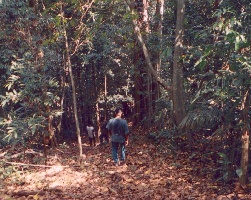 On reaching the transect end, there was a troup of Nilgiri Langurs
passing thru a bamboo brakes outside the Evergreen. It took 90 min.
to cover the Transect. When relaxing there, from far away,
heard a tiger roar..., as Mano identified.
On reaching the transect end, there was a troup of Nilgiri Langurs
passing thru a bamboo brakes outside the Evergreen. It took 90 min.
to cover the Transect. When relaxing there, from far away,
heard a tiger roar..., as Mano identified.
For the second outing, I went to a teak-forest for a change.. could spot lotsa birds, spotted deer, sambar, bison etc.. but no primates this time, though it's easier to spot 'em here with lesser canopy of leaves..
Next day by the third outing, some people had the experience of facing elephant herds and bears.. I wasn't that lucky, but thoroughly enjoyed being with Nature, learning lil things about the jungle world..
Another guy with a swollen palm.. he'll never ever forget 'Aanamayakki' .. just a rubbing on its leaves gave him unbearable pain which stayed on "like electric shock", and took away last night's sleep..
One Forestry college student with his 'catch' of list of more than 75 bird species spotted.. rather, identified.. I tho't.. "I've got more than 20.. hmm.. Not bad.. and there were as much more that I couldn't identify"
Overheard the narration of this chap who, by instinct, ran for his dear life when a Black Panther was spotted, though it was relaxing 'at a safe distance' as the guide reassured, on a tree inside an evergreen forest..
{ Some leopards are completely black and are known as panthers. Panthers are mostly found in the dense, wet forested areas of India and SE Asia, where the dark coat offers an advantage in camouflage.. Black leopards are often called black panthers and are of the same litter as normally marked cats.
__from BBC WildFacts page. }
When I look back for the most memorable pages added to my life from those days, it's Darkness that appears first!.. of that Night Trek.. and the Glowing eyes of the deers in the torch-light.. staring at us..
Then I can hear the insects' incessant ear-piercing chirping.. echoing all over.. inside the evergreen rainforest..
Another moment flashes in mind.. when inside a teak forest, I caught glimpses of a pair of Bulbuls chitter-chattering on a nearby branch, when focusing the binox, 2 Drongos landed on the tree next to it.. and there was another sparrow-sized yellow song bird behind.. it's high pitch tones masking all others.. now all looking towards me, inquisitively.. what's-this-guy-upto kind of looks.. some moved to nearer branches.. then there were these two myna-sized yellow birds with greenish head and crimson patches on the breast.. pecking on flowers, perched higher up.. another Green Barbet landed and disappeard into the foliage.. looked at the song bird again.. it took to wings.. wavy flight between a row of trees.. when it disappreared, I realised that "I'm quite far behind than the other two guys.. can't see them.. I've to catch up fast".. I walked off briskly..


)