)
|
|
| Culture : Festivals |
|
|
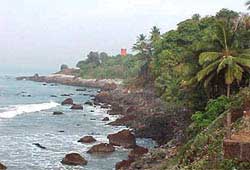
The LightHouse.. Below that, on the rocks, I had my first bottle of beer :-) ..with buddies Suppudu,Kurup,Chiku,Manju et al. |
Kerala is a strip of land sandwiched between the
Western Ghats mountain range and the Arabian Sea..
It is the Gateway for the Southwest Monsoons to India.. large portion of the monsoon clouds
gets blocked by the Mountains.. resulting in heavy rainfall in this area..
Kerala has more than 600kms of coastline, serene backwaters.. wetlands..
tropical rainforests.. a veritable verdant world.. making it a popular travel destination..
It's one of the centres of Spice trade in India since ancient times...
 The Malabar coast has been famous for its Cotton
handlooms since time immemorial. Along with
spices they formed an important item of foreign
trade. Kannur proudly maintains that tradition
even today. Several weaving centers and handloom
export houses flourish here.
The Malabar coast has been famous for its Cotton
handlooms since time immemorial. Along with
spices they formed an important item of foreign
trade. Kannur proudly maintains that tradition
even today. Several weaving centers and handloom
export houses flourish here.
Kannur has the biggest cinnamon estate in Asia.
Cashew tree was introduced here by The Portuguese.
Today cashew nut is a major export earner for the State.

|
Marco Polo at the age of 17 set out from Venice on a 24 year odessey across Asia.
His accounts, boldly titled "Description of the World", revealed to the Europeans places
never before described, or even dreamed of.
Columbus was inspired by Marco's descriptions. (Though in 1492, he sailed westwards to find the
Fabulous East !, and landed on The Carribean, thinking that was India :)
- check out the
"When you leave the Islands of Seilan and sail westwards about sixty miles, you come to the great province of Malabar, which is styled India the greater. It is the best of all the Indus and is on the main land. There is in the kingdom a great quantity of pepper and ginger and cinnamon and nuts of India" |
The quest for spices lured several European powers to this land. The Portuguese Captain
Vasco da Gama and his men were the first to find a Sea route to India.. landed near Calicut in 1498.. @ Kappad beach (~70km from Kannur).. Viceroy, Francisco De Almedia arrived from
Portugal soon after to build fortifications at strategic points.
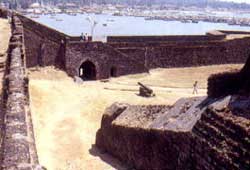 One such was built at Kannur, circa 1505, and named Fort St Angelo. By 1663, the Dutch arrived, defeated
the Portuguese and captured the Fort; and the rule of the Portuguese had come to an end. The Dutch
continued till the advent of the English East India Company.
One such was built at Kannur, circa 1505, and named Fort St Angelo. By 1663, the Dutch arrived, defeated
the Portuguese and captured the Fort; and the rule of the Portuguese had come to an end. The Dutch
continued till the advent of the English East India Company.
The English East India Company got its first foothold in the district in the closing years of the 17th century, when the Thalassery Fort was built. The British were more successful than the Portuguese since they refused to interfere in the religious and social life of the natives. By the 18th century they managed to capture the lucrative spices trade and were the unquestioned masters of the seas around Kannur.
The conquest of Malabar by Tippu Sultan in the closing years of the 18th century caused much distress and unrest in the region. But his defeat by the British at Srirangapatanam in 1792 formally ended his reign here and the entire province ceded to the British.
Cannanore played a prominent part in the freedom struggle against the British a century later. The Salt Satyagraha of Mahatma Gandhi found its echo on the beaches of Payyannur.
Kannur also is the region from which the Communist movement in Kerala really took roots under AK Gopalan. In 1957, Kerala entered the annals of history by being the first place in the world to have elected a Communist Government. Even today, Kannur remains a stronghold of the Communists; and it's the most politically volatile and hypersensitive part of the state.
#########
Some Articles featured in NG magazine:
+
Kerala
is selected as one among the 10 most beautiful places in the 'Paradise Found'
section of
'50 places of a lifetime'
National Geographic Traveler magazine. (October 1999)
+
Festivals of Kerala
National Geographic Traveler magazine. (Apr 2001)
+ Edwards, Mike. "The Adventures of Marco Polo," National
Geographic (May 2001), 2-31.
+ Severy, Merle. "Portugal's Sea Road to the East," National
Geographic (November 1992), 56-93.
+ Miller, Peter. "Kerala, Jewel of India's Malabar Coast,"
National Geographic (May 1988), 592-617.
+ McKibben, Bill. "Kerala, India," National Geographic Traveler
(October 1999), 152-154.
#########
+ Ward, Geoffrey C., "India: Fifty Years of Independence,"
National Geographic (May 1997), 2-57.
+ McCourt, Malachy. "Bombay," National Geographic Traveler
(May/June 2000), 126-130.
+ McCarry, John. "Bombay: India's Capital of Hope," National
Geographic (March 1995), 42-67.