
SAND MAP OF BUDDHISM
By Ngawang Janchub
Cyclic Existence
Nothing exists of itself – all experience is conditioned by mental states dominated by being caught up in a world-of-self where cause & effect often disrupt ones sense of inner balance. Led about by the results of former actions, it seems prudent
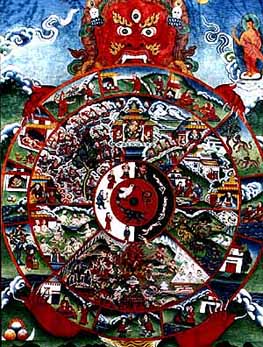
to reject that which causes us unhappiness & pursue the causes of happiness. However – having mistaken the true mode of existence through the adventitious stains of karmic conditioning – we often set about on a path that ultimately brings negative results ranging from the relatively minor to rebirth in hell, or as a hungry ghost, or as an animal.
The positive results of good karmic actions, such as benevolence, also ripens in the continuum of our minds from time-to-time resulting in rebirths in more pleasant realms such as a fortunate human rebirth (one endowed with sufficient leisure and intellect to ponder the meaning of life). This provides the opportunity to work towards freeing ourselves and others from suffering and its causes.
Being reborn in heavenly realms based on the mistaken belief in a soul, or attachment to pleasurable states of existence, does not normally help one to finally sever the connection with cyclic existence. Once the merit required to enrapt one for long periods of time expires, the darkened state of mind produced by indulgence in intense pleasure manifests in the form of a lack of concern for the welfare of oneself and others in beyond what is presently appearing to ones mind. The weakened positive mental factors of wisdom and insight are often insufficient to redirect one to a human rebirth and in the following rebirth, the consciousness often manifests in the form of an animal.
As we transmigrate, and our karma leads to people and places we have known in the past, new dynamics come into play with old lusts & hatreds, which then create the impetus for further spinning-around in cycles. So equanimity & patience, as well as other positive mental traits need to be brought out in one’s consciousness from beneath that dark layer of ignorance.
That is, true wisdom must be developed, and the different methods of fostering this, relate to the different approaches taken by the various schools of Buddhism.

Return to Contents Page