
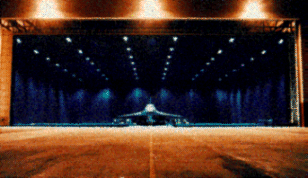
 We
have an experienced technical staff that includes scientists and engineers,
computer scientists and technicians, and facility technicians for facility/test
article support for our customers. Other features of the BAF include
the Data Acquisition Center, Test Operations Center and a small shielded
room used for near-field testing. We use a CEESIM 8000 for
signal generation and a wide variety of equipment for
signal monitoring. There are several upgrades in the works and major additional capabilities
being added. Click here for a list of some of our satisfied customers. We
have an experienced technical staff that includes scientists and engineers,
computer scientists and technicians, and facility technicians for facility/test
article support for our customers. Other features of the BAF include
the Data Acquisition Center, Test Operations Center and a small shielded
room used for near-field testing. We use a CEESIM 8000 for
signal generation and a wide variety of equipment for
signal monitoring. There are several upgrades in the works and major additional capabilities
being added. Click here for a list of some of our satisfied customers.
FEATURES
A shielded 1,000 sq ft (93 sq meters) Data
Acquisition Center (DAC) is located directly below the turntable for chamber
test article monitoring. All test article support utilities and data and
instrumentation interfaces are routed through the turntable to the DAC.
The Test Operations Center (TOC), located in a shielded room, can control
all test activities in the chamber. Test monitoring is accomplished with
closed circuit television cameras and an internal intercommunication (ICOM)
system.
A separate smaller (30 ft L X 16 ft W X 10
ft H) shielded RF enclosure is also located on the premises. This is available
for testing smaller articles when the large chamber is not necessary, or
is in use by another program. Most testing done in this enclosure involves
radiated/conducted emissions test on component and line replaceable units
(LRU) level items.
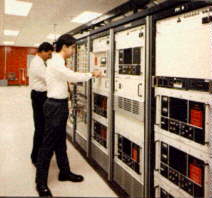 SIGNAL
GENERATION SIGNAL
GENERATION
There are three threat emitter sites
located around the perimeter of the BAF. The primary threat site houses
Amherst Systems Combat Electromagnetic
Environment Simulator 8000 (CEESIM 8K) signal generator. The CEESIM
can simulate single or multiple emitter environments, antenna sidelobe
patterns, background signal environments, telemetry signals and other
tailored events.
The CEESIM consists of 19 channels divided
into 25 independent radiating sources. These sources can be dispersed virtually
anywhere in the chamber for a more realistic threat layout. Amplification
is achieved by either traveling wave tube amplifiers (TWTAs) for higher
power or solid state amplifiers (SSAs) for lower noise floor, depending
on customer test requirements.
Free space radiated RF signals consist
of high fidelity threat models with frequency and PRI agility, various
modulations and scan patterns. Our GPS Satellite Constellation Simulator
(SCS) is capable of providing a full simulated constellation of 12 L1/L2
P(Y) coded satellite signals.
Signal requirements are configured using the electronic
warfare integrated reprogrammable (EWIR) data base. Our signal library
provides simulation of red/blue/gray (threat/friendly/unknown) air-to-air,
air-to-ground, ground-to-air, shipborne and telemetry systems RF signals.
Up to 640 simultaneous emitters are possible at the digital level. This
provides the BAF with a pulse density of several million pulses per second.
Access to Defense Mapping Agency (DMA) and World Databank cartography files
simulate terrain occlusion. Independent verification of the simulated signals
can be provided during testing.
TEST SUPPORT
RF test equipment includes Hewlett
Packard frequency spectrum analyzers, digital oscilloscopes, vector
network analyzers, and time domain analyzers to name a few. Data acquisition
and processing capability includes capture and display of real time,
customer defined parameter and data input streams tagged with inter-range
instrumentation group (IRIG) time. Data streams include two pulse code
modulated (PCM) and five MIL-STD 1553 data buses. Multiple computer
systems include SUN and VAX workstations, and PCs and Macintosh computers.
An HVLogger recording system is capable of
handling two dual redundant MIL-STD 1553 data buses. The HVLogger can record
at 100% of bus loading for a minimum of 2 hours. Raw or engineering unit
data can be transferred using BBN Probe on a SUN workstation to produce
an 8mm Q150 or 9 track tape. Information can be downloaded to a 1.44MB
DOS (3.5 inch) diskette. Our Loral 500 System is capable of monitoring
and simulating one MIL-STD 1553 data bus and three PCM data streams at
fixed frequencies.
Test article support utilities include: 400/60
Hz 230/115 volts alternating current (VAC) and 28 volts direct current
(VDC) electrical power, emergency back up generators, separate uninterrupted
electrical power sources, avionics air cooling, liquid coolant system,
hydraulic system (regulated pressure up to 4,000 psi), regulated gaseous
nitrogen and compressed air, and instrumentation.
The facility supports special projects testing.
Security measures include multiple controllable and isolatable security
zones, closed circuit television, automated security card key access, safety
surveillance and monitoring.
Through the use of environment monitoring
systems, an independent agency captures, records and verifies RF generated
signals in real time. This system has the capabilities for real time and
post test RF signal parameter measurement, instrument display recording,
data analysis and test coordination, as well as providing the data for
signal verification.
PLANNED UPGRADES
- Radar Target Generator (RTG) for precise and fully controllable simulated
radar return that enables repeatable testing of a radar system.
- High Intensity Radiated Fields (HIRF) test capability. (Based on customer
requirements.)
- Dynamic radar imaging/reflectivity measurements
- Multiple aircraft/vehicle interoperability
 A major upgrade
to our facility as a whole is the Electronic Combat Integrated Test
(ECIT) project. ECIT will provide multispectral, correlated, high density
environments. The contract for this project was awarded to the Boeing,
Amherst, Hughes
team. We will post updates as the project progresses. A major upgrade
to our facility as a whole is the Electronic Combat Integrated Test
(ECIT) project. ECIT will provide multispectral, correlated, high density
environments. The contract for this project was awarded to the Boeing,
Amherst, Hughes
team. We will post updates as the project progresses.
CUSTOMERS
We conduct normal test operations and preparations
on a single shift per day, with surge capability to meet customer requirements
up to a full 24 hour per day testing. BAF programs in various stages of
test planning and test support include: F-16s, F-15s, C-130 variants, F-22,
B-1, B-52, UAVs, HARMs, foreign military sales, special projects, DoD contractors
and civilian testing.
Programs supported by the BAF have included
the Combat Talon II MC-130, F-4G/HARM, AFTI F-16, F-16C avionics and electronic
warfare suites, F-16/HARM, Royal Air Force F-3 Tornado (multiple aircraft),
Navy sensor systems, Air Force Reserve F-16 Integrated EW suite, F-16/AMRAAM/ECM
pod integration, Miniature Sensor Technology Integrator (MSTI) Satellite,
HARM target system, Navy sponsored monostatic and bistatic radar signature
measurements, B-52 integration testing, C-17 NVIS, Falcon 20 GPS testing,
Marine AV-8B Harrier, F-15s, AC-130U Gunship, EC-135 ARIA, U-2 EMI/EMC,
Navy F-14, various C-130 testing and other DoD contractors.
POINT OF CONTACT
Chief, Anechoic Facility Branch
412 TW/EWWA
30 Hoglan Avenue
Edwards AFB, CA 93524-8210
Voice: (661) 555-5680, DSN 555-5680
Secure Voice: (661) 555-5667, DSN 555-5667
FAX: (661) 555-5405, DSN 555-5405
Secure FAX: (805) 555-3492, DSN 555-3492
Return to top.
|