| An Excerpt from "Our Family - An Early Historical Documentation" |
|
 |
|
|
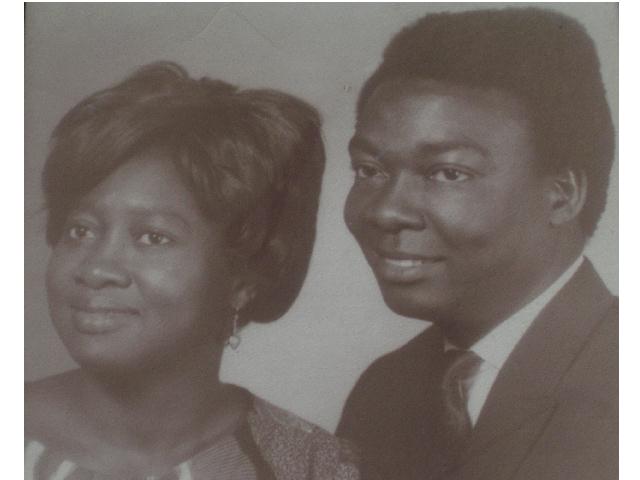
Alex and Kate Abankwa, late 1960s |
|
|
Get in touch with me by email! |
|
|
|
[email protected] |
|
|
|
FOREWARD
On a visit to Ghana from St Petersburg, Russia, in January 1994, I had the opportunity to visit an ageing relative, my mother�s aunt, Eno Adwoa Boakyewa, who despite advanced years, was running a bar in Aduamoa. She flitted agilely and youthfully around the place, posing eagerly for the video camera while playing tour guide. Despite its sorry state of repair, she proudly showed Cord, Jared and me the family home, pointing out who had occupied which rooms, chattering away excitedly all the while. Assuming I was using a reflex camera, she asked to have a passport sized photo of her developed from the shots; she urgently needed one for her liquor licence renewal formalities. Disappointment weighed down leadenly in the air when she discovered it would not be possible.
Six years later, in January 2000, the family had expanded to four members and we were in Ghana again, this time from Berlin. My elder sister Cordelia and her family were also there on an extended vacation, and we all drove up to Abetifi to stay at the beautiful new Mediterranean-style house overlooking Kwahu-Tafo and Pepease that Daddy had just completed. Such a visit would not have been complete without a stop at the home of Mama Ntim, my paternal grandmother. Mama received us, as usual, seated sovereign-style on her long veranda, overseeing the bustling activity in the inner courtyard. After an exchange of news, we prepared to go. �When I die, I want all of you to come to my funeral�, my octogenarian grandmother said as we stood to leave. Daddy stopped in his tracks. �What do you mean, funeral?�, he asked her, taken aback. �Tell them you want them all to attend your ninetieth birthday party instead!� he suggested on the spur of the moment. And with that, a plan was hatched that would see fruition two years later. Two years later, because in 2000, we believed her 90th birthday would fall in 2002, but as a forage through the records revealed, she would reach that mark later that very year.
These two encounters sowed the seeds of curiosity about the two lines of our family from which a child- and adulthood of global mobility had hitherto unfortunately kept me estranged. Time and again, I considered putting down what I thought must be a fascinating family history for posterity and in early 1996, even started an Internet-based genealogy research course to learn how best to go about it. Whenever I got the chance, I hounded Mummy for information about her family. I even gave her a book that I thought might help her fight procrastination by providing interesting memory joggers and precise questions for her to answer. The book was returned to me sometime later untouched by the ink of a pen. There was, however, a slip of paper enclosed bearing her family tree as she best remembered it. It is interesting to note that an additional aunt appeared in the version I received in 2003.
Mama�s ninety second birthday celebration in 2002 provided an excellent opportunity for me to interview her and other family members and try to fill in some of the gaps in what will probably always remain wanting knowledge. I was astounded by the clarity of Mama�s memory and the exactitude with which she named not only her own siblings, but those of her parents and grandparents. Further interviews in 2003 and information gleaned from various sources provided the basis for the short history that I have compiled here. What started out as an exploration of the family tree took on an active and intense life of its own. I have enjoyed unravelling this tale and also learned immensely the process. The course was made somewhat difficult by the Akan custom of shrouding one�s origins in mystery, but persistence yielded the coveted fruit. Unfortunately, I was not able to obtain copies of all of the historical documents that do exist, but perhaps they can be appended at a later date.
I hope that this compressed and, per force, limited account, covering the earliest known members of the family from the mid 19th century until the beginning of the 1960s, will not cause offence to anyone who may feel more or less has been included than should or could be; my memory, biographical material of contemporaries, photographic archives, video material and the aforementioned interviews were my only references. I ask for your indulgence if my interpretations and hypotheses are at odds with yours, or if I have misinterpreted customs or events; my statements are based on extrapolations from history and again, there is no wilful intent to offend.
My sincere thanks go to all of my relatives who took the time to answer my questions in writing, or who through unhurried conversations, contributed to the information that I have gathered here. It is my hope that the younger generation be inspired and empowered by what they read. Let us all vouchsafe our family history by compiling our own memoirs, written or otherwise recorded. Later, there need be no regrets.
Moscow, July, 2004
THE NTIM LINE
During the rainy season, the bauxite rich escarpment that rises from the plain to form the Kwahu mountains is blanketed in a melange of saturated greens that relaxes the mind and soothes the eye. Emerging into the vibrant sunshine from an intense downpour, the forest is enveloped in a cool, damp veil, alive with the chirp, call, screech, and twitter of animal life. The scent of cooking fires, sodden earth and the slow, natural decomposition of flora and fauna compete for attention in this sensually charged atmosphere.
My paternal grandmother, Elizabeth Akosua Adobea Ntim, n�e Oppong, more popularly known as Mama Ntim or simply Mama, was born in Bepong, on just such a day. It was the 17th of July, 1910, a Sunday. You see, the name Akosua means �Sunday-born girl�. She was the first of the 11 common children of her parents. Her mother had 12 in all; the first child, who did not share the same father as the others, was born before great-grandmother moved to Abetifi. Being the eldest and a daughter, Mama grew up caring for her siblings Braku, Yaw Hene, Kwabena Ayisi, Ajo Sika, Kweku Deku, Kwame Anim , Ama Brakua, Akosua Badu, Afua Duku, and Abena Gyamfua (�Nakuma�).
Her father and my great grandfather, Opanyin* Kwabena Oppong, of Abetifi, Kwahu, was probably born in the 1870s. He plied the trade of itinerant salesman, taking Aggrey beads, the colourful mosaic glass baubles found throughout West Africa to potential customers across the land. It is almost certain that he met my great grandmother, Obaapanyin* Ophelia Okani, on a sales trip to the Akwapim region, as it is unlikely that she would have travelled very far from her hometown in those days. Travel then was almost exclusively by foot, and a distance of 80 kilometres (50 miles) quickly translated into a 3 day trek involving overnight stays in villages or in the open forest en route. Great grandmother, also known as Maame Akosua Mansah, was born in 1882, the same year the planet Venus� orbit of the sun was last visible on earth before a reoccurrence in 2004. She was a native of Asisieso who, like many fellow country people, made her living by farming. She relocated to Kwahu to marry Opanyin Kwabena Oppong; for her, it was a second marriage. Christian though Kwabena Oppong claimed to be, she was one of nine women he married according to traditional custom: old habits die hard and I suppose he was not quite ready to let go of that part of his culture. Great grandmother reputedly walked all the way from Asisieso across bluff and brush with her first child on her back to join him in Abetifi, a journey that took her two weeks on foot.
In his younger days, Kwabena Oppong was a compactly built, muscular man of medium height, who in middle age spread to become the corpulent, thick, bushy-eye-browed man with a moderately toned voice that Mama remembers. He dressed in the traditional, toga-style cloth that was both practical and comfortable. Attracted by the prosperity of others, he settled in Hwehwe to take up farming, and there kept company with Opanyin Daaku and Opanyin Yaw Tenkorang, successful men who had found their calling in husbandry of the land.
Great grandmother Maame Akosua Mansah, the sixth child and third consecutive daughter of her parents (thus the name Mansah), Aku and Kwabena Ayesi, grew up in a large family of recent converts to Christianity. Her mother Aku was the first convert in that line of the family. Ophelia had 10 siblings, all of whom received three to six years of schooling: Akua Dende (she attended Aburi Girls� School, a Methodist institution), Adjoa Akono, Peter, Ama Krassi, Adjoa Akono II, Wofa Ay�, Botchway, Adobea, Maame Yaa Mankosa and Abena Ayisi. In those days, wealth was measured in people; in rural societies, hands were required to work the land and provide sustenance for the family. Having large families and retinues was indicative of political power and economic status. In fact, �big� men and women often acquired dependents that were not related to them biologically or even through kinship to prop up their status. For women, and perhaps to a slightly lesser extent for men as well, infertility was, and in many places still is equated with reduced worth and for many, it could mean ostracism, or divorce in the case of married women. We have an example of the latter in our family.
Conversion to Christianity in Kwahu started after 1828, when the Basel Mission, with missionaries mainly from South West Germany, Switzerland, and the West Indies, first established stations in the Ga- and Twi-speaking eastern part of the Gold Coast. The mountainous landscape of the area undoubtedly played a significant role in the selection of Abetifi by Swiss missionaries as their base. One can only attempt to imagine what it must have been like for those first Europeans, tramping up the mountains on bush paths in the heat and humidity �for Christ and conviction�. Though they were most certainly aided by local porters, the journey must have been long and taxing, and many either perished making the effort or soon succumbed to malaria and other tropical diseases in the �white man�s grave�.
Acceptance of Christianity meant that the African convert had to abandon his or her culture and way of life. As is evident from preceding information, the reality was often quite different. In order for a clean cut to be made, "Salems" or Christian communities gradually emerged, physically and socially isolating new converts from traditional society and life. Women, slaves, former slaves and pawns - the socially marginalized or the politically peripheral - dominated the ranks of early Christian converts. Chiefs, elders, and indigenous priests rallied to the defence of the status quo, and they were often the last to convert to Christianity or to allow their wards to access the western education introduced by Christian missions � at that time the Methodist and Basel Missions. Missionaries also �redeemed slaves and pawns in West Africa by paying compensation to their owners. � Young freed slaves were enrolled in mission schools, and older emancipees were equipped with economically useful skills. Missionaries often provided homes for ex-slaves, schooling them in carpentry, tailoring and other trades. It must be noted, however, that slavery in most parts of Africa bore no resemblance to the cruel and inhuman version known to those unfortunate enough to end up in the hands of Europeans: more often than not, one would have been at pains to distinguish slave from master. Asanteland stubbornly resisted the abolition of slavery until colonial annexation at the end of the Anglo-Asante war in 1896, though elsewhere in the Gold Coast, the formal onset of British colonialism began in 1875.
At the beginning of the 20th century, Abetifi had less than 2,000 inhabitants, about a quarter of its present population. Most of the dwellings there were built of a mixture of local clay and wattle (landcrete) or wood, and according to Mama, it was her father who first erected a cement structure. There were no real roads and movement was effected by dirt track and path. The majority of Abetifi�s inhabitants were still adherents of the traditional, indigenous religion and according to Mama, Christian families, notably those of Agya* Atokoraa, Agya Yeboa, Agya Sumani and Agya Kodjo Joseph Abankwa (Nanakra), formed an insignificant minority. Nanakra, one of the church elders and after whom both my father and his youngest brother are named, appears in a portrait-collage on a historical Basel Mission calendar which hangs in Mama�s room today. Given the Asante attitude to conversion, it is interesting to note that that Nana Kra�s father, Baah, a native of Agogo, Asante, was the first convert to Christianity. It is completely plausible that he was a socially marginalised person who left Asanteland to begin a new way of life.
A skilled carpenter, Nanakra Abankwa assisted the Ramseyers, early Swiss missionaries, in building the Basel Mission House at the highest spot in Abetifi. Europeans introduced shingles for roofing, replacing the indigenous thatch, and the abundance of forests around Abetifi provided the necessary raw material. Wooden shingles represented an important advance, as they lasted longer and cooled the temperature of dwellings. Corrugated iron roofing later superseded shingles. Nanakra wielded his hammers and saws not only for others, but also built himself a wooden house in the European style, with a stone foundation and two storeys around which open verandas ran. This house unfortunately fell victim to modernisation in the 1970s, when his son, Richard Ntim, demolished it to make way for a contemporary addition to his own house. Other examples of early 20th century wooden architecture still exist in Abetifi, as can be seen in the example of a great granduncle�s house, located opposite the family home where Mama resides.
Nanakra refused to take part in what he considered to be pagan fetish rituals. His faith was so unwavering that once, when a fetish priest came to town, he gathered up and confiscated the priest�s paraphernalia, something no layperson had dared do in the past. Though he was warned of the potentially fatal consequences of his actions, he defied all, and living to tell the tale, drove the fetish priest out of town. That single act probably contributed indirectly to the conversion of a number of the townspeople to Christianity, and today a sizable proportion of the population is Presbyterian. The first indigenous pastor, David Asante, was trained in Basel and ordained in 1864. A commemorative plaque bearing his name can be found on the wall of the Small Presbyterian Church in Abetifi. That same year, Friedrich A. L. Ramseyer (affectionately known as Fritz Ramseyer), with whose name 44 years of Abetifi history are linked, arrived at the Mission House.
A local anecdote has it that one fine day, Fritz Ramseyer travelled from his Abetifi base to nearby Twenedrase, and on arriving found a festival for a local deity in full swing. He started preaching the Gospel to the townspeople, appealing to them to renounce their gods. This angered the people so much that the chief and his chief priest had Ramseyer arrested. His head was shorn and the unfortunate missionary forced to carry the festival drum around an entire day. At the end of the festivities, Ramseyer was chased out of town, but not before he could lay a curse on it. "If you do not renounce your gods, your town will remain insignificant forever." Today most of the town�s inhabitants are Christians and the largest Church is Presbyterian. But though neither missionaries nor Europeans have since been made to carry festival drums, the power of the curse appears to remain strong. The town is still small, with a single road running through it.
Opanyin Kwabena Oppong was a strict disciplinarian who came to accept Christianity and, like many of his contemporaries valued education and believed in its merits. The missions were very active in the field of education, surpassing the government in their commitment. By 1881 there were 139 schools in the Gold Coast of which only one in Cape Coast and two in Accra were directly managed by the government. The Wesleyan Mission lead the independents with 84 schools, the Basel Mission had 47, the Bremen Mission 4 and the Roman Catholic Church, one. In 1890, when total school enrolment was 5,076, approximately one in five of those attending school were girls, though the proportion in the interior of the country may have been somewhat lower.
Akosua Adobea Oppong was the first female pupil from Omanimu, where the unconverted lived in Abetifi, to attend school at Abarim, the Basel Mission�s Christian community (a Salem) on the grounds of the present-day Small Presbyterian Church. She was about ten years old when her schooling started, and while there, two other girls, Sarah Addo and Ajo Adobea, joined her. As was the custom in the Basel and Wesleyan schools scattered around the country, most of the teaching was done in the local language, in this case, Twi, and they were instructed by a teacher named Danso. Women rarely taught school in the interior of the country in those days and if present in a school environment at all, only at the kindergarten level; the care of older pupils was entrusted solely to men. The case was somewhat different in the cities, where one of the exceptions, Miss Elizabeth Waldron, the daughter of an Irishman and a Ghanaian woman, from 1837 until 1880 ran the Methodist girls� school in Cape Coast which my mother would later attend.
During my grandmother�s primary schooldays, children came from as far away as Pepease, some 3 or 4 kilometres, to attend classes. Considering that none were shod, the daily trek required some determination, to say nothing of calloused feet. Her classmates included Richard Boateng, who subsequently became a famous photographer, and Kwame Atakora, in later life a merchant. For Mama and her contemporaries, a university education was a fantastic proposition, the stuff of dreams that few believed attainable. But the word and the ideas it represented cast a spell on Mama, and while still a schoolgirl, she vowed to do everything possible to make it a reality for her children.
After a day at school, Mama helped her family on the farm by planting cocoa, even then a major Gold Coast cash crop valuable as the primary ingredient in chocolate. The pods were bought at a farm, and the seeds separated, cleaned, washed, dried and then sown. It was arduous work, but a task that every able family member was expected to share in. Before the arrival of motorised vehicles, it took about 4 hours to walk the approximately 15 kilometres of footpath to Nkawkaw, the commercial centre in the valley, something Mama regularly did on market days. But it was not all work and no play: the children explored the forest and its diverse inhabitants when planting season was over. In 1923, the first road was built for vehicular traffic in Abetifi, revolutionising travel. Today, the distance to Nkawkaw is covered in about 20 minutes on a steep, switchback mountain road. By comparison, a journey to Accra which took 8 or 9 hours by car in the 1920s now takes only two and a half hours.
By her third year at school, Mama had already decided that she wanted to marry a teacher. Voicing her intentions to her father, he replied that her second cousin, who was away at teacher training college in Akropong at the time, was expected to return to Abetifi on graduation, and that when he did, they would be brought together. It was a promise he kept.
On completing Standard 3 (primary class 6) in 1926, she enrolled at Wesleyan Girls� School, a Methodist senior school established in Accra in the 1880s. It was there that she met her lifelong friends, Yaa Jane Animwaa, affectionately known as Auntie Jane, and Abena Korang, both classmates, and was baptised in 1927, taking the name Elizabeth. That same year, the Prince of Wales College, which later became Achimota College and School, was opened. In the years preceding its establishment, two Governors of the Gold Coast, Sirs Hugh Clifford and Gordon Guggisberg, working with a native of the Gold Coast, the scholar and educationist James Kwegyir Aggrey, had laid the ground work for its creation, a project originally conceived as three separate institutions. In 1898, Dr. Aggrey received a scholarship and sailed to America where he studied and taught for 20 years. On his return to the Gold Coast, Dr. Aggrey was appointed Assistant Vice-Principal of the Prince of Wales College. He advocated interracial cooperation and campaigned vigorously for the education of women at a time when the idea was not popular. In his view, to educate a man was to educate an individual, while educating a woman had more far-reaching benefits to family and community. His direct intervention led to an increase in the number of places offered to girls by the College. From the Prince of Wales College, scholarships were awarded to suitable candidates to pursue further studies at British universities.
Achimota College offered general secondary education as well as post secondary technical education and teacher training for both sexes. Its first Principal was Rev. Alek Fraser, a British missionary and educationist. Ghana�s first president, Dr Kwame Nkrumah, began his teacher training there the year it opened. Today the former College is a secondary school and is still a prestigious establishment. The University College of the Gold Coast, established as an independent body in 1948, had its roots in Achimota College, and was later moved to a separate campus in Legon. It is now known as the University of Ghana.
In the 1920�s, there were few professions open to educated African women, nursing and midwifery among them, and Mama set her sights on paediatric nursing. Korle Bu Teaching Hospital, founded in 1925, was the leading medical centre in the country then as today, and trained African dispensers and nurses. It was there that Mama would have gone for further studies. That dream was sadly never realised. It was not the general custom to educate girls past the primary level and balking at the �huge sums� of money he was spending on school fees, Opanyin Kwabena Oppong withdrew Mama from the school two years after she started, believing he could invest that amount better elsewhere. Her schooling was thus never completed, a fact she regrets to this day.
Devastated by her father�s decision, but resigned to her fate, Elizabeth returned to Abetifi. She confessed to her pastor that the best surrogate for a lack of education would be to marry an educator, convinced as she was that a teacher would clothe and educate his children well. Home-grown teachers were a new social class and a by-product of mission education; western clothing was central to their new social identity. In colonial Ghana, teachers, catechists and pastors were called akrakyefo (�gentlemen�), marked by literacy and their style of dress. In fact, their training at the various seminaries was so extensive, that it prepared them to teach a wide variety of subjects, including music theory.
Abetifi was a town buzzing with Basel Mission activity, and various educational institutions, including the Abetifi Theological Seminary and a junior and senior school were based there. Richard Abankwa Ntim (Papa), ten years her senior, now a certified teacher and recent graduate of the Basel Mission Seminary (now the Presbyterian Training College) in Akropong, returned there to take up a post at the Presbyterian Junior School. This was the same relative she had been told of during her primary school days.
Richard Ntim was a slim, tall young man who stood apart from the crowd with his signature Charlie-Chaplin-style moustache and dapper good looks. He was always particular about his appearance and dressed in the meticulously pressed flannels and starched shirts expected of a person of his stature. His refined looks, gentle nature and the fact that he was a teacher drew him to my grandmother immediately. With their parents� encouragement, the young people developed an interest in one another, and the seed sown in a young girl�s imagination sprouted into courtship and blossomed into marriage.
Their 12 children, 11 of whom survived birth, were born between 1930 and 1956, the first nine children within a period of 15 years. His 8 siblings, 7 brothers and one sister, all died quite early on, in their thirties and forties, and Daddy still remembers the day they received the telegram in a red envelope which brought news of the death of the last remaining sibling, his aunt. After the death of his parents in 1947 and 1969, grandfather was left with no close relatives living in Abetifi. Tragic as this was, owing to the matrilineal nature of inheritance, the absence of relatives who could meddle or squabble over his worldly possessions proved a great stabiliser for their growing family. Young Elizabeth, though slim when she married, purposefully began to gain weight to meet the physical expectations of her status as a teacher�s spouse. She moved into her present home when she married, but always returned to her mother�s house to give birth.
Despite the financial and physical stresses of having so many young children in their home, the couple was determined to educate each to the highest level of his or her intellectual ability. Their children were generally quiet, obedient, diligent learners and well behaved, perhaps as a result of Papa�s severe discipline. Yaw Beng was the only exception. �He was the most outgoing of us all�, Daddy recalls, �and he was allowed things the rest of us weren�t� smoking, drinking. He got away with everything�. After completing elementary school, Yaw Beng went to live with an uncle in Accra, where he learned the trade of contractor, though neither of them had the slightest idea about building. All one needed was the requisite start-up cash. Eldest child Joanna Ama Oforiwaa remembers things somewhat differently. She recalls how the three oldest children were punished for �roaming� around town. �We would be sat in a row outside the house when Papa left for school in the morning and were to remain there until he returned at noon. �What if I have to answer the call of nature, Papa?� I asked on one occasion. �Well, you�ll just have to answer it where you sit, because you are not to move an inch��, she told me in a conversation in 2002.
Papa�s work as a headmaster took him around the country to postings in Bompata, Agogo, Konongo-Odumase, back to Abetifi and finally to Hwehwe, where the last three children successfully sat competitive secondary school entrance examinations, and subsequently attended some of Ghana�s most prestigious schools. Papa�s strict discipline yielded its rewards: one of the girls and four of the seven boys went on to graduate from university, one with a Ph.D.; two others completed military and teacher training colleges. And so Mama�s dream of a university education for her children was largely fulfilled.
Mama continued to preside over the family as the older children left for further education in other parts of the country and on foreign shores. A devoutly religious woman, she dedicated most of her life to Church activities and to her family. She never mentioned anything that was to happen without adding �God willing� ; the same remains true today. Her love and loyalty to her husband arose from his provision for the family and care for his children. He never begrudged them a penny. She served as a Presbyter in Abetifi�s Presbyterian Church for over 25 years and as the treasurer of the Kwahu Presbyterian Women�s Fellowship for several years. Her counselling skills were recognised by the National Council on Women and Development in 1975-76 and she became a resource person who participated in preparatory seminars for counsellors.
Papa continued to work as a head master until he retired in the 1960s and thereafter was never seen without his signature cap and cane, enjoying an esteemed position in Abetifi society. He also occasionally made trips to visit his children resident elsewhere. In early1983, he wrote to his son Ben Aggrey, then working for UNESCO in Paris, expressing concern about his wife�s health, gently preparing him for the possibility of an imminent demise. Ironically, his own health declined suddenly later that same year, and he succumbed to the illness that rapidly left him a thin shadow of the man he once was.
The capacious house that Mama now occupies was once a much smaller and more modest edifice, with wooden shutters and floors. Nankra�s original wooden house, with three bedrooms on each of two floors, stood on the left side of the building as it now stands. Evidence of the former appearance of the present structure can still be seen upstairs in the north wing of the house. Gradual and continuous additions eventually gave each child a room of his or her own, while retaining the traditional communal element. The house had attained its present form by 1977. The large U-shaped two-storied building, erected into the slope of the mountain, greets visitors with verandas lining the facade and inner courtyard, an architectural style popular with European missionaries at the beginning of the 20th century, and the only remaining reference to Nanakra�s original building. Activity from the adjoining single-storied kitchen wing often spills out into the area where it closes the �U� of the house, creating the inner courtyard, and at noon, the rhythmic pounding resulting from pestle meeting mortar creates anticipation in the household of the fufu to come. A well in the courtyard provided water until the mains were connected in the 1980s and the house was first lit by electricity during the same decade.
Much has changed since Mama was a girl. �In those days, when there was a bereavement in the family, one would roll around in the dirt and mud and one�s wretchedness was seen as a demonstration of one�s grief�. Wailing often went on for days. After the death of a relative, children went about with a distinct, half-shaven haircut. Death was believed to be accompanied by "dirt," which needed to be cleansed. Shaving the heads of those closely related to the deceased effected this. In the case of children, shaved heads was not only to cleanse them, but also to depict their orphaned state. �These days, people in mourning dress well and look good�, she says.
Despite the advent of family planning, Mama remains a staunch detractor of birth control. �Have as many children as God gives you!� she enjoins anyone who asks her opinion, adding that if it were physiologically possible, she would still be bringing children into the world today.
On the occasion of Mamas ninety second birthday in July, 2002, four generations of the family, clad in the same black and white geometrically patterned fabric, gathered in Abetifi to help her celebrate. Family members flew in from as far afield as Canada, the USA, the UK, and Germany. The youngest was just under 1 year old. At last estimate, the family that had its origins deep in Asanteland now has French, American, British, Canadian and German descendants and around one hundred members.
Return to my
home page
|
|
|
|
|
|
 |
|
|
|
|
|
|
|
|
|
|
|
|
|
|
 |
|
|
|
|
|
 |
|
|
|
|
|