
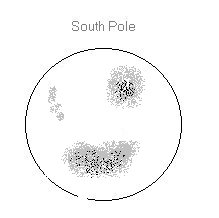
Mars was growing in the sky when this sketch was made. Mars reached opposition approx 24 April, and actually largest size of disk on 1 May. The drawing was made approx. 4:00 a.m. Magnification was 160X using a 12.4 mm eyepiece.
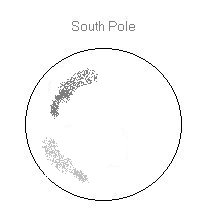
For several weeks we were very disappointed with the quality of seeing. The sky was hazy or cloudy or the moon was very bright. The moonlight can interfere with clarity of seeing. However, on May 8 we had a very clear night and again saw surface features on Mars. My son Kevin (age 17) made sketches independent of mine, and they matched when compared the next morning. I have tried to convert pencil sketches to JPEG drawings using MS Paint. They are pretty close, but not "exact."
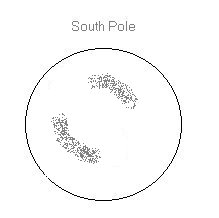
Ironically, with almost six weeks before the first good night and the second, we had a second good night in a row. The sketch was done independently by me and by my son Kevin. The next morning, they matched, so I was pretty sure we were really seeing true surface markings on Mars. The picture blurs and then from time to time gets slightly sharper. It's in those moments of sharpness that we can discern surface markings. At this point we had the Lanthanum eyepiece described above, and were at about 250X.
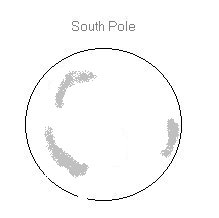
These sketches were made from about 10:15 to 11:15 p.m. Besides myself, my sons Chris and Kevin observed Mars, as well as my niece Claudia. Again we sketched what we saw and compared later. Chris -- with young eyes -- noticed the faint marking to the right, and we started to look for it. It was there all right, but sometimes to pick up these markings you have to look a bit away from the disk, and also wait for those occasional short instants of clarity. I spent by far the most time at the telescope, and kept being "teased" by a sense of a shape at the lower left in this sketch. It took a number of viewings over half an hour to figure out that it was really there-- these faint "shadows" come in moments of clear seeing, and then seem to vanish as the air gets a bit more blurry. At this point, Mars was growing smaller. Maximum disk size was 1 May, and with each day that passed Mars was receding. Hence following 18 May I have no more Mars sketches.
. . . to help understand these drawings. The South Pole is up because the telescope reverses images. This can be tricky reading star maps, because the scope reverses top and bottom of the images.
Also bear in mind that Mars rotates. A Martian day is approximately the same length as ours-- about 24 hours. However it is a little off. So over a period of days different sides of Mars face the telescope. Imagine a Martian astronomer looking at Earth. One night he sees North and South America, another night he sees Europe and Africa. Still another night he sees the eastern edge of Eurasia and the Pacific. We are observing a spinning world, and during no two nights are the images the same.
What are we really seeing? Well, there are good maps of Mars available today. We may be seeing great areas swept clean of dust by Martian winds, which thus look darker. These features change over the years as the dust disappears and reappears. Several of the sketches have a distinctive dark area at or near the South Pole. This could be the ice cap. However, Mars also has seasons, and Mars at the time of these observations was moving from late Spring toward Summer. Hence the ice cap would have become much smaller and fainter.
Mars is much closer than a planet like Jupiter. However, Jupiter is so much larger than Mars, it offers a considerably greater disk than Mars. One reason a person needs a pretty good-sized telescope to pick up surface features on Mars is the very small disk size. Also, Mars was fairly low in the southern sky during these observations, so the telescope is looking through a lot more air than if the object appeared to be overhead. Looking through a lot of air blurs clarity.
All observations that showed any surface detail made use of a red filter. This is a red disk of glass that screws onto the bottom of the eyepiece. Colored glass filters are very important to amateur astronomy. A person, also, uses a neutral density filter for the moon, a blue filter for Jupiter, and the there are a number of others.