main
contents


A Glance at Life in Kosovo
By Stefie Kan.


Teenager n. 1. A person between the ages of thirteen to nineteen.

    You’re walking in a high school; you see the cliques, the problems, the hazing, everything you can possible thing of. You can hear the girls complaining about how they broke a nail, and the guys talking about their cars. This is what typically happens in a typical, American high school; but are international high schools any different?

    Zana Zeqiri, a Kosovar-Albanian teenager currently living in Pristina, Kosova, with her parents and her 19 year old sister a
On  9-11 –

“I felt really bad and I strongly dislike those terrorists. I was just recently at Ground Zero, and I thought of something; how could anyone resort to killing thousands of people to express their anger?” –

Zana Zeqiri, Albanian Muslim
in Kosovo

and 15 year old brother. This is where she currently attends the twelfth grade at Xhevdet Doda High School, telling about her life there, in relation to the wars there in 1999.

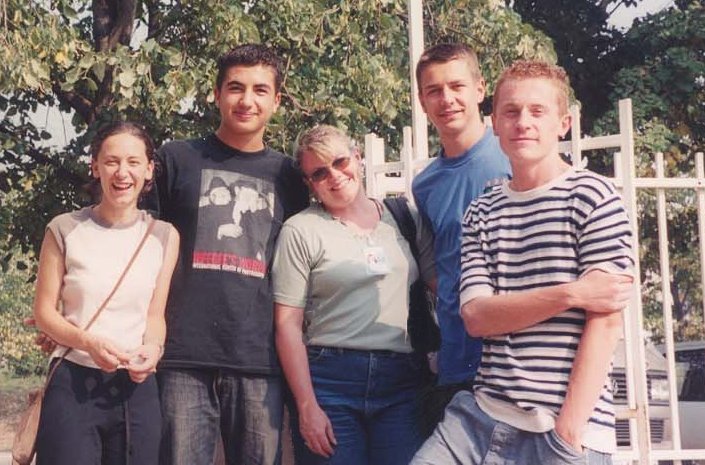
         Just to breeze through some background information, most of it starts back in Balkan history, dating from World War II through the Cold War’s Tito. After Tito’s Zana,Fisnik, Jill Cerqueira, Ali, and Mesut in Pristina death, Yugoslavia would be ruled by a rotation of presidents. This was supposed to insure equality amongst the six republics.   Three years after the 1984 Olympics in Sarajevo, Bosnia, Milosevic was elected president of Serbia.  In 1991, Milosevic refused to give up his Presidency, which caused Croatia and Slovenia, and eventually Bosnia, to declare independence. A war is provoked in which “ethnic-cleansing” is started in the Balkans.  Ethnic-cleansing, concentration camps, refugees and mass graves came to the Balkans.   250,000 Bosnian Muslims lost their lives.  In 1995 after the Dayton Accords ended hostilities, the United States send U.S. peacekeepers to Bosnia, which was divided  into 2 neutral parts of Serbs and Bosnians. Further peace tal ks
failed in 1998, and NATO started bombing Serbia.
A cease-fire was negotiated and American troops arrived       Jill Cerqueira and Albanian students in Pristina in
                                                                                              Kosovo in June 2000.


         The conflicts with Serbians and Albanians continue to thrive, along with the debates over what should be called what and so forth. For Albanians, they refer to the  region of which they live as “Kosova”; as for Serbians, they refer to is as “Kosovo”. “Although Americans refer Kosova as
  ‘Kosovo’, most Albanians, in Macedonia and Albania, as well as Romanians, refer to it as  ‘Kosova’,” says Zeqiri. “I feel that the correct name is ‘Kosova’ because it is the way I learned it.”

          Many of these little disagreements are dealt with every day by the average Serbian and Albanian teenager. For example, when maps were going to be published, they could not say whether it was Kosovo or Kosova because of the continuity of their disputes. Also, religion is another aspect; most Serbians are Eastern Orthodox Christians, while most Albanians, like Zeqiri, are Muslim. “I am a Muslim,” Zeqiri says, “but I celebrate both Christmas and Bajram. Bajram is the feast that is held after Muslims fast for a month from sunrise to sunset. Although I don’t fast myself, I support the other fasters.”

            Although the problems in Kosova differ completely from those of the United States, the average Albanian teenager’s life is similar to that of an American one. She speaks fluent English, as well as watches the same movies and listens to the same music. Since she has lived through a war movement, she enjoys watching war films, as well as the classic comedy and action ones. She also enjoys the show, “Who’s Line Is It Anyway?” which she saw only when she was in New York City; her music interests consists that of Kenny Rogers, Dr. Dre, Mariah Carey, Red Hot Chili Peppers, and The Doors. Like any other typical American teenager, she hangs out with her friends at café bars, similar to Starbuck’s, because unlike the US, they do not have parks or other alternative gathering places. They serve both coffee and alcoholic drinks there; in Kosova, there is no legal age for drinking. “I feel that it’s good but bad sometimes, even though most of the youth that are at the café bars aren’t really drunk; it would be worse if they forbade it because all the youth would want to break rules and drink to be ‘cool’. So, I’m sort of glad they didn’t forbid it yet.” When she is alone, she likes to travel, read lots of books, watch MTV and movies; but as of right now, she is preparing for the SAT I and TOEFL [Test of English as a Foreign Language], in order to go to college.


        Unlike the US custom of having a cafeteria in school, there is no meal served in an average school day. But the classes run typically like an average school in the US would. All Albanian students must take twelve classes, with 5-7 subjects per school day. These are typical subjects taken at school: Albanian [the mother tongue in Kosova], English, Geometry, Physics, Computer Science, Social Defense, Constitution and Human Rights, Astronomy, Philosophy, and Chemistry.

        What differs from schools in Kosova and U.S. are that Albanians do not receive credits; instead they get a grade and next year, they start all over again, learning the same things. “I think it should be changed mainly because it has been the same for the last thirty years,” she says.

        As Holmdel High School is trying to understand the situations/customs of Kosova, Zeqiri’s high school is doing the same. They held an “Americanized” party, celebrating the New Year 2001. “People here in Kosova are almost like Americans. Living in Kosova, or wherever in Europe, you have a clear view of what America’s culture is because we watch the same movies and listen to the same music,” she comments, “but we have different customs. For example, if you’re a guest in an Albanian family, you are someone really important to them and also, the whole neighborhood; you cannot leave the house until you have eaten or had tea you’re your guest.  The custom nowadays seems to be losing its significance, but it still exists. I’ve always tried to imagine how great it would be to live in a place like the US, where you feel free around a mixture of different people from all over the world, and being able to work together.”Living under what is similar to a war-like situation, Zeqiri speaks out: “I felt really bad; felt like a ‘nobody’, because anyone who lives in these situations was unable to do anything. Everything was out of control; as in every war nothing was fair, mostly towards us Albanians and in some cases, the Serbians (this was after the NATO bombings). I sometimes was against the US for recognizing only one solution to solve our conflict: NATO bombing. But I was the happiest person when they bombed Yugoslavia’s military bases because I thought it would be the end of suffering, a chance to start a new life; but I never imagined that we would also suffer. So, I thank God it’s all over.”

        Since then, an organization was formed called “Seeds of Peace” in 1993, that brings the youth of conflicting regions together, for the Middle Eastern conflict, and in 2000 (in Greece) for the Balkans. “My first time to participate in the Seeds of Peace was in the summer of 2000 in Greece (Olympia),” says Zeqiri.

        The Seeds of Peace continuously works and organized camps, conferences for the youth from regions like Balkans, India, Pakistan, Israel, and Egypt. Here, they are trying to co-exist in Kosova and struggle for a better future, by starting to talk to enemies.

        As for the tragedy on September 11th, she says, “I felt really bad and I strongly dislike those terrorists. I was just recently at Ground Zero, and I thought of something; how could anyone result to killing thousands of people to express their anger?”

         Although someone may live under a different environment, that doesn’t mean that they don’t go through the everyday problems of a typical teenager.  All teenagers are the same, regardless of their color, their religion, the place and conditions they live under, their norms and values; they are all the same, experiencing the triumphs, tragedies, and struggles of life.


Hosted by www.Geocities.ws

1