ATHENS
Introduction
What to see
Beaches
Food
Beaches
Getting Around
History
Nightlife
Shopping
Getting there
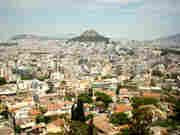
Introduction
Most people have a love hate relanshionships to Greece's capital. On one hand it is a city with a wide variety of things to see and do. From here you can also
get to most places in Greece: by air, train, boat or bus.On the other hand it is a huge, busy place with about half of Greece's population living there close to 5 million. There are places you do not want to be alone at night, and Athens has a big problem with traffic jams and pollution, especially the smog.It is a fascinating place, though. It is one of the oldest cities in the world, and walking through its ancient Agora or on the Acropolis, it does make you feel you are walking on, if not sacred, very important ground.The Athenians are now preparing eagerly for the Olympic games that will be held in 2004. This means that a lot of buildings are being renovated, and big projects are being carried out.
History
Athens is often mentioned in Greek mythology. The ancient Athenians believed that they originally came from Attica and were not an immigrated people. To support this, they would refer to their first king, Cecrops, who was a man snake born out of the earth. He had been the ultimate judge, when the goddess Athena and the sea god Poseidon competed in becoming the patron of the city, a competition Athena was to win, naming the city.The greatest hero of Athens was Theseus, whose wicked stepmother was the infamous Medea, hated by the Athenians and forced to flee. The hero had managed to stop the yearly tribute of youngsters to king Minos of Crete by killing the Minotaur, and his bones were kept in a special monument here. Oedipus died in Athens, and Orestes was brought before the Aeropagus here after revenging his murdered father Agamemnon. Many historical personalities were also born here, and even more lived and worked here. Socrates wandered the streets, discussing philosophical questions with those he met. Demosthenes preached against the Macedon-ians, and Plato and Aristotle taught here. Pericles made his time a golden one, and Alcibiades was admired and hated. Later on, St. Paul was to preach a new religion called Christianity. The list could go on forever.There are evidence of ancient settlements in Athens from the 7th millennia BC. Athens was not always the most important city of Greece, and its greatest rival in antiquity was Sparta and the Persians.The great orator Demosthenes warned the people of Athens about the Macedonians, and he was right: in 322BC Athens was conquered by them. The Turks invaded Athens in 1456, and the city stayed under Turkish rule for about 350 years. In 1834 Athens was declared capital of Greece - then, only about 6000 people lived there.In 1941 the Germans occupied Athens and during the two months the Greeks resisted and over 300 000 people died of starvation. The old film footage of Hitler walking on the Acropolis is a bitter memory of this time. Athens was also a battlefield during the civil war 1946-1949. The junta took over in 1967 and Greece was a dictatorship until 1974. In 1981 Greece joined the EU.
What to See
The first place you should visit when in Athens is of course the Acropolis. Standing up there, on the sacred rock as the Greeks call it, you can practically feel the magnificence of ancient Greece. Don't think you'll be alone there though.Other archeological sites are the agora, the market, with the temple to Hephaistos still in quite good shape, as well as the temple to Zeus and the arch of Hadrian.Museums of interest are, amongst others, the Acropolis museum, the National Archeological museumosed until April 2004, the Folklore museum, the Ceramics museum Keramaikos, the Byzantine museum, the Music museum, the War museum, the Benaki museum etc. All in all, there are about 50 museums in Athens.A popular place for shopping or food and drink is Plaka, just below the Acropolis. It is considered quite a touristy area, but the fact is that you here can get an idea of old Athens, with low buildings and little streets.In Monastiraki there is a bazaar which is quite incredible.At the Syntagma Square you can visit the Tomb of the Unknown soldier. Here you can see the guards in their impressing uniforms, the Evzones, and if you are lucky you will see the slow and complicated change of guards. You can also feed pigeons here. Interestingly, there used to be a tomb to the unknown hero in ancient AthensThe opera, Megaron Mousikis, holds many wonderful performances, but even lovelier is the Herodes Atticus theater just below the Acropolis.
What to do
Athens has such a wide variety of things to do that it almost is no idea to write it all down. For example, you have all the sights and the museums, concerthalls and theatres. Then, there are many cinemas, a great nightlife, bazaars and shops. Go up to the Lycavitos hill and get a wonderful view. You can go to Athens riviera for some sun and sea.
Beaches
There are several beaches at Athens Riviera The most popular ones are in Glyfada, Vouliagmeni, Nea Makri, Crysi Akti Golden Coast and Faliron. You often have to pay a small entrance fee to these beaches - this is to keep them clean since it has millions of visitors every summer.
Nightlife
Jazz bars, discos, bouzoukia clubs, heavy metal bars - it's all here. There are places all over Athens, but the most frequented areas are Syntagma, Kolonaki and Glyfada.
Food
Just like the bars, the restaurants and taverns are everywhere in Athens. The Plaka area is probably the most picturesque, but also the most visited by tourists. Keep a lookout for the places with lots of Greeks in them - that applies all over Greece. In Syntagma and Kolonaki there are also many places, and in Glyfada and Vouliagmeni you are close to the sea, and the atmosphere is usually a little bit more sophisticated. The area Psiri not far from Acropolis is very expensive with lots of lovely places with live music day and night. But as I said, there is a place in every corner and you can get absolutely anything you want.
Shopping
Being Greece's capital you can find everything in Athens. The big shopping street is Ermou, just off Syntagma square, Glyfada and Kolonaki are the exclusive quarters with many boutiques and shops. In Plaka you'll find lots of souvenirs from all over Greece, and the biggest department store is Vassilopoulos. In Monastiraki there is a great Bazaar every Sunday, and many antiquity shops. These are just a few example though, there are shops just about everywhere.
Getting Around
While the overcrowded buses usually just pass the bus stops, leaving you there with a long face, the new Metro is an excellent way to get around (it is also very beautiful, worth a visit just to see it). There are also electric trams that are quite efficient.You can rent cars and bikes but it is not recommended -the people in Athens drive like absolute madmen. Taking a taxi can also be quite a horrific experience and there has also been reports of taxi drivers trying to overcharge foreigners. Make sure the taximeter is on and running properly and you won't have a problem.In general, be careful when crossing the streets - green lights does NOT mean that you can cross the road without looking.
Getting There
In March 2001 the new airport Eleftherios Venizelos at Spata was opened. It is hypermodern, but a little bit difficult to reach. Without traffic jams it takes about 45 minutes to get there from the center of Athens, but unfortunately, traffic jams are more rules than exceptions. There is no train. Since the the airport opened there has been a lot of problems with flights getting canceled or leaving before the time stated on the monitors, bags being sent in every direction but the right and a general chaos. This is slowly getting better, but it will take time until it works perfectly if ever.If you are coming from the islands the boats will stop at Pireus, Port Rafina or Agios Konstantinos. A train runs through the whole of Greece - starting in Thrace, through Thessaloniki, Larisa to Athens, and is also connected with the Peloponnese. There are also many buses that go to just about every place in Greece, even to many of the Ionian islands (you buy an "all-included" ticket.If you would like to visit some of the ancient sites or monasteries on the mainland like Delphi, Mycenae and the Kesarian monastery, you can either get an ordinary bus, or go on one of the many excursion buses that the travel agencies sell tickets for.
CLICK HERE TO RETURN TO THE TOP
NEXT
PREVIEW
Back to the index page