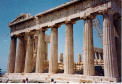
The Erechtheum, with its caryatids--or marble female figures--supporting the roof, and the Temple of Athena Nike were also built on the Acropolis during the same period. This collection of temples was approached through the Propylaea, a large entrance building. The Theater of Dionysus, built in the 5th century BC at the southern base of the Acropolis, was the city's drama center. The city was connected with the port of Piraeus by the parallel Long Walls, which formed a corridor 550 feet (170 meters) wide.
 After Athens lost the Peloponnesian War in 404 BC its place as the premier city-state in Greece was also lost, and the city went into a decline that lasted until the period of Roman control three centuries later. Although the Romans sacked Athens and pulled down the Long Walls in 88 BC, they later built many magnificent buildings. The emperor Hadrian, in particular, completed a huge Temple of Olympian Zeus, built a library and a gymnasium, erected a large arch, and constructed an aqueduct that still serves the city.