The greece people
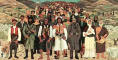
The boys of Ancient Greece were different from the girls because they had different priorities.
In Athens wealthy boys at the age of 7 would attend school and when they did math problems, they would use an abacuses, and wrote with a wax pad and stick. Poor boys would become shepherds and work with their dads or granddads. Also, in Sparta, boys would begin military training at the age of 7, and at the military training the boys would learn about hardship, hunger, and pain. Both boy and girl babies had a bottle that looked like a genie lamp and written on the bottles were these words: "Drink, Don't Drop." Also both boy and girl babies weren't named until the age of ten days. Usually they were named after their parents or grandparents.Girls were not very similar to us. They stayed at home with their mother.
They did not go to school because they had other priorities at home like learning how to spin and weave wool to make clothes, wall hangings, and bed covers.Some girls were lucky and some were not, because the men chose if the families kept the babies or not. Some healthy girls were abandoned at birth.
Most girls did not go to school, but some rich girls could. Girls played many games but during most of the day they had to work.Rich boys would get their own slaves. Each slave would look after their boy master, take him to school, and help him with homework. Poor boys would be taught like their fathers and have the same jobs. In both Athens and Sparta, at the age of 14, boys would go to wrestling school. Boys would use a wax pad and stick to write. So that will conclude the information on boys of Ancient Greece.Probably girls from rich families got married younger, and girls from poor families got married a little older.The Greeks had a general tendency to divide the world into pairs of things, one opposed to the other. They saw everything as divided into two parts, which fought with each other all the time. So they tended to divide people into two groups too.There are a lot of different ways to divide people. One important way is to divide people from animals: the Greeks said that people were different from animals because animals ate their food raw, and people ate theirs cooked (that is, people know how to use fire). And people have rational thought, but animals do not.People are also divided from gods. People eat food, and gods do not. People die, but gods do not. Another way of looking at these divisions is to divide Greek people from barbarians, people who are not Greek. The Greeks called all foreigners barbarians, even if they were very civilized like the Egyptians or the Persians. Or you can divide men from women. The Greeks did feel that men and women were very different, and naturally opposed to each other. Men, in the Greek view, were rational, thinking, stable, normal creatures, while women were irrational, hysterical, and dangerous. If you had to take sides (and the Greeks always took sides), men were more like gods, while women were more like animals.The Greeks also divided people into different age groups. The two most important age groups were, again, often talked about as if they were in opposition to each other. These were teenaged boys and young men. Teenaged boys were those who had passed puberty but had not yet grown beards (say about 15-20 years old), while young men had grown beards but were not yet married (say about 20-30 years old). Of course all the teenaged boys soon became young men, so this is not a permanent distinction. Finally, you can divide slave and free people. The Greeks made this distinction less than the others, because a slave can become free, and a free person can become a slave. So it is not as basic a difference as the difference between a man and a woman, or a Greek and a foreigner. But certainly there were slaves and free people in all the Greek city-states, and the Greeks felt that the difference was an important one.
preveus page
home page
next page